
The term Navagraha combines nava ('nine') and graha (a term used for planets and literally glossed as 'seizer' or 'one who lays hold of'). Its conceptual formation draws on Vedic recognition of Sun and Moon and on later incorporation of planetary concepts; historical syntheses with Hellenistic, Babylonian and Indo‑Iranian astral ideas contributed to the full ninefold set. Rahu and Ketu, the two lunar nodes (chaya‑grahas or 'shadow' grahas associated with eclipses), were integrated into the canonical nine over a long process of cosmological development that reached medieval stabilization by around the early medieval period.
In ritual and temple art each graha is anthropomorphized with distinguishing attributes, colours, mounts (vahanas), arms and weapons; iconographic programmes developed from roughly the 5th–12th centuries CE. Typical motifs cited in textual and temple sources include Surya shown standing or seated in a chariot drawn by seven horses and holding lotuses (often wearing northern‑style boots and armour in classical depictions); Chandra riding a chariot sometimes pulled by an antelope or shown with a hare and carrying a lotus; Mangala (Mars) with a red complexion riding a ram and bearing a trident and mace; Shani (Saturn) depicted in dark blue or black; Rahu and Ketu depicted as the chaya‑grahas conventionally rendered in serpentine or partially dismembered forms (Rahu as a severed head and Ketu as a headless torso with a serpent tail). Regional variation exists (for example, South Indian Shaiva temple arrangements differ from North Indian lintel guardians) and full iconographic detail varies by period and locality.
Within Jyotisha the Navagraha are treated as causal agents in astrological theory: they 'rule' particular rasis (zodiac signs), govern domains of life, and preside over temporal regimes such as dashas (planetary periods). Traditional classification distinguishes natural benefics (for example Jupiter, Venus, Mercury and the waxing Moon in many schemata) and natural malefics (for example Mars, Saturn and the shadow planets, with variations including the Sun); adverse configurations are termed dosha. Beyond technical computation the grahas function as objects of worship and ritual propitiation—texts, stotras and homams address them to gain favor or mitigate harm—and they are embedded in temple practice, pilgrimage circuits and devotional music.
Weaknesses
- ritualGraha śānti practices (propitiatory rites to mitigate adverse influence)
- mantraNavagraha mantras and stotras (textual recitation used as remedial measures)
- ritualNavagraha Homam (fire ritual performed by a priest as a corrective rite)
- otherPilgrimage to Navagraha shrines / installation and worship in Navagraha mandapa (temple-based remedy)
Wards
- mantraNavagraha mantras and stotras (prescribed recitations listed in manuscript catalogues)
- ritualNavagraha Homam Puja (scheduled homam with priest and offerings shown in contemporary temple/priestly practice)
- ritualRegular temple worship and installation in Navagraha mandapa; visiting Navagraha temple circuits
- otherDevotional musical performance (Dikshitar's Navagraha kritis) used in propitiatory contexts
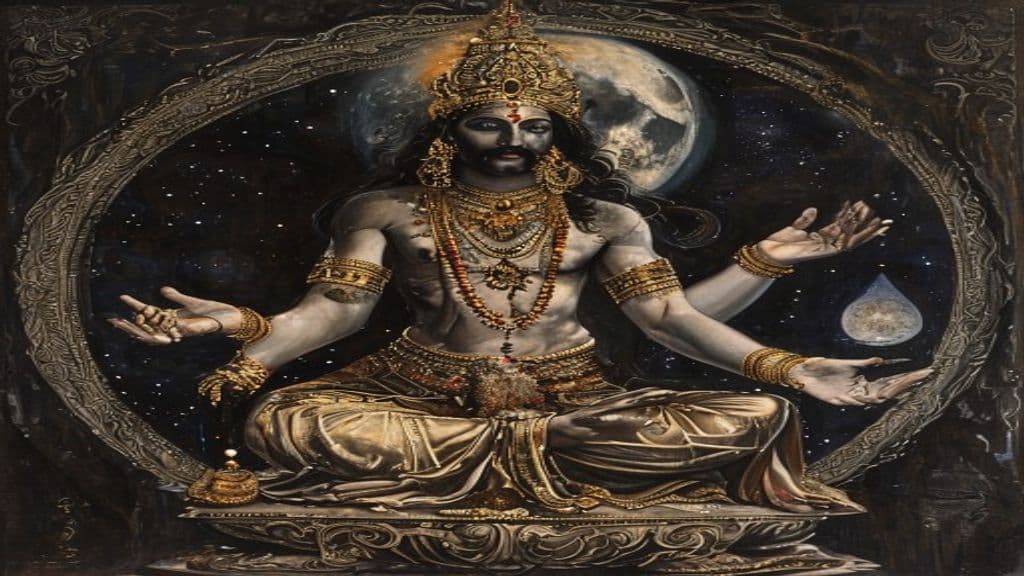
*Péh₂usōn (reconstructed)
Péh₂usōn is a hypothetical Proto‑Indo‑European pastoral guardian reconstructed by comparative scholars from parallels in Greek and Vedic traditions. Proposed as a Graeco‑Aryan ancestor‑figure, the reconstruction describes a protector of flocks, roads, and travellers rather than an attested historical cultic personality.
Abhimanyu
Abhimanyu is a youthful Kuru/Pandava warrior-hero in the Sanskrit epic Mahābhārata. Son of Arjuna and Subhadra, he is famed for entering the Chakravyuha battle formation on the thirteenth day of the Kurukshetra War and dying at age sixteen; his posthumous son Parikshit continues the Kuru line.
Achyuta
Achyuta (Sanskrit: अच्युत, acyuta) is primarily an epithet/theonym in Vaishnava Hindu tradition applied to Vishnu and Krishna, signifying the divine quality of being 'not fallen' — immutable, infallible, and imperishable. It functions as a devotional name in scripture, liturgy, and Pancharatra lists of divine emanations rather than as an autonomous folkloric spirit.
Acintya
Acintya is an Indonesian Hindu theological-symbolic representation of the ineffable supreme divine principle. In Balinese and Javanese practice it functions as a way to make ultimate reality present in ritual and art—often aniconically as an empty throne (padmasana) or anthropomorphically as a naked, flame-surrounded figure—rather than as a narrative, intervening deity.
Adi (asura)
Adi is attested in modern reference works as the name of an Asura who 'appears in the Matsya Purāṇa.' Beyond this single-line citation in secondary sources, no descriptive material about the figure is provided in the supplied research notes.
Adi Shakti
Adi Shakti (also Adi Parashakti, Mahadevi, Adya Shakti) is the primordial feminine power in Hindu/Shakta theology, regarded as the ultimate reality (Para Brahman) and the source from which all goddesses and gods manifest. She is both an impersonal cosmic principle (Mulaprakriti) and a focus of devotional invocation in temples, mantras, and pilgrimage sites such as Shakti Peethas.
Adi Vinayaka
Adi Vinayaka (Ādi Vināyaka; also called Nara Mukha Vinayaka) is a named iconographic and devotional form of the Hindu god Ganesha portraying the deity with a human head, described in sources as the form before the episode of decapitation by Shiva. It is rarely worshipped and appears in a small number of South Indian shrines and in devotional/musical repertoires.
Aditi
Aditi is a major Vedic goddess in Hindu tradition who personifies the boundless, infinite cosmic principle and functions as the maternal matrix from which many celestial deities (the Ādityas and other groups) are born. In the Vedic hymns she is invoked as a protective liberator who guards petitioners, provides wealth and safety, and frees devotees from hindrances such as sin and sickness.
Agastya
Agastya (also Agathiyar/Agasti) is a revered Vedic and later-period Indian rishi (sage) figure credited in textual traditions as an inspired seer, ascetic, teacher, culture-founder, and attributed author of Vedic, Puranic and Tamil works; in South Indian tradition he is associated with origins of Tamil grammar and Siddha medicine and is identified astronomically with the star Canopus.
Aghasura
Aghasura is an asura from the Vaishnava/Hindu narrative tradition (notably the Srimad‑Bhāgavatam) who, at the command of Kamsa, assumed the form of a vast serpent to ambush Kṛṣṇa and the cowherd boys in Vṛndāvana. The episode demonstrates Kṛṣṇa’s protective, divine power as he enters and destroys the demon from within.
Agiya Baital
The fire-form of the Vetala — a cremation ground spirit of UP and Bihar that manifests as a wandering flame rather than a corpse-inhabitor, leading night travellers off roads and into marshland or flames with a dancing fire that seems always just ahead.
Agneya / Āgneyī
Āgneyī (feminine) or Āgneya (masculine adjective) is a Vedic–Puranic divine figure and ritual principle tied to the fire-god Agni and the southeastern direction. In textual traditions she appears both as a personified daughter/shakti of Agni and as an adjectival/technical term applied to fire-consecrated things (direction, astra, etc.). She also occurs as the name Agneya (or Anala) among items revealed in a Shaiva-Agamic list associated with the Aghora face of Sadashiva.
Community Record
- [1]Navagraha. Wikipedia entry 'Navagraha'wiki
- [2]Navagraha Mantra Navagraha Stotra (M‑1384) — Sarasvati Mahal catalogue / Ramtek collection. Catalogued manuscript listing: 'Navagraha Mantra Navagraha Stotra' (Kavikulguru collection)other
- [3]An Alphabetical Catalogue of the Sanskrit Manuscripts in the Sarasvati Mahal Library, Thanjavur — vol. 24. Sarasvati Mahal manuscript catalogue (Thanjavur)other
- [4]Navagraha temples. Wikipedia entry on Navagraha temple circuitswiki
- [5]The Navagraha Shrines of Tamilnadu (templenet). Templenet: description of the Tamil Nadu Navagraha circuit and temple arrangementsother
- [6]Navagraha Homam Puja (HTCC of KC). Contemporary temple/service page describing Navagraha Homam scheduling and item listsother
- [7]Navagraha (Dikshitar's Navagraha kritis). Collection and commentary on Dikshitar's Navagraha kritis (musical/devotional compositions)other
- [8]Hinduism StackExchange thread on graha incense/offering preferences. Contemporary devotional Q&A discussing offering traditions associated with grahasother
- [9]Mantra Jyotish (archival text in Bengali). Archival text relating mantra and astrological practiceother