
In Sumerian mythic tradition the goddess Sud, tutelary deity of Shuruppak, is married to Enlil and, in the narrative preserved in the myth Enlil and Sud (also called Enlil and Ninlil), receives the name Ninlil upon marriage to Enlil. Genealogical attributions vary in the sources: some lists and hymns give Nisaba and Haya as parents in certain traditions, while other god‑list traditions and hymns reflect differing local filiations. Over time the figure known as Ninlil is syncretized with regional goddesses (Sud) and later appears in Akkadian/Assyrian contexts under Mullil/Mullissu and related forms.
The cited sources do not preserve a consistent iconographic portrait. Literary hymns and adabs emphasize majestic epithets rather than bodily detail — e.g., “comprehensively replete with numerous divine powers,” “Equal to the Great Mountain,” and “pre‑eminent over heaven and earth.” Thus surviving descriptions foreground rank, power, and metaphoric imagery instead of fixed visual attributes or costume.
Texts and hymns attribute to Ninlil a role sharing with Enlil in the assignment of destinies and the appointment of other deities to offices; she is a mother figure to important gods in several traditions (commonly cited children include Nergal, Nanna, and Ninurta though genealogical details vary). In temple hymns she appears as a source of divine authority invoked in royal ideology, and in some compositions she is explicitly called a healing goddess through syncretism with Sud or other maternal/healing figures. In intercultural contexts she can be equated with or serve as the consort analogue to foreign high gods and in some Hurrian texts functions as a divine witness in treaties.

Enlil
Enlil is a principal deity of ancient Mesopotamia, originally preeminent in the Sumerian pantheon as a supreme lord who orders the world by separating heaven (An) from earth (Ki). His principal cult center was the E-kur temple at Nippur, and his cult practices focused on daily offerings and priestly care of his cult statue; mythic traditions portray him as both benefactor and punisher in the administration of cosmic and social order.

Mullissu
Assyrian goddess and consort of Asshur, associated with fertility, marriage, and family. (Note: 1. Power tier: Based on her association with a major deity (Asshur) and potential identity with Ninlil, a goddess on par with Enlil, Mullissu's power tier should be Primordial or Ancient, not Greater.)
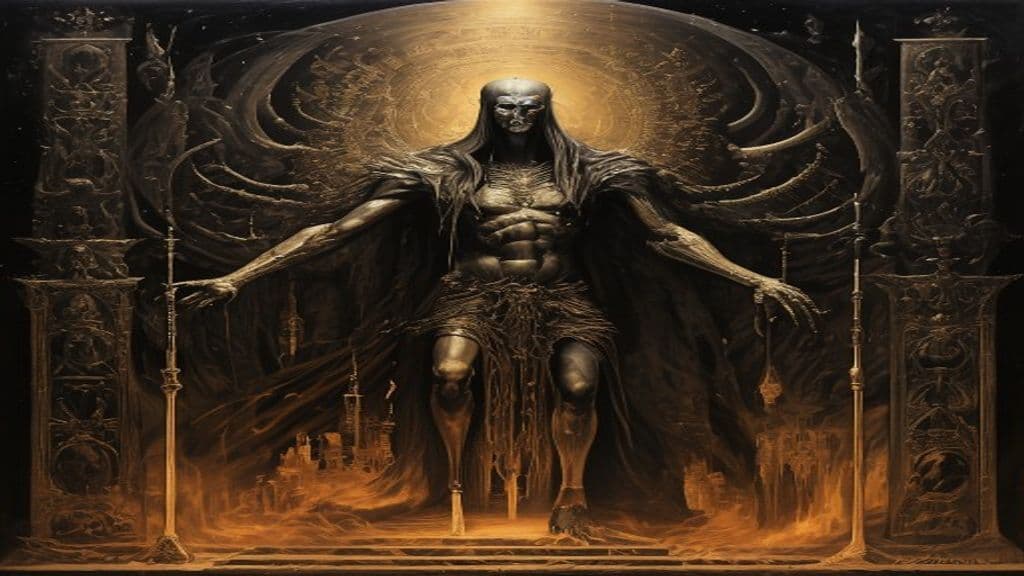
Nergal
Nergal is a major Mesopotamian deity associated with war, disease, inflicted death, and rulership of the underworld. Principal cult center at Kutha (temple E‑Meslam), he appears in hymns and myths (e.g., the Epic of Erra, "Nergal and Ereshkigal") and is sometimes equated with or called Erra or Meslamtaea.
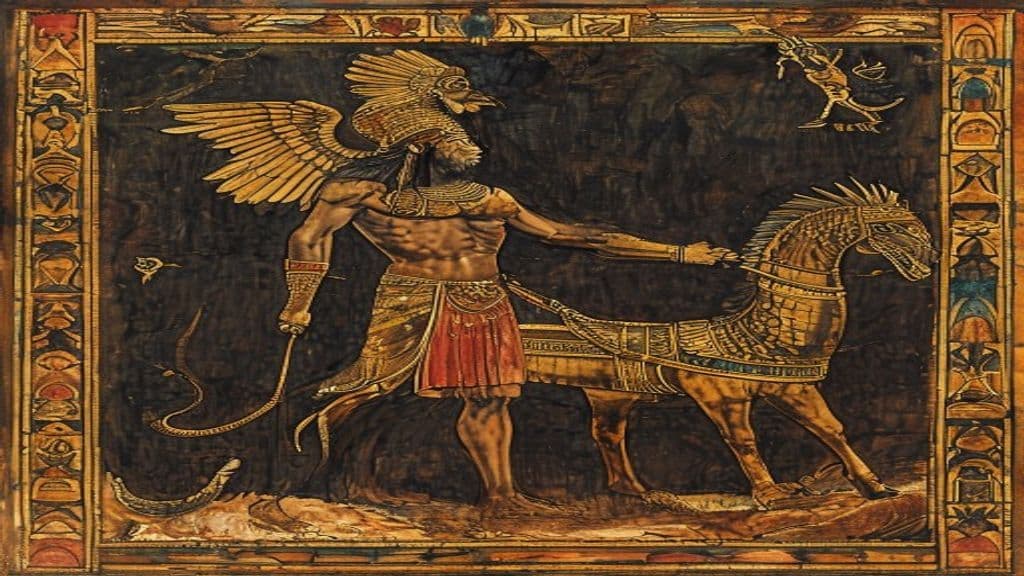
Ninurta
Ninurta is a major deity of ancient Mesopotamia (Sumerian–Akkadian–Assyrian–Babylonian) whose roles include agriculture, healing/exorcism, law and scribal authority, and martial champion of the gods. He is attested from the mid-third millennium BC onward and was venerated at city cult-centers such as Nippur (Eshumesha), Girsu/Lagash (as Ninĝirsu), and later in Assyrian Kalhu.
'Ain Samiya Goblet
Silver cup from the Middle Bronze Age I, discovered in a tomb at Ain Samiya. (Note: 1. Power tier should be "None", but add a note explaining that historical artifacts don't fit into the typical power tier classification. 2. Add a description of its appearance based on it being a sil)
*Perkʷūnos
*Perkʷūnos is the reconstructed Proto-Indo-European thunder‑god hypothesized by comparative linguistics and mythology. Scholarly reconstructions portray him as a storm or thunder figure associated with fructifying rain and as the combatant who fights a multi‑headed water‑serpent to release life‑giving waters; no direct attestations from the Proto‑Indo‑European period survive and the figure is inferred from later Indo‑European traditions.
*Péh₂usōn (reconstructed)
Péh₂usōn is a hypothetical Proto‑Indo‑European pastoral guardian reconstructed by comparative scholars from parallels in Greek and Vedic traditions. Proposed as a Graeco‑Aryan ancestor‑figure, the reconstruction describes a protector of flocks, roads, and travellers rather than an attested historical cultic personality.
57 Mnemosyne
57 Mnemosyne is a large main-belt asteroid (S-type) discovered in 1859 and named after the Greek Titaness Mnemosyne. It is a non-sentient astronomical body studied for its orbital and rotational properties and has been used in dynamical measurements related to Jupiter.
A'annepada
A'annepada (Sumerian cuneiform 𒀀𒀭𒉌𒅆𒊒𒁕; also romanized Aanépàdda) is attested as a historical ruler of the First Dynasty of Ur, flourishing c. 2350 BC. He is recorded in dedicatory and foundation inscriptions as king of Ur and as son of Mesannepada, credited with temple-building and dedication to deities such as Ninhursag and Inanna.
A'ra
No reliable sources in the supplied material establish A'ra as a distinct supernatural entity. The token "A'ra" appears in the dataset as (a) part of general references to pre-Islamic Arabian deities, (b) a modern Korean female given name (A-ra/아라), and (c) an Arabic toponym (A'ra, one village merged into Ar'ara).
Abaddon
In Hebrew scripture Abaddon is primarily a noun meaning 'destruction' or a section/condition of the underworld paired with Sheol; in the New Testament Book of Revelation Abaddon is personified as an angelic figure (Greek Apollyon) described as the king of an army of locusts released from the abyss during the apocalypse.
Aban Yasht
The Aban Yasht is a hymn from the Persian tradition that praises Anahita, a goddess associated with water, fertility, and wisdom. It consists of 132 stanzas and is part of the 21 Yashts collection. (Note: - Power tier should be "Primordial" or possibly "Cosmic", given that it's a hymn of great spiritual significance and associated with a goddess. - The article incorrectly states that Anahita is associa)
Abath
No corroborated folkloric entity named "Abath" is documented in the provided sources. The string appears in the supplied material only as a surname/personal name in Aruban/Dutch-Caribbean archival records and as an unrelated taxonomic or encyclopedic hit; no mythic attributes, origin stories, rituals, or apotropaic practices for an entity called Abath are present in the documents reviewed.
Abatur
Abatur is an uthra (celestial emanation) in Mandaeism described as the 'father of the Uthras' and called the Ancient (ʿattīqā). He resides on the boundary between the World of Light and lower regions, functions as a judge who weighs souls (Abatur Muzania), and supplies instructions and materials to the demiurgic uthra Ptahil in accounts from the Diwan (Scroll) of Abatur.
Abatwa (Twa / Batwa)
Abatwa (also recorded as Twa, Batwa, Mutwa; singular forms Barhwa or Murhwa in some transcriptions) are indigenous hunter‑gatherer peoples of the Great Lakes region of Central Africa, historically identified as some of the earliest inhabitants of the area. The available sources treat them as human ethnic groups whose livelihoods, lands, and populations have been severely affected by conservation policies and modern violence.
Abellio
Abellio is a theonym attested in Roman‑period inscriptions from the Comminges area of the Pyrenees and reported as worshipped in the Garonne Valley of ancient Gallia Aquitania. Surviving evidence is limited to a small number of inscriptions; scholars have variously hypothesized solar or arboreal associations and compared the name to forms of Apollo or to Celtic Belenus, but the deity's precise role in local cosmology remains uncertain.
Community Record
- [1]Ninlil. Wikipedia article 'Ninlil'wiki
- [2]An adab to Ninlil (Ninlil A): translation. ETCSL translation 'An adab to Ninlil (Ninlil A)'academic
- [3]Enlil and Ninlil. Wikipedia article 'Enlil and Ninlil' (myth summary)wiki
- [4]Electronic Text Corpus of Sumerian Literature (Enlil and Ninlil text). ETCSL: 'Enlil and Ninlil' (Sumerian text)academic
- [5]Gateways to Babylon: Ninlil - goddess of Nippur. GatewaysToBabylon entry on Ninlilother
- [6]Ninlil's Descent (retelling / mythic material). Site retelling of Ninlil mythic materialother
- [7]Liber Ninlil (archive item — modern esoteric text, not treated as primary ancient evidence). Archive.org item 'Liber Ninlil'other