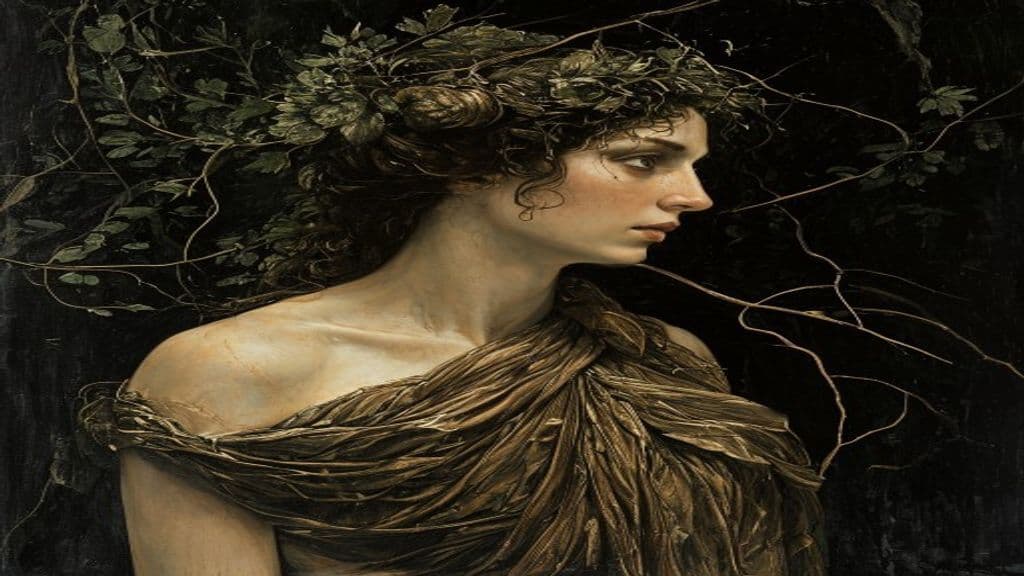
Oenone is presented in the classical tradition as a place-bound mountain nymph (a local nature deity) of Mount Ida in Phrygia. Sources differ on her parentage: she is variously called the daughter of the river-god Cebren or of Oeneus. Her name (Οἰνώνη, 'wine-woman') links her semantically to viticulture and local beneficence. She is integrated into the Trojan narrative as the first wife of Paris; her story unfolds as Paris returns from exile, abandons her for Helen, and later is mortally wounded, producing variant accounts of Oenone's responses and death.
Classical sources do not give a detailed physical description of Oenone; she is identified by role and place— a Mount Ida nymph— rather than distinct visual features. As with many classical nymphs, literary emphasis falls on her functions and actions (prophecy, healing, grieving) and on her setting (Ida, the pastoral slopes where Paris was raised) rather than on specific garments or bodily markers. No consistent iconographic or physical attributes are attested in the cited texts.
Attested capacities include prophetic knowledge—explicitly learned from the mother-goddess Rhea—and practical herbal healing arts. Narratively these abilities appear in key episodes: she foretells Paris's abandonment and the ruin his choices will bring, and Paris later begs her to use her 'herbal arts' to heal a mortal wound. Traditions vary: in Quintus Smyrnaeus (Posthomerica) she refuses to heal and casts Paris out; in other accounts she attempts to save him but arrives too late. Additional behaviors attested in variant sources include killing the messenger who brought news of Paris (Conon) and committing suicide (variants: self-immolation on Paris's funeral pyre in Quintus Smyrnaeus; hanging in Apollodorus; leaping from Troy's walls in Lycophron).
Weaknesses
- conditionEmotional vulnerability (jealousy, remorse, rage)
- otherLimited efficacy against large-scale fate: despite prophetic knowledge and healing arts she does not avert Paris's decisions or the broader doom associated with his actions
Wards
None recorded.

*Péh₂usōn (reconstructed)
Péh₂usōn is a hypothetical Proto‑Indo‑European pastoral guardian reconstructed by comparative scholars from parallels in Greek and Vedic traditions. Proposed as a Graeco‑Aryan ancestor‑figure, the reconstruction describes a protector of flocks, roads, and travellers rather than an attested historical cultic personality.
3-D Man
3-D Man is a Marvel Comics superhero identity associated with a 1950s-era origin in which the body of Chuck Chandler can materialize in three-dimensional existence when activated by his brother Hal via a pair of glasses. The mantle was later assumed by Delroy Garrett (formerly Triathlon) in modern continuity.
5 Ronin
5 Ronin is a 2011 Marvel Comics five-issue limited series that reimagines five Marvel superhero archetypes as rōnin (masterless samurai) in a fictionalized post‑Sekigahara feudal Japan. The work places Wolverine, Hulk, Punisher, Psylocke, and Deadpool analogues into period roles to explore displacement, revenge, and identity in an era of political upheaval.
A Elbereth Gilthoniel
An Elvish hymn in Sindarin addressed to Elbereth (Varda) from J. R. R. Tolkien's legendarium. Presented in The Lord of the Rings and later musical and dramatic adaptations, the hymn functions as devotional poetic language that evokes Elvish reverence for the star-kindler rather than an independent supernatural agent.
A.R.G.U.S.
A.R.G.U.S. is a fictional clandestine United States government agency in the DC Comics universe that investigates, contains, and manages superhuman, meta-human, and supernatural incidents and assets. Introduced in The New 52 continuity, it functions as an institutional actor providing intelligence, logistical support, covert task forces (notably Task Force X / the Suicide Squad), and a dedicated magic division across comics and media adaptations.
Aba (disambiguation / name-form)
Aba is a polyvalent name-form attested across many unrelated contexts (place names, personal names, animal names, and brief mythological listings). The provided sources do not support a single, coherent supernatural entity called "Aba" and offer no descriptive or ritual material for such a being.
Abarbarea
Abarbarea is a name attested in classical Greek and Roman sources for freshwater nymphs (naiads). The name appears for at least two individual mythic figures — a naiad wife of Bucolion and a naiad counted among ancestors of the Tyrians — and Hesychius records plural forms that may indicate the name was also used as a class-name (Abarbareai / Abarbalaiai).
Abas
Abas (Ancient Greek: Ἄβας, gen.: Ἄβαντος) is not a single mythic being but a recurring personal name borne by multiple mortals and minor mythic figures in Greek epic and genealogical traditions — kings, founders, seers, warriors, attendants, a centaur, and a youth transformed by a goddess. The name is glossed in the sources as 'guileless' or 'good-hearted' and appears across Argive, Theban, Trojan, Euboean, and other local cycles.
Abderus
Abderus (Ancient Greek: Ἄβδηρος, romanized Ábdēros) is a mortal heroic figure in Greek myth closely associated with Heracles, remembered as the youth left in charge of the Mares of Diomedes who was killed by them. He functions as an eponymous local/divine-hero ancestor for the city of Abdera and received funerary commemoration and athletic agones at his tomb.
Abin Sur
Abin Sur is a fictional extraterrestrial Green Lantern from the planet Ungara in DC Comics. A former history professor turned Green Lantern of Space Sector 2814, he discovered and investigated a prophecy tied to the "Blackest Night," died wounded on Earth and chose Hal Jordan as his ring-successor, and was later reanimated as a Black Lantern in the Blackest Night storyline.
Abomination of Desolation
An apocalyptic prophetic phrase originating in the Book of Daniel designating a profaning thing or act that renders the Jerusalem Temple cult desolate; later reused in the Synoptic Gospels as an eschatological sign prompting urgent flight. The term denotes ritual/cultic impurity (Hebrew shiqquts) and is variously interpreted as pagan offerings or altar, a foreign cult statue, or (in some New Testament readings) an acting agent.
Absolute Green Lantern (tradition)
A modern comic-book reinterpretation in DC's Absolute Universe in which a giant green lantern-shaped vessel appears above Evergreen, Nevada, generates an impenetrable green dome, judges townspeople and sends the judged into the Lantern to await further adjudication in OA (Omega‑Alpha). The story reframes Green Lantern mythos as cosmic/religious horror with an "Enlightenment Spectrum" of flames (Qard, Rao, Sur, Aur) stewarded by Oans such as Abin Sur.
Community Record
- [1]Oenone — Wikipedia. Wikipedia contributors, 'Oenone,' Wikipedia, The Free Encyclopediawiki
- [2]Oenone — Wikidata. Wikidata entry Q34713158other
- [3]Quintus Smyrnaeus, Posthomerica (Book 10, 259–489). Quintus Smyrnaeus, Posthomerica, Book 10, lines 259–489 (narration of Paris's wounding, request to Oenone, her refusal in that version, and her self-immolation)literary
- [4]Apollodorus, Library (summary references). Apollodorus, Bibliotheca (attested variant that Oenone hanged herself)literary
- [5]Lycophron (variant). Lycophron (attested variant that Oenone leapt from the walls of Troy)literary
- [6]Conon, Narrations (variant). Conon (attested variant that Oenone killed the messenger who brought news)literary
- [7]Parthenius; Ovid, Heroides (receptions). Parthenius and Ovid's Heroides (later poetic reworkings and variants of Oenone's story)literary