
The sources supplied do not record a single unified origin narrative for Padmāvatī; rather the name appears as an epithet or identity applied in multiple traditions. In Hindu Vaishnava devotional contexts Padmāvatī is identified with Alamelu Manga, the consort of Venkateshvara (a form of Viṣṇu), locating her as part of the divine household of a major deity (Wikipedia). In Jain tradition Padmāvatī appears as a yakṣiṇī — an attendant goddess associated with a tirthankara (Wikipedia). Separately, Padmāvatī (Padmāvati / Rani Padmini) functions as a legendary queen and heroine in epic and balladic literature (notably the 16th-century Awadhi Padmavat and other classical and vernacular texts listed in the disambiguation). These multiple attributions indicate the name's emergence within overlapping devotional, attendant-goddess, and narrative-royal registers rather than from a single origin myth (Wikipedia; Wikidata; archive listings).
The provided sources do not offer a consistent or detailed physical description for Padmāvatī in any of her roles. Entries and archival titles list her identifications (Vaishnava consort Alamelu Manga; Jain yakṣiṇī; legendary queen) and occurrences in texts and media but do not supply iconographic particulars or uniform visual attributes. Thus, based on the supplied materials, Padmāvatī's appearance is unspecified and varies by tradition and textual portrayal (Wikipedia; Wikidata; archive listings).
Specific supernatural powers or behaviors are not described in the supplied sources. The roles implied by the identifications suggest customary functions: as a Jain yakṣiṇī Padmāvatī would traditionally serve as an attendant and protective female deity associated with a tirthankara; as Alamelu Manga, consort of Venkateshvara, she occupies a devotional relational role within Vaishnava worship and temple practice; and as legendary queens (e.g., Rani Padmini/Padmāvati) she functions within narrative traditions as a royal heroine whose actions belong to epic and balladic plots. The sources enumerate these institutional and narrative placements but do not document formulaic powers, magic, or specific ritual capacities (Wikipedia; Wikidata; archive listings).
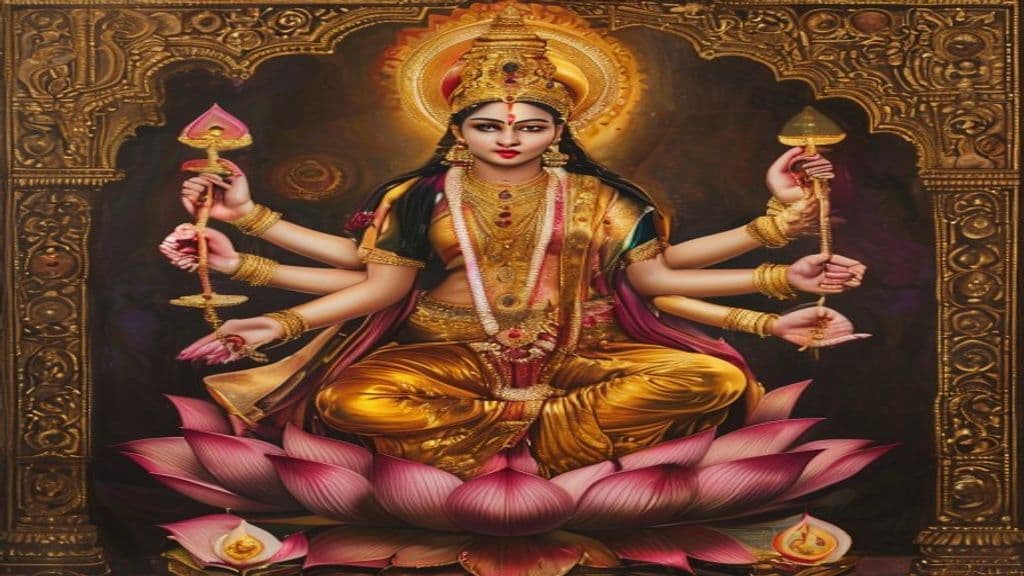
Lakshmi
Lakshmi is a principal Hindu goddess who personifies śrī (auspiciousness) and is revered as the giver of fortune, wealth, prosperity, beauty, fertility, sovereignty, and abundance. She is the consort and shakti of Vishnu in Vaishnavism, part of the Tridevi with Parvati and Sarasvati, and is the focus of popular devotional and festival practices such as Lakshmi Puja during Deepavali and Navaratri.

Yaksha
Nature spirits of Hindu, Buddhist, and Jain cosmology — guardians of forests, treasures, and wilderness. Ambivalent beings, capable of great benevolence to the respectful and terrible harm to the greedy.
*Péh₂usōn (reconstructed)
Péh₂usōn is a hypothetical Proto‑Indo‑European pastoral guardian reconstructed by comparative scholars from parallels in Greek and Vedic traditions. Proposed as a Graeco‑Aryan ancestor‑figure, the reconstruction describes a protector of flocks, roads, and travellers rather than an attested historical cultic personality.
Abhimanyu
Abhimanyu is a youthful Kuru/Pandava warrior-hero in the Sanskrit epic Mahābhārata. Son of Arjuna and Subhadra, he is famed for entering the Chakravyuha battle formation on the thirteenth day of the Kurukshetra War and dying at age sixteen; his posthumous son Parikshit continues the Kuru line.
Abhinandananātha
Abhinandananātha is the fourth Tīrthaṅkara (ford-maker) of the current Jain cosmic age (avasarpini). Traditional accounts place his birth in Ayodhyā to the Ikshvāku (Solar) dynasty, describe his renunciation and attainment of omniscience beneath a priyangu tree, and record his liberation on Mount Śikharjī.
Achyuta
Achyuta (Sanskrit: अच्युत, acyuta) is primarily an epithet/theonym in Vaishnava Hindu tradition applied to Vishnu and Krishna, signifying the divine quality of being 'not fallen' — immutable, infallible, and imperishable. It functions as a devotional name in scripture, liturgy, and Pancharatra lists of divine emanations rather than as an autonomous folkloric spirit.
Acintya
Acintya is an Indonesian Hindu theological-symbolic representation of the ineffable supreme divine principle. In Balinese and Javanese practice it functions as a way to make ultimate reality present in ritual and art—often aniconically as an empty throne (padmasana) or anthropomorphically as a naked, flame-surrounded figure—rather than as a narrative, intervening deity.
Adi (asura)
Adi is attested in modern reference works as the name of an Asura who 'appears in the Matsya Purāṇa.' Beyond this single-line citation in secondary sources, no descriptive material about the figure is provided in the supplied research notes.
Adi Shakti
Adi Shakti (also Adi Parashakti, Mahadevi, Adya Shakti) is the primordial feminine power in Hindu/Shakta theology, regarded as the ultimate reality (Para Brahman) and the source from which all goddesses and gods manifest. She is both an impersonal cosmic principle (Mulaprakriti) and a focus of devotional invocation in temples, mantras, and pilgrimage sites such as Shakti Peethas.
Adi Vinayaka
Adi Vinayaka (Ādi Vināyaka; also called Nara Mukha Vinayaka) is a named iconographic and devotional form of the Hindu god Ganesha portraying the deity with a human head, described in sources as the form before the episode of decapitation by Shiva. It is rarely worshipped and appears in a small number of South Indian shrines and in devotional/musical repertoires.
Aditi
Aditi is a major Vedic goddess in Hindu tradition who personifies the boundless, infinite cosmic principle and functions as the maternal matrix from which many celestial deities (the Ādityas and other groups) are born. In the Vedic hymns she is invoked as a protective liberator who guards petitioners, provides wealth and safety, and frees devotees from hindrances such as sin and sickness.
Agastya
Agastya (also Agathiyar/Agasti) is a revered Vedic and later-period Indian rishi (sage) figure credited in textual traditions as an inspired seer, ascetic, teacher, culture-founder, and attributed author of Vedic, Puranic and Tamil works; in South Indian tradition he is associated with origins of Tamil grammar and Siddha medicine and is identified astronomically with the star Canopus.
Aghasura
Aghasura is an asura from the Vaishnava/Hindu narrative tradition (notably the Srimad‑Bhāgavatam) who, at the command of Kamsa, assumed the form of a vast serpent to ambush Kṛṣṇa and the cowherd boys in Vṛndāvana. The episode demonstrates Kṛṣṇa’s protective, divine power as he enters and destroys the demon from within.
Agiya Baital
The fire-form of the Vetala — a cremation ground spirit of UP and Bihar that manifests as a wandering flame rather than a corpse-inhabitor, leading night travellers off roads and into marshland or flames with a dancing fire that seems always just ahead.
Community Record
- [1]Padmavati (Wikipedia disambiguation). Wikipedia: 'Padmāvatī may refer to: ... Padmavati (Jainism), a Jain attendant goddess (Yakshini) ... Padmavati (Hinduism), or Alamelu Manga, a Hindu goddess and consort of Venkateshvara ... Rani Padmini, also known as Padmavati... Padmâvatî (opera) ... Padmāvatī, in Bhasa's Svapnavasavadattam.'wiki
- [2]Wikidata: Padmāvatī (Q4705901). Wikidata entry identifying Padmāvatī and linking to related articles and identifiers.wiki
- [3]पद्मावतीआख्यान. (a Story Of Padmavati). Archive listing titled 'पद्मावतीआख्यान.' (a Story Of Padmavati) — attests a manuscript/item bearing the name Padmāvatī.other
- [4]Padmavati Maha Mantram (archive listing). Archive listing titled 'Padmavati Maha Mantram' — indicates a mantric/devotional item associated with Padmāvatī but provides no ritual text in the supplied metadata.other
- [5]The Stream: #Padmavati — ALJAZ (archive listing). Archive listing for an Al Jazeera program noting that the modern film Padmaavat (formerly titled Padmavati) sparked threats of violence — evidence of the name's modern cultural and political resonance.other