
Within the Mahabharata narrative the Pandavas are the five sons of King Pandu by his two wives Kunti and Madri and—crucially—of different gods invoked by Kunti's boon from the sage Durvasa. Kunti, having been granted a mantra by Durvasa that allowed her to bear a son by any god she respected, used it to invoke Dharmadeva (father of Yudhishthira), Vayu (father of Bhima), and Indra (father of Arjuna); Madri invoked the Ashvins and bore the twins Nakula and Sahadeva. The patronymic Pāṇḍava literally marks them as 'sons/descendants of Pandu'. Their births occur against the background of Pandu's curse and the dynastic politics of the Kuru court; they are raised in Hastinapura under the guidance of elders and teachers such as Bhishma, Vidura, and Kripa.
Descriptions in the sources treat each brother individually and link physical features to moral or social qualities. Yudhishthira is slender, with a prominent nose, large eyes, and a complexion described as like 'pure gold'. Bhima is portrayed as tall and powerful—long-armed, plump, fair-golden (gaura) in complexion, and ferocious in expression. Arjuna is dark-complexioned (syama) and exceptionally handsome, famed as the greatest of archers. Nakula is praised for outstanding handsomeness (Draupadi calls him 'the most handsome person in the whole world'), and Sahadeva is noted for a heroic and wise bearing though his precise physical details receive less emphasis. These appearances are given in epic descriptive passages and are tied to each brother's character and social role.
The brothers are mortal princes whose exceptional qualities are attributed to their divine paternity and rigorous training. Yudhishthira, as son of Dharmadeva, embodies justice, ethical knowledge, and claims to rightful rule. Bhima, son of Vayu, is famed for prodigious physical strength and ferocity in battle. Arjuna, son of Indra, is the peerless archer and model of martial self-control and courage. The twins Nakula and Sahadeva, born of the Ashvins, are lauded for handsomeness, skill (Nakula as swordsman), wisdom, and counsel (Sahadeva for intelligence and eloquence). Behaviorally, they undergo royal education under Bhishma, Vidura, and Kripa; enter into the shared marriage with Draupadi; suffer exile after losing a game of dice (twelve years plus one year in hiding); and lead the Pandava cause in the climactic Kurukshetra War, aided politically and strategically by Krishna.
Weaknesses
- conditionhuman mortality and moral fallibility
- conditionvulnerability to political manipulation (e.g., loss in game of dice leading to exile)
Wards
- othernone (no canonical magical wards against the Pandavas are cited in the provided sources)

Bhunni
The female guardian-spirit of agricultural fields in Bihar and eastern UP — her presence ensures fertile soil and good harvest, but she is territorial and punishes those who plough without permission, steal crops, or use chemical methods that poison the soil she inhabits.
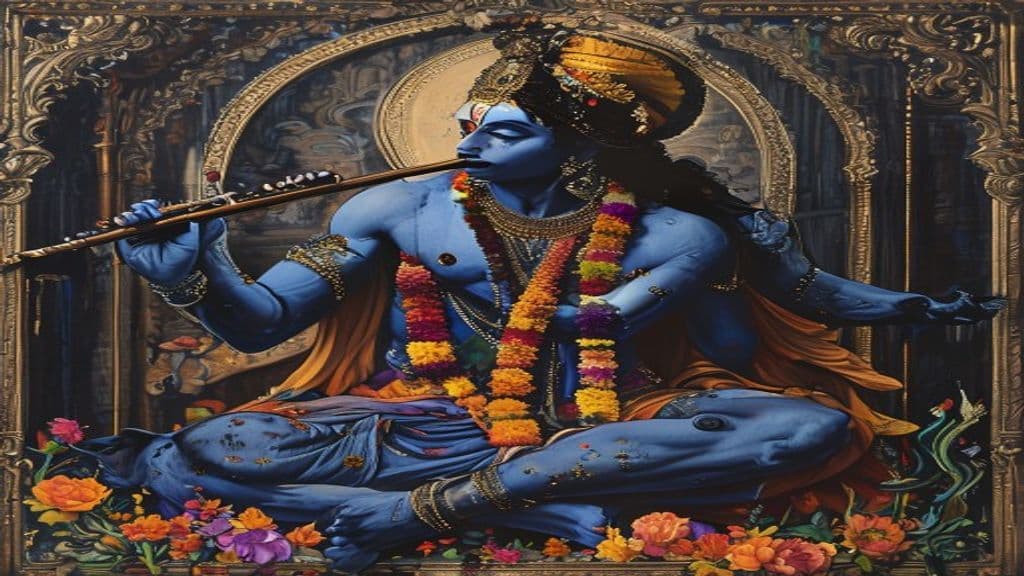
Krishna
Krishna (Sanskrit: Kṛṣṇa) is a major Hindu deity presented in the supplied sources both as the eighth avatāra of Vishnu and, in many traditions, as the Supreme Being (Svayam Bhagavān). He appears in a range of roles—child, cowherd, lover, charioteer, teacher and divine hero—and his life episodes (Krishna-līlā) are central to bhakti devotion, performance arts, and pilgrimage traditions.
*Péh₂usōn (reconstructed)
Péh₂usōn is a hypothetical Proto‑Indo‑European pastoral guardian reconstructed by comparative scholars from parallels in Greek and Vedic traditions. Proposed as a Graeco‑Aryan ancestor‑figure, the reconstruction describes a protector of flocks, roads, and travellers rather than an attested historical cultic personality.
Abhimanyu
Abhimanyu is a youthful Kuru/Pandava warrior-hero in the Sanskrit epic Mahābhārata. Son of Arjuna and Subhadra, he is famed for entering the Chakravyuha battle formation on the thirteenth day of the Kurukshetra War and dying at age sixteen; his posthumous son Parikshit continues the Kuru line.
Achyuta
Achyuta (Sanskrit: अच्युत, acyuta) is primarily an epithet/theonym in Vaishnava Hindu tradition applied to Vishnu and Krishna, signifying the divine quality of being 'not fallen' — immutable, infallible, and imperishable. It functions as a devotional name in scripture, liturgy, and Pancharatra lists of divine emanations rather than as an autonomous folkloric spirit.
Acintya
Acintya is an Indonesian Hindu theological-symbolic representation of the ineffable supreme divine principle. In Balinese and Javanese practice it functions as a way to make ultimate reality present in ritual and art—often aniconically as an empty throne (padmasana) or anthropomorphically as a naked, flame-surrounded figure—rather than as a narrative, intervening deity.
Adi (asura)
Adi is attested in modern reference works as the name of an Asura who 'appears in the Matsya Purāṇa.' Beyond this single-line citation in secondary sources, no descriptive material about the figure is provided in the supplied research notes.
Adi Shakti
Adi Shakti (also Adi Parashakti, Mahadevi, Adya Shakti) is the primordial feminine power in Hindu/Shakta theology, regarded as the ultimate reality (Para Brahman) and the source from which all goddesses and gods manifest. She is both an impersonal cosmic principle (Mulaprakriti) and a focus of devotional invocation in temples, mantras, and pilgrimage sites such as Shakti Peethas.
Adi Vinayaka
Adi Vinayaka (Ādi Vināyaka; also called Nara Mukha Vinayaka) is a named iconographic and devotional form of the Hindu god Ganesha portraying the deity with a human head, described in sources as the form before the episode of decapitation by Shiva. It is rarely worshipped and appears in a small number of South Indian shrines and in devotional/musical repertoires.
Aditi
Aditi is a major Vedic goddess in Hindu tradition who personifies the boundless, infinite cosmic principle and functions as the maternal matrix from which many celestial deities (the Ādityas and other groups) are born. In the Vedic hymns she is invoked as a protective liberator who guards petitioners, provides wealth and safety, and frees devotees from hindrances such as sin and sickness.
Agastya
Agastya (also Agathiyar/Agasti) is a revered Vedic and later-period Indian rishi (sage) figure credited in textual traditions as an inspired seer, ascetic, teacher, culture-founder, and attributed author of Vedic, Puranic and Tamil works; in South Indian tradition he is associated with origins of Tamil grammar and Siddha medicine and is identified astronomically with the star Canopus.
Aghasura
Aghasura is an asura from the Vaishnava/Hindu narrative tradition (notably the Srimad‑Bhāgavatam) who, at the command of Kamsa, assumed the form of a vast serpent to ambush Kṛṣṇa and the cowherd boys in Vṛndāvana. The episode demonstrates Kṛṣṇa’s protective, divine power as he enters and destroys the demon from within.
Agiya Baital
The fire-form of the Vetala — a cremation ground spirit of UP and Bihar that manifests as a wandering flame rather than a corpse-inhabitor, leading night travellers off roads and into marshland or flames with a dancing fire that seems always just ahead.
Agneya / Āgneyī
Āgneyī (feminine) or Āgneya (masculine adjective) is a Vedic–Puranic divine figure and ritual principle tied to the fire-god Agni and the southeastern direction. In textual traditions she appears both as a personified daughter/shakti of Agni and as an adjectival/technical term applied to fire-consecrated things (direction, astra, etc.). She also occurs as the name Agneya (or Anala) among items revealed in a Shaiva-Agamic list associated with the Aghora face of Sadashiva.
Community Record
- [1]Pandava (Wikipedia). Wikipedia contributors. 'Pandava.' Wikipedia, The Free Encyclopedia.wiki
- [2]Mahabharata Episode 53: The War Begins (archive summary). Archive.org: Mahabharata Episode 53: The War Begins (episode summary and assembly description).other
- [3]Prachand Pandava Natak Of Raj Shekhar Prefatory Material. Prefatory material to Prachand Pandava Natak (archive record).other
- [4]Pandava (Wikidata). Wikidata entry for 'Pandava' (notes alternate uses including a taxonomic homonym).other