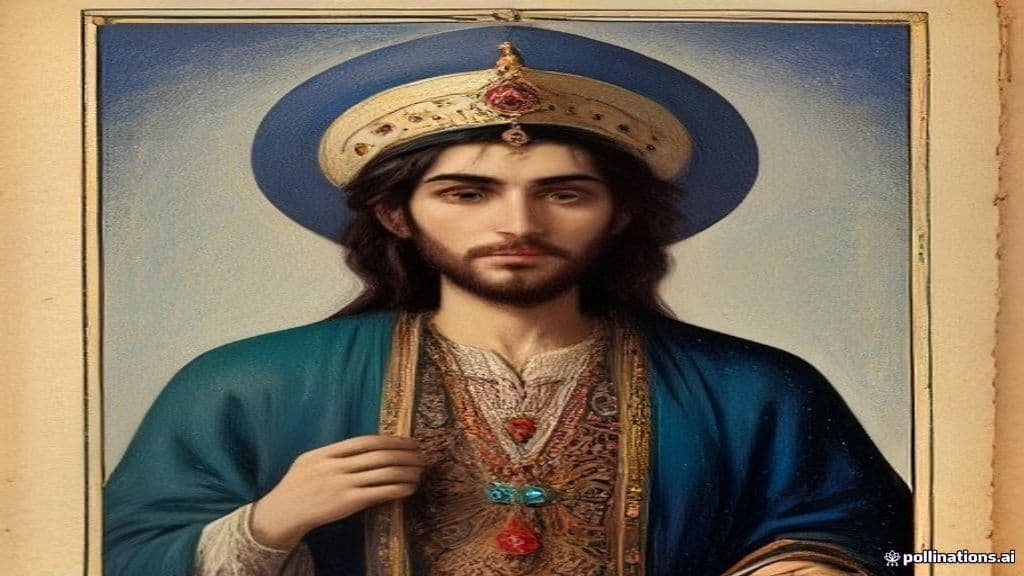
The supplied historical materials present Papak (often spelled Pabag) as an Iranian prince who came to rule Istakhr (Stakhr), the capital of Pars, around 205–210 CE and as a progenitor figure in the dynastic narrative that led to the rise of Ardashir I and the Sasanian line. Secondary sources note conflicting formulations of his precise kinship to Ardashir I (father, stepfather, grandfather, or father-in-law) and record that he was succeeded by his eldest son Shapur. Beyond these historical and dynastic associations, the name appears across modern contexts (judge, village name, fictional characters), and the supplied material contains no mythic origin tale that treats Papak as a supernatural being.
In the documented sources Papak is described as a human political and religious actor rather than a supernatural form. Historical descriptions identify him as a prince or local ruler of Istakhr and, in some modern blog commentary, as the mobad (high priest) of a fire temple of the goddess Anahita in Istakhr. Fictional uses likewise portray characters named Papak as ordinary humans (for example, a story character who laughs and drinks). The sources supply no description of any non-human or supernatural appearance.
Sources attribute to Papak human roles and actions: political leadership and territorial consolidation in Pars (he "ruled Stakhr" and "had probably united most of Pars under his rule"), dynastic relationships linked to the founding of the Sasanian dynasty, and, in some accounts, priestly office as mobad of a temple of Anahita. The supplied material contains no attribution of supernatural powers, spirit behavior, or occult abilities.
3-D Man
3-D Man is a Marvel Comics superhero identity associated with a 1950s-era origin in which the body of Chuck Chandler can materialize in three-dimensional existence when activated by his brother Hal via a pair of glasses. The mantle was later assumed by Delroy Garrett (formerly Triathlon) in modern continuity.
5 Ronin
5 Ronin is a 2011 Marvel Comics five-issue limited series that reimagines five Marvel superhero archetypes as rōnin (masterless samurai) in a fictionalized post‑Sekigahara feudal Japan. The work places Wolverine, Hulk, Punisher, Psylocke, and Deadpool analogues into period roles to explore displacement, revenge, and identity in an era of political upheaval.
58 Concordia
58 Concordia is a fairly large main-belt asteroid orbiting the Sun, discovered in 1860 and named after the Roman goddess Concordia. Astronomical sources classify it as a C-type (carbonaceous) body with a multi-year orbital period and measurable rotation and pole orientations.
9MOTHER9HORSE9EYES9
An anonymous Reddit screen name and online persona used by the author of the Interface series, a multipart speculative-horror narrative posted in short installments across Reddit in 2016. The name functions as the signature of an authorial identity and as a focal label for a fandom that created archives, a subreddit, and a wiki documenting the story and its fictional phenomena (notably entities called "flesh interfaces").
A Elbereth Gilthoniel
An Elvish hymn in Sindarin addressed to Elbereth (Varda) from J. R. R. Tolkien's legendarium. Presented in The Lord of the Rings and later musical and dramatic adaptations, the hymn functions as devotional poetic language that evokes Elvish reverence for the star-kindler rather than an independent supernatural agent.
A.R.G.U.S.
A.R.G.U.S. is a fictional clandestine United States government agency in the DC Comics universe that investigates, contains, and manages superhuman, meta-human, and supernatural incidents and assets. Introduced in The New 52 continuity, it functions as an institutional actor providing intelligence, logistical support, covert task forces (notably Task Force X / the Suicide Squad), and a dedicated magic division across comics and media adaptations.
Ab-Zohr
Ab-Zohr is the culminating rite of the Zoroastrian Yasna service: a formal offering to the waters (Aban/Apas) that creates the consecrated liquid parahaoma and functions to purify, strengthen, and atone for damage done to waters. It is a ritual action rather than an independent supernatural being.
Aban (Āb/Ābān)
Aban (Avestan apas; Middle Persian āb/ābān) is the collective, sacred principle of the waters in Zoroastrian cosmology — both the element water and its personified hypostases (the Apas/Ahuranis). Aban functions as a primordial, life-giving creation, a calendrical and liturgical focus (day-name, month-name, Abanagan feast), and a ritual object of veneration (ape zaothra, Aban Yasht) rather than a malign force to be expelled.
Aban Yasht
The Aban Yasht is a hymn from the Persian tradition that praises Anahita, a goddess associated with water, fertility, and wisdom. It consists of 132 stanzas and is part of the 21 Yashts collection. (Note: - Power tier should be "Primordial" or possibly "Cosmic", given that it's a hymn of great spiritual significance and associated with a goddess. - The article incorrectly states that Anahita is associa)
Abena Mansa
A name attested in a single contemporary Ghanaian blog anecdote as a 'mysterious being'; available sources do not establish Abena Mansa as a coherent, traditional supernatural figure or provide corroborating ethnographic detail.
Abin Sur
Abin Sur is a fictional extraterrestrial Green Lantern from the planet Ungara in DC Comics. A former history professor turned Green Lantern of Space Sector 2814, he discovered and investigated a prophecy tied to the "Blackest Night," died wounded on Earth and chose Hal Jordan as his ring-successor, and was later reanimated as a Black Lantern in the Blackest Night storyline.
Abishai
Abishai is a personal name attested in several distinct sources: a biblical individual described as the eldest son of Zeruiah (sister of King David); a Semitic chief named in an inscription at Beni-Hasan in Middle Egypt; and modern cultural uses including a named monster in Dungeons & Dragons and as an artist/stage name. The supplied materials do not present Abishai as a supernatural being within a living cosmology.
Community Record
- [1]Pabag (Wikipedia). Wikipedia: "Pabag was an Iranian prince who ruled Stakhr, the capital of Pars, from 205 or 206 until his death sometime between 207 and 210."wiki
- [2]Ardashir I (Wikipedia). Wikipedia: notes Papak's relation to Ardashir I and that "Papak had probably united most of Pars under his rule by then."wiki
- [3]Sasan (Wikipedia). Wikipedia: contextual material linking Papak/Pabag to the dynastic origins of the Sasanian line.wiki
- [4]Zenobia: Empress of the East: Sassanian Stuff II (Judith Weingarten blog). Blog: describes Papak as "the high priest, mobad, of the important fire temple of the goddess Anahita... in the Persian capital of Istakhr."other
- [5]Papak (Wikidata). Wikidata: entry identifying Papak as a village in Puncak Jaya Regency, Central Papua, Indonesia.wiki
- [6]Judge Papak (U.S. District Court of Oregon). Court website: modern occurrence of Papak as a personal name (Judge Papak).other
- [7]Papak's Midwinter Kiss (Bewildering Stories). Fiction: uses Papak as a human character name in a short story.literary
- [8]Papak's Midwinter Kiss (Bewildering Stories, part 1). Fiction: additional installment using the name Papak for a human character.literary
- [9]Archive item: gov.uscourts.ord.103894. Archive: document referencing modern occurrences of the name Papak in legal context.other
- [10]Toolbox Records — Miss Papak. Music release listing using Papak as an artist name.other