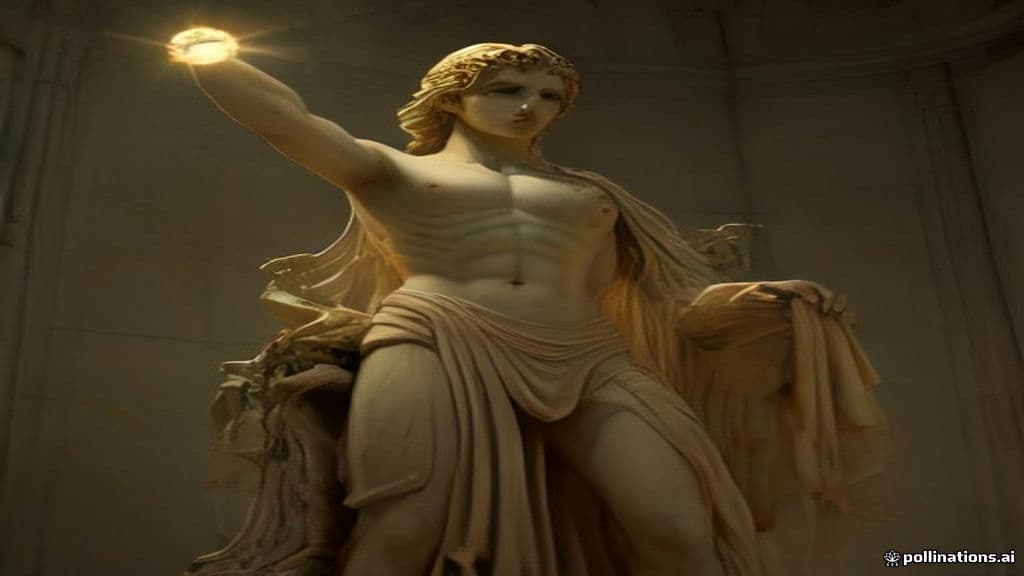
In the received classical accounts summarized in the provided material, Phaethon is usually the son of the Oceanid Clymene and the sun‑god Helios. Seeking confirmation of his paternity, the youth asks to drive his father's sun‑chariot for a single day. Although Helios warns him at length about the dangers and stresses that only he can control the horses, Helios accedes to Phaethon's insistence. Phaethon's inability to keep the horses on course causes the chariot to swing too near the earth—scorching regions—and too far—bringing cold; to end the catastrophe Zeus hurls a thunderbolt that kills Phaethon, whose body falls into the river Eridanus. His sisters, the Heliades, mourn and are transformed, with their tears becoming amber and themselves becoming poplars, a mythic explanation for amber deposits and aetiologies of extreme climates. Sources vary in some genealogical and locational details and the story is attested mainly in literary and tragic traditions.
Classical summaries do not contain an extended physical portrait beyond identifying Phaethon as a youth and the son of Helios and Clymene. Surviving literary and artistic reception, however, commonly represents him as a young man associated with the sun‑chariot (implicit in the narrative and explicit in later art and poetic treatments cited in reception histories). The emphasis in the sources is on his role—entering the sun‑chariot—rather than on distinctive corporeal description; tragic fragments and later visual representations typically place him as a youthful charioteer of the sun.
Phaethon's only demonstrated capacity in the myth is that, by his father's permission, he takes the reins of the sun‑chariot for a single day. He lacks Helios' mastery and authority over the horses and the cosmic course of the sun; his failure to control them produces catastrophic climatic disturbances (alternating scorching and freezing) that the tradition attributes directly to his mismanagement of a divine function. He is not portrayed as an inherently divine or competent cosmic agent but as a mortal or semi‑divine youth whose overreaching action precipitates divine corrective intervention (Zeus' lightning).
Weaknesses
- conditionmortality and lack of authority/skill
- othersubject to divine intervention (Zeus' thunderbolt)
Wards
None recorded.
*Péh₂usōn (reconstructed)
Péh₂usōn is a hypothetical Proto‑Indo‑European pastoral guardian reconstructed by comparative scholars from parallels in Greek and Vedic traditions. Proposed as a Graeco‑Aryan ancestor‑figure, the reconstruction describes a protector of flocks, roads, and travellers rather than an attested historical cultic personality.
57 Mnemosyne
57 Mnemosyne is a large main-belt asteroid (S-type) discovered in 1859 and named after the Greek Titaness Mnemosyne. It is a non-sentient astronomical body studied for its orbital and rotational properties and has been used in dynamical measurements related to Jupiter.
Aamon
Aamon (also Amon) is a named spirit in early modern Western grimoire tradition (Pseudomonarchia Daemonum; the Ars Goetia / Lesser Key of Solomon). He is presented as a high-ranking infernal officer (Marquis/Prince) who governs forty legions and is credited with knowledge of past and future and with affecting human relationships (reconciling or procuring feuds and favor).
Aba (disambiguation / name-form)
Aba is a polyvalent name-form attested across many unrelated contexts (place names, personal names, animal names, and brief mythological listings). The provided sources do not support a single, coherent supernatural entity called "Aba" and offer no descriptive or ritual material for such a being.
Abarbarea
Abarbarea is a name attested in classical Greek and Roman sources for freshwater nymphs (naiads). The name appears for at least two individual mythic figures — a naiad wife of Bucolion and a naiad counted among ancestors of the Tyrians — and Hesychius records plural forms that may indicate the name was also used as a class-name (Abarbareai / Abarbalaiai).
Abas
Abas (Ancient Greek: Ἄβας, gen.: Ἄβαντος) is not a single mythic being but a recurring personal name borne by multiple mortals and minor mythic figures in Greek epic and genealogical traditions — kings, founders, seers, warriors, attendants, a centaur, and a youth transformed by a goddess. The name is glossed in the sources as 'guileless' or 'good-hearted' and appears across Argive, Theban, Trojan, Euboean, and other local cycles.
Abderus
Abderus (Ancient Greek: Ἄβδηρος, romanized Ábdēros) is a mortal heroic figure in Greek myth closely associated with Heracles, remembered as the youth left in charge of the Mares of Diomedes who was killed by them. He functions as an eponymous local/divine-hero ancestor for the city of Abdera and received funerary commemoration and athletic agones at his tomb.
Abomination of Desolation
An apocalyptic prophetic phrase originating in the Book of Daniel designating a profaning thing or act that renders the Jerusalem Temple cult desolate; later reused in the Synoptic Gospels as an eschatological sign prompting urgent flight. The term denotes ritual/cultic impurity (Hebrew shiqquts) and is variously interpreted as pagan offerings or altar, a foreign cult statue, or (in some New Testament readings) an acting agent.
Abrahel
Abrahel is a demonological entity attested in early modern sources (notably Nicholas Rémy's Demonolatria as summarized in modern reference) portrayed as a female sexual spirit who seduced a man in 1581, induced him to kill his son, then restored the child to life in exchange for worship; the revival produced a diminished, foul-smelling corpse that later died again.
Abraxas
Abraxas (Abrasax) is a late‑antique Gnostic and magical name attested as a high-ranking cosmic power in heresiological summaries and as a potent name engraved on amulets (so-called Abraxas stones) in the Greco‑Roman magical milieu. Heresiologists associate Abraxas with rulership of 365 heavens and note the name's numerological value, while archaeological and papyrological contexts show its use as an amuletic formula.
Absyrtus
Absyrtus (Ancient Greek: Ἄψυρτος) is a Colchian prince in the Greek Argonautic cycle, son of King Aeëtes and brother or half-brother of Medea. He appears in variant traditions either as a companion taken by Medea during her flight with Jason and murdered/dismembered to delay pursuit, or as a pursuer sent by Aeëtes who is overtaken and slain by Jason; his death functions as a key narrative device in the escape from Colchis.
Acacallis
Acacallis (Ancient Greek: Ἀκακαλλίς; also Acalle) is a mythological princess of Crete in Greek tradition, daughter of King Minos and Pasiphae. She functions primarily as a dynastic and etiological figure: in varying accounts she is mother, by gods such as Hermes (Mercury) or Apollo, of eponymous or founder-figures like Cydon (founder of Cydonia), Miletus, or Lydon/ Lydus.
Community Record
- [1]Phaethon (Wikipedia). Wikipedia article 'Phaethon' (summary of name, parentage, myth, etymology, and reception)wiki
- [2]Phaethon (Wikidata). Wikidata entry for 'Phaethon' (modern reuse and identifiers)other
- [3]Archive holdings and reception references. Archive listings and modern reception contexts mentioning Phaethon in chapter/article titles (illustrating reception history)other
- [4]3200 Phaethon (Wikipedia). Modern astronomical reuse of the mythic name 'Phaethon' (rock‑comet 3200 Phaethon)wiki