
The name Plexippus appears in classical Greek as Πλήξιππος (Plēxippos / Plexippos), a compound name literally glossed in the sources as 'striking horses' or 'one who drives/ lashes horses.' In the mythographic material cited, Plexippus is not a single unified character but a personal name that recurs across separate genealogical and narrative contexts: a son of King Thestius of Pleuron (Aetolia), a son of Phineus and Cleopatra (linked to Thrace), a son of Aegyptus who married one of the Danaids (Egyptian myth-cycle), and an Arcadian prince son of Choricus. The classical summaries treat these as mortal figures embedded in human familial and heroic networks rather than as a distinct supernatural origin-entity.
Classical sources in the provided summaries give no physical or supernatural description for the mythic name-bearers called Plexippus; they are known from genealogical listings and narrative actions (roles such as son, brother, husband, hunter) rather than from bodily description or distinctive attire. Separate modern usages of the name in taxonomy (the spider genus Plexippus and the butterfly species Danaus plexippus) refer to biological organisms whose morphology is described in natural-history sources, but those descriptions pertain to the taxa and not to the ancient mythic persons.
As mortal figures in Greek narratives, the actions attributed to individuals named Plexippus are social and narrative rather than supernatural: the Pleuronian Plexippus (son of King Thestius) participated in the Calydonian Boar hunt and was killed by his nephew Meleager after disputing the awarding of the boar's hide to Atalanta; the Thracian Plexippus (son of Phineus and Cleopatra) was blinded by his father Phineus at the instigation of the stepmother Idaea along with his brother Pandion; the Egyptian Plexippus (son of Aegyptus) married Amphicomone and was slain by her in the Danaid marriages cycle; an Arcadian Plexippus is listed as son of King Choricus without specific actions recorded in the provided excerpts. The taxonomic usages denote organisms (jumping spiders; monarch butterfly) whose biological behaviors are outside the classical-myth sources cited here.

Meleager
Meleager is a named mortal hero of ancient Greek myth, a prince of Calydon famed as the leader and host of the Calydonian boar hunt. His life is bound to a prophesied household token (a charred piece of wood), his actions precipitate family conflict and metamorphosis, and he is remembered in local cult at Calydon and in epic and Hellenistic literary traditions.

Atalanta
Atalanta is a mortal heroine of ancient Greek myth, famed as a swift-footed huntress and archer who lives at the margins between wilderness and polis. Her story—exposure and fosterage by a she-bear, prominence in the Calydonian boar hunt, a marriage-footrace won by Hippomenes with Aphrodite's golden apples, and a later metamorphosis into a lion—appears in multiple regional variants and literary traditions.
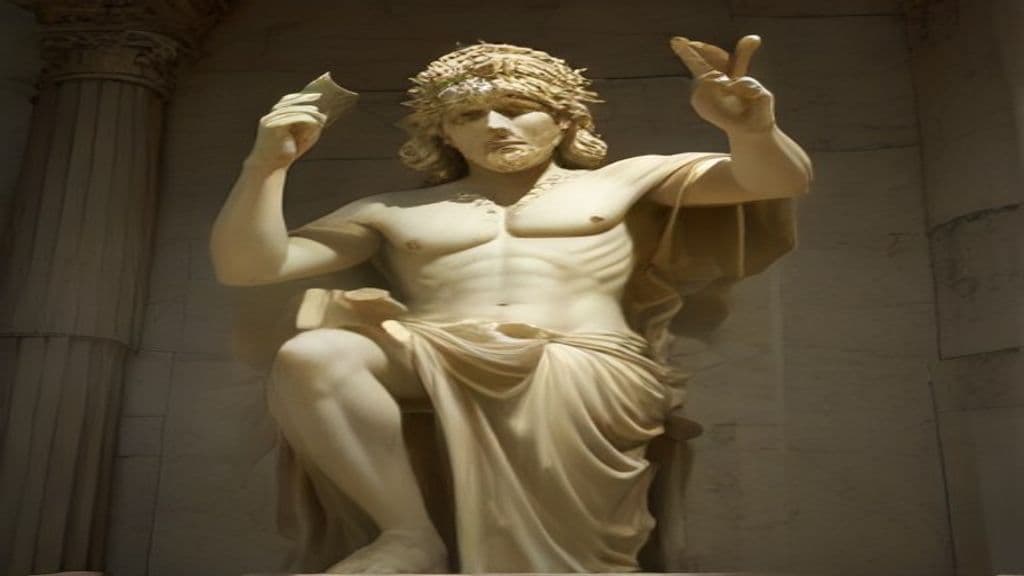
Danaus
Danaus is a mythic founding-king figure in ancient Greek tradition, remembered as the eponymous ancestor of the Danaids and as a culture-hero whose migration from Egypt/Libya to Argos explains local institutions, place-names, and cultic associations in archaic and classical lore.
*Péh₂usōn (reconstructed)
Péh₂usōn is a hypothetical Proto‑Indo‑European pastoral guardian reconstructed by comparative scholars from parallels in Greek and Vedic traditions. Proposed as a Graeco‑Aryan ancestor‑figure, the reconstruction describes a protector of flocks, roads, and travellers rather than an attested historical cultic personality.
3-D Man
3-D Man is a Marvel Comics superhero identity associated with a 1950s-era origin in which the body of Chuck Chandler can materialize in three-dimensional existence when activated by his brother Hal via a pair of glasses. The mantle was later assumed by Delroy Garrett (formerly Triathlon) in modern continuity.
5 Ronin
5 Ronin is a 2011 Marvel Comics five-issue limited series that reimagines five Marvel superhero archetypes as rōnin (masterless samurai) in a fictionalized post‑Sekigahara feudal Japan. The work places Wolverine, Hulk, Punisher, Psylocke, and Deadpool analogues into period roles to explore displacement, revenge, and identity in an era of political upheaval.
58 Concordia
58 Concordia is a fairly large main-belt asteroid orbiting the Sun, discovered in 1860 and named after the Roman goddess Concordia. Astronomical sources classify it as a C-type (carbonaceous) body with a multi-year orbital period and measurable rotation and pole orientations.
9MOTHER9HORSE9EYES9
An anonymous Reddit screen name and online persona used by the author of the Interface series, a multipart speculative-horror narrative posted in short installments across Reddit in 2016. The name functions as the signature of an authorial identity and as a focal label for a fandom that created archives, a subreddit, and a wiki documenting the story and its fictional phenomena (notably entities called "flesh interfaces").
A.R.G.U.S.
A.R.G.U.S. is a fictional clandestine United States government agency in the DC Comics universe that investigates, contains, and manages superhuman, meta-human, and supernatural incidents and assets. Introduced in The New 52 continuity, it functions as an institutional actor providing intelligence, logistical support, covert task forces (notably Task Force X / the Suicide Squad), and a dedicated magic division across comics and media adaptations.
Aba (disambiguation / name-form)
Aba is a polyvalent name-form attested across many unrelated contexts (place names, personal names, animal names, and brief mythological listings). The provided sources do not support a single, coherent supernatural entity called "Aba" and offer no descriptive or ritual material for such a being.
Abarbarea
Abarbarea is a name attested in classical Greek and Roman sources for freshwater nymphs (naiads). The name appears for at least two individual mythic figures — a naiad wife of Bucolion and a naiad counted among ancestors of the Tyrians — and Hesychius records plural forms that may indicate the name was also used as a class-name (Abarbareai / Abarbalaiai).
Abas
Abas (Ancient Greek: Ἄβας, gen.: Ἄβαντος) is not a single mythic being but a recurring personal name borne by multiple mortals and minor mythic figures in Greek epic and genealogical traditions — kings, founders, seers, warriors, attendants, a centaur, and a youth transformed by a goddess. The name is glossed in the sources as 'guileless' or 'good-hearted' and appears across Argive, Theban, Trojan, Euboean, and other local cycles.
Abderus
Abderus (Ancient Greek: Ἄβδηρος, romanized Ábdēros) is a mortal heroic figure in Greek myth closely associated with Heracles, remembered as the youth left in charge of the Mares of Diomedes who was killed by them. He functions as an eponymous local/divine-hero ancestor for the city of Abdera and received funerary commemoration and athletic agones at his tomb.
Abena Mansa
A name attested in a single contemporary Ghanaian blog anecdote as a 'mysterious being'; available sources do not establish Abena Mansa as a coherent, traditional supernatural figure or provide corroborating ethnographic detail.
Abin Sur
Abin Sur is a fictional extraterrestrial Green Lantern from the planet Ungara in DC Comics. A former history professor turned Green Lantern of Space Sector 2814, he discovered and investigated a prophecy tied to the "Blackest Night," died wounded on Earth and chose Hal Jordan as his ring-successor, and was later reanimated as a Black Lantern in the Blackest Night storyline.
Community Record
- [1]Plexippus — Wikipedia. Wikipedia, 'Plexippus' entry (summary of classical references), accessed via provided research notes.wiki
- [2]Plexippus (spider) — Wikipedia. Wikipedia, 'Plexippus (spider)' entry listing genus and species distributions, accessed via provided research notes.wiki
- [3]Wikidata: Plexippus (Q1578433). Wikidata item identifying Plexippus as a genus of arachnids, cited in research notes.other
- [4]Danaus plexippus — multiple natural-history sources. Natural-history references for Danaus plexippus (monarch butterfly) cited in the research notes (e.g., Las Pilitas; Butterfly House; UC Davis site).other
- [5]Archive items and additional references listed in research notes. Various archive links and resources included in the provided research notes referencing the name Plexippus in modern and historical contexts.other