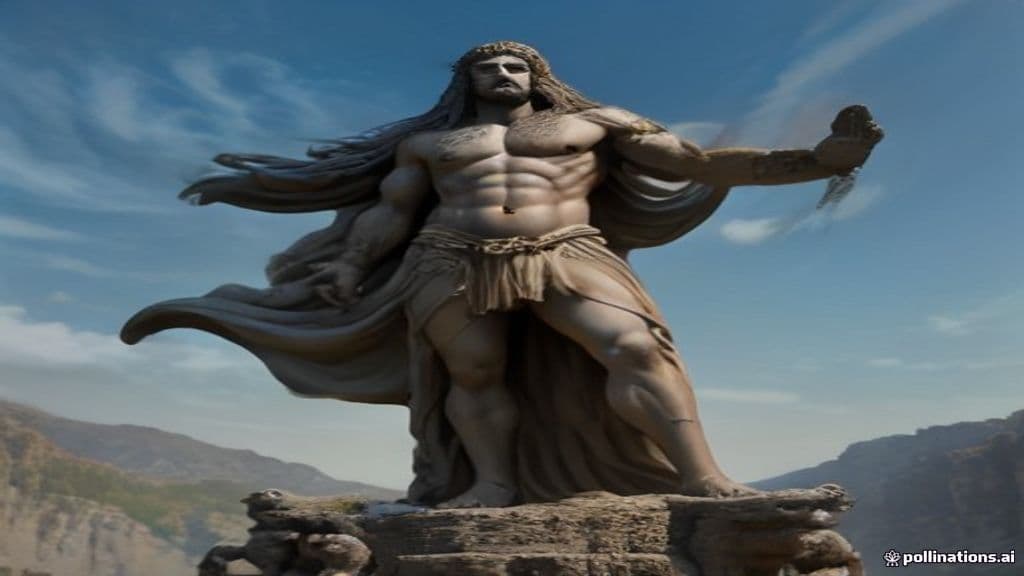
Polybotes is one of the Gigantes, born of Gaia in the wake of Uranus's castration; as a member of the earth-born Giants he took part in the Gigantomachy, the primordial struggle in which the Giants rose against the Olympian gods. In the tradition preserved in Apollodorus and repeated by later authors, Poseidon chased Polybotes through the sea to the island of Cos and broke off a piece (Nisyrum) to hurl upon him, so that the Giant was crushed and lies beneath the island. Strabo records the same tradition and notes an alternative that Polybotes lies beneath Cos itself. Pausanias records Coan local versions and mentions an Athenian statue depicting Poseidon attacking Polybotes.
As a member of the Gigantes, descriptions applied to Polybotes follow general Gigantes traits: enormous bulk and invincible might, a terrible aspect with long locks, and (in Apollodorus's description of the race) dragon-like scales on the feet. Specific visual attestations identify Polybotes in vase-painting scenes from the sixth and fifth centuries BC showing him in combat with Poseidon or Zeus; one amphora depicts Poseidon bearing an island (Nisyros) on his shoulder ready to hurl it at the Giant, and a late fifth-century cup shows Poseidon attacking the Giant with his trident while Gaia rises from the earth.
The sources portray Polybotes primarily as a martial opponent in the Gigantomachy: a powerful Giant who fought the Olympian gods and was prominent enough to be singled out in literature and art. The tradition does not attribute independent geological or ritual powers to Polybotes; the island-underfoot motif is the result of Poseidon's action in pursuing and subduing him rather than an ability of the Giant himself.
Weaknesses
- othersubdual by Olympian gods (notably Poseidon)
- othercrushing/containment beneath an island (Nisyros or Cos) as attested etiological outcome
Wards
- othernone attested

Poseidon
Poseidon is a principal deity of the ancient Greek pantheon, counted among the Twelve Olympians; he presides over the sea, storms, earthquakes and horses and functions as protector of seafarers and guardian of cities and colonies.

Typhon
The last great monster of Greek mythology — a vast, fire-breathing giant whose shoulders sprouted a hundred serpent heads, nearly toppling Zeus from Olympus.

Alcyoneus
Alcyoneus (Ancient Greek Alkyoneús, Ἀλκυονεύς) is a colossal monstrous figure in Greek myth, variably presented as one of the Gigantes (Giants) born of Gaia and as a singular enormous hostile herdsman/warrior opposed to Heracles. Noted for prodigious strength and for a peculiar invulnerability tied to his native land, he is defeated when Heracles drags him out of his homeland at Athena's counsel in one influential tradition.
*Péh₂usōn (reconstructed)
Péh₂usōn is a hypothetical Proto‑Indo‑European pastoral guardian reconstructed by comparative scholars from parallels in Greek and Vedic traditions. Proposed as a Graeco‑Aryan ancestor‑figure, the reconstruction describes a protector of flocks, roads, and travellers rather than an attested historical cultic personality.
Aba (disambiguation / name-form)
Aba is a polyvalent name-form attested across many unrelated contexts (place names, personal names, animal names, and brief mythological listings). The provided sources do not support a single, coherent supernatural entity called "Aba" and offer no descriptive or ritual material for such a being.
Abarbarea
Abarbarea is a name attested in classical Greek and Roman sources for freshwater nymphs (naiads). The name appears for at least two individual mythic figures — a naiad wife of Bucolion and a naiad counted among ancestors of the Tyrians — and Hesychius records plural forms that may indicate the name was also used as a class-name (Abarbareai / Abarbalaiai).
Abas
Abas (Ancient Greek: Ἄβας, gen.: Ἄβαντος) is not a single mythic being but a recurring personal name borne by multiple mortals and minor mythic figures in Greek epic and genealogical traditions — kings, founders, seers, warriors, attendants, a centaur, and a youth transformed by a goddess. The name is glossed in the sources as 'guileless' or 'good-hearted' and appears across Argive, Theban, Trojan, Euboean, and other local cycles.
Abderus
Abderus (Ancient Greek: Ἄβδηρος, romanized Ábdēros) is a mortal heroic figure in Greek myth closely associated with Heracles, remembered as the youth left in charge of the Mares of Diomedes who was killed by them. He functions as an eponymous local/divine-hero ancestor for the city of Abdera and received funerary commemoration and athletic agones at his tomb.
Abomination of Desolation
An apocalyptic prophetic phrase originating in the Book of Daniel designating a profaning thing or act that renders the Jerusalem Temple cult desolate; later reused in the Synoptic Gospels as an eschatological sign prompting urgent flight. The term denotes ritual/cultic impurity (Hebrew shiqquts) and is variously interpreted as pagan offerings or altar, a foreign cult statue, or (in some New Testament readings) an acting agent.
Absyrtus
Absyrtus (Ancient Greek: Ἄψυρτος) is a Colchian prince in the Greek Argonautic cycle, son of King Aeëtes and brother or half-brother of Medea. He appears in variant traditions either as a companion taken by Medea during her flight with Jason and murdered/dismembered to delay pursuit, or as a pursuer sent by Aeëtes who is overtaken and slain by Jason; his death functions as a key narrative device in the escape from Colchis.
Acacallis
Acacallis (Ancient Greek: Ἀκακαλλίς; also Acalle) is a mythological princess of Crete in Greek tradition, daughter of King Minos and Pasiphae. She functions primarily as a dynastic and etiological figure: in varying accounts she is mother, by gods such as Hermes (Mercury) or Apollo, of eponymous or founder-figures like Cydon (founder of Cydonia), Miletus, or Lydon/ Lydus.
Acacus
Acacus (Ancient Greek: Ἄκακος) is, in Arcadian Greek tradition, a mortal eponymous founder-king of Acacesium and is remembered as the foster-father who reared the infant Hermes (Mercury) in that local tradition. He is presented in genealogies as a son of Lycaon and functions as a local ancestral/onomastic figure rather than a supernatural spirit.
Academus
Academus (Greek: Akádemos / Hekádemos) is an Attic hero-eponym tied to a sacred grove (Akademeia) on the Cephissus near Athens. In myth he revealed where Helen was hidden to the Dioskouroi, an act said to have saved the city, and the place bearing his name became a long-lived sacred precinct, later the site of Plato's Academy.
Acamas
Acamas (Ancient Greek: Ἀκάμας) is a personal name recurrent in ancient Greek narrative traditions applied to multiple human characters (warriors, princes, suitors), once to a Cyclops, and once as a hound's name. Rather than a single supernatural entity, bearers of the name appear episodically across the Trojan War, Theseid, and Theban cycles as mortal actors whose deeds intersect with gods and fate.
Acantha
Acantha (Ancient Greek: Ἀκάνθα, 'thorn') is a late or secondary mythological figure known from modern retellings as a nymph transformed into the acanthus plant. The tale that she scratched Apollo and was changed into a spiny-leaved plant is not attested in surviving classical corpora and appears to be a modern compilation or invention rather than a firmly documented ancient myth.
Community Record
- [1]Polybotes — Wikipedia. Wikipedia entry 'Polybotes' (accessed via provided research notes)wiki
- [2]Wikidata: Polybotes. Wikidata item Q1233841 'Polybotes' (accessed via provided research notes)other
- [3]LP0026 The Gigantomachy (archive audio/text fragments). Archive recordings and summaries of Gigantomachy material referencing Polybotes and general Gigantes descriptions (as provided in research notes)other
- [4]Strabo (as cited in research notes). Summary citation of Strabo's report on the Nisyros/Cos tradition concerning Polybotes (as provided in research notes)literary
- [5]Pausanias (as cited in research notes). Summary citation of Pausanias noting an Athenian statue of Poseidon attacking Polybotes and Coan local tradition (as provided in research notes)literary
- [6]Museum vase attestations (Getty 81.AE.211; Louvre E732) — as cited. References in the provided material to archaic and classical vase-paintings naming or depicting Polybotes (Getty dinos, Louvre amphora) as summarized in research notesother