Renpetneferet is a deity in Egyptian folklore, from Egypt. Renpetneferet (rnpt-nfrt) is a minor divine figure attested in Late Period Egyptian literary and cultic material as a member of the deified household of Imhotep. Her name ties her conceptually to the renpet (the personified year) and to nefer (youth/beauty), placing her within late Hermopolitan associations of time, renewal, and the Ogdoad imagery surrounding Thoth-related syntheses.
Renpetneferet is attested in Late Period sources as a member of the divine family assembled around the deified sage Imhotep. Primary literary evidence includes a demotic papyrus from the temple of Tebtunis (2nd century AD) that preserves a long Imhotep narrative and names Renpetneferet as his younger sister (the same Late Period tradition in secondary summaries also records variant statements identifying her as his wife). The Late Period phenomenon that elevated Imhotep and accorded divine status to his mother and wife/sister is the cultural context in which Renpetneferet appears; she thus originates in processes of local deification and theological reanalysis that integrated exceptional mortals into Hermopolitan/Thoth-associated cosmology rather than in an independent, ancient state cult of her own.
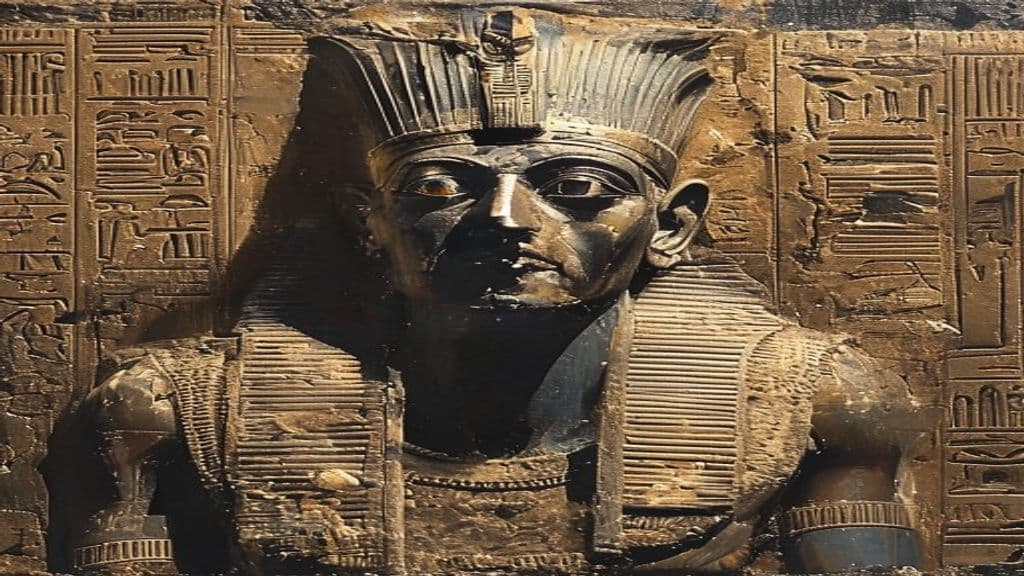
No preserved source from the provided material gives a detailed anthropomorphic description of Renpetneferet as an individual deity. What the sources do supply is the iconographic vocabulary associated with the renpet concept more generally: the renpet is often depicted as a palm frond (the time-register) emerging from a Shen ring, sometimes surmounted by a frog associated with the Ogdoad and Heh, and Seshat is shown inscribing years on the renpet. Renpetneferet’s name evokes that imagery and the qualities of youth/beauty (nefer), but the texts cited do not record a distinct carved or painted cult statue type or a canonical anthropomorphic portrait specific to her.
The available sources do not record explicit powers, miracles, or ritual functions uniquely performed by Renpetneferet. Her conceptual role, as inferred from her name and associations, links her to the renpet (year) and thus to themes of cyclical time, renewal, youth, and beauty; she functions as a minor divine personification within Imhotep’s household and the Late Period assimilation of Imhotep to Thoth and Hermopolitan ideas. Because no independent miracle narratives, healing rites, or exorcistic texts invoking Renpetneferet are provided in the sources, her power tier is assessed as 'Minor Spirit' on the basis of late, localized literary and cultic attestations and the absence of an independent widespread cult tradition or recorded thaumaturgic deeds.
Weaknesses
- otherNo weaknesses attested in provided sources
Wards
- otherNo apotropaic wards or protective measures against Renpetneferet are attested in the provided material
3-D Man
3-D Man is a Marvel Comics superhero identity associated with a 1950s-era origin in which the body of Chuck Chandler can materialize in three-dimensional existence when activated by his brother Hal via a pair of glasses. The mantle was later assumed by Delroy Garrett (formerly Triathlon) in modern continuity.
5 Ronin
5 Ronin is a 2011 Marvel Comics five-issue limited series that reimagines five Marvel superhero archetypes as rōnin (masterless samurai) in a fictionalized post‑Sekigahara feudal Japan. The work places Wolverine, Hulk, Punisher, Psylocke, and Deadpool analogues into period roles to explore displacement, revenge, and identity in an era of political upheaval.
A Elbereth Gilthoniel
An Elvish hymn in Sindarin addressed to Elbereth (Varda) from J. R. R. Tolkien's legendarium. Presented in The Lord of the Rings and later musical and dramatic adaptations, the hymn functions as devotional poetic language that evokes Elvish reverence for the star-kindler rather than an independent supernatural agent.
A.R.G.U.S.
A.R.G.U.S. is a fictional clandestine United States government agency in the DC Comics universe that investigates, contains, and manages superhuman, meta-human, and supernatural incidents and assets. Introduced in The New 52 continuity, it functions as an institutional actor providing intelligence, logistical support, covert task forces (notably Task Force X / the Suicide Squad), and a dedicated magic division across comics and media adaptations.
Aani
Aani (ancient Egyptian jꜥnr) is the lexical term for the baboon in ancient Egyptian language and functions in religious contexts as an animal icon and theophoric epithet. Attested repeatedly in Egyptian texts and images, the baboon image is used to represent or denote aspects of gods such as Thoth, Hapy, Khonsu, and Osiris rather than implying the animal itself is an independent deity.
Aati
Aati (also rendered Ati) is one of the 42 judges of the dead in ancient Egyptian funerary literature, attested in the Book of the Dead tradition (notably the Papyrus of Nebsemy). Described as originating 'from Heliopolis', Aati's documented function is to question the deceased about a specific moral accusation during the Duat judgment; the funerary texts supply a formulaic denial the soul must recite.
Abadiu of Antinoe
Abadiu of Antinoe was a fourth‑century bishop of Antinoe (Antinoopolis, in Roman Egypt) commemorated as a martyr and saint in the Coptic Orthodox Church, with a feast day on 26 December. Sources record that he was killed during a theological dispute with Arian opponents and reference him in collections of Egyptian martyrs.
Abaset
Abaset is a localized ancient Egyptian goddess attested in tomb decoration at El‑Bawiti in the Bahariya Oasis during the 26th Dynasty. She is depicted anthropomorphically with a hedgehog motif incorporated into her headdress and appears on the walls of Qarat Qasr Salim, including twice in the Tomb of Bannentiu. No cult texts, myth narratives, or ritual prescriptions for her are recorded in the cited corpus.
Abib and Apollo
Abib and Apollo are Christian ascetics and hagiographic saints of Akhmim (Upper Egypt) attested in Coptic sources and the Historia Monachorum. Remembered for extreme asceticism, monastic leadership, angelic encounters, and inclusion in the Coptic Synaxarion (feast day November 4).
Abin Sur
Abin Sur is a fictional extraterrestrial Green Lantern from the planet Ungara in DC Comics. A former history professor turned Green Lantern of Space Sector 2814, he discovered and investigated a prophecy tied to the "Blackest Night," died wounded on Earth and chose Hal Jordan as his ring-successor, and was later reanimated as a Black Lantern in the Blackest Night storyline.
Absolute Green Lantern (tradition)
A modern comic-book reinterpretation in DC's Absolute Universe in which a giant green lantern-shaped vessel appears above Evergreen, Nevada, generates an impenetrable green dome, judges townspeople and sends the judged into the Lantern to await further adjudication in OA (Omega‑Alpha). The story reframes Green Lantern mythos as cosmic/religious horror with an "Enlightenment Spectrum" of flames (Qard, Rao, Sur, Aur) stewarded by Oans such as Abin Sur.
Absorbing Man
A fictional Marvel Comics character (Carl "Crusher" Creel) whose body acquires the physical properties of materials or energies he touches. Debuting in Journey into Mystery #114 (March 1965), created by Stan Lee and Jack Kirby, he is presented as a mortal supervillain/occasional antihero who challenges heroes such as Thor, Hulk, Spider-Man, and the Avengers.
Community Record
- [1]Renpetneferet. Wikipedia, 'Renpetneferet' (summary of Late Period attestations and Tebtunis papyrus reference).wiki
- [2]Wikidata: Renpetneferet. Wikidata entry summarizing attestations and name (rnpt-nfrt).other