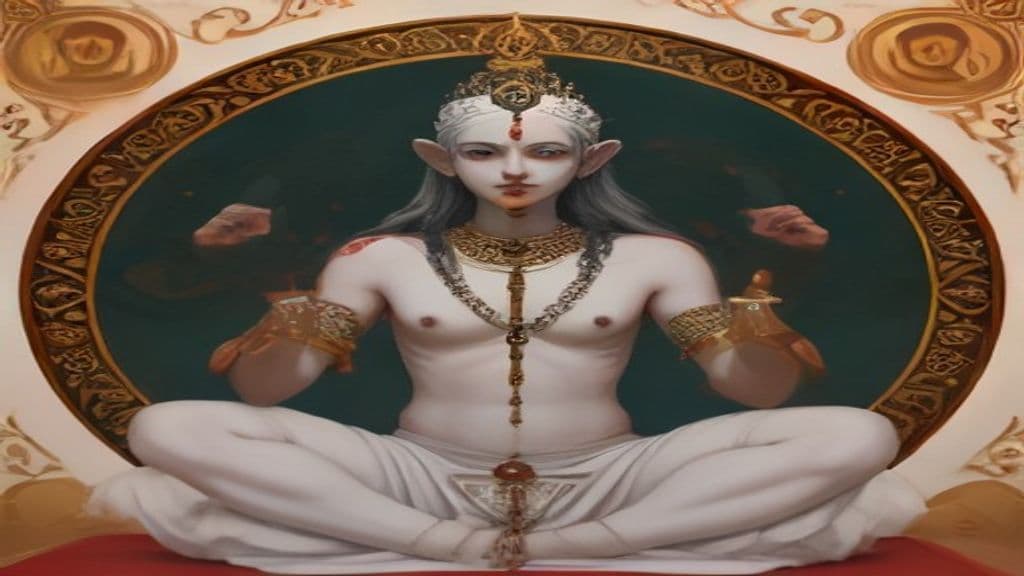
Within Jain tradition Śreyānsanātha is presented as the eleventh Tīrthaṃkara of the current descending half-cycle of time (Avasarpini). The supplied sources record that he was born to King Vishnu and Queen Vishna at Simhapuri, near Sarnath, into the Ikshvaku dynasty. As a Tīrthaṃkara he functions as one of the succession of spiritual teachers who renew and exemplify the Jain path; the supplied material emphasizes his eventual attainment of Siddhahood, meaning he completed the soteriological process and was liberated from all karmic bonds.
The provided sources contain no descriptive material about Śreyānsanātha's physical appearance, iconography, posture, attendant symbols, or typical artistic attributes. Therefore no specific iconographic details are recorded in these sources. The absence of such description in the supplied texts means that any standard Tīrthaṃkara motifs (if they exist in broader Jain art) are not attested here and are not asserted in this entry.
The sources explicitly record Śreyānsanātha's soteriological status: he became a Siddha, a liberated soul which has destroyed all of its karma. From the supplied material this is the defining capacity attributed to him. The sources do not record any additional miraculous acts, supernatural powers, or behavioral narratives for Śreyānsanātha beyond his attainment of liberation.
Weaknesses
- otherno specific weaknesses or wards recorded in the supplied sources
Wards
- otherno specific weaknesses or wards recorded in the supplied sources
Abhinandananātha
Abhinandananātha is the fourth Tīrthaṅkara (ford-maker) of the current Jain cosmic age (avasarpini). Traditional accounts place his birth in Ayodhyā to the Ikshvāku (Solar) dynasty, describe his renunciation and attainment of omniscience beneath a priyangu tree, and record his liberation on Mount Śikharjī.
Agni
Agni is the Vedic personification of fire in Hindu tradition: a sacred, mediating principle that manifests as terrestrial fire, atmospheric lightning, and celestial sun, and that receives and conveys sacrificial offerings. Prominent in the Rigvedic corpus, Agni functions as sanctifier, witness of rites of passage, and a transformational inner principle in later Upanishadic literature.
Ajitanātha
Ajitanātha is the second tirthankara of the current cosmic age in Jainism: an enlightened spiritual teacher who renounced worldly life, attained omniscience (kevalajñāna), and achieved liberation (moksha), and who is credited with establishing a large four-part monastic order in the tradition's hagiography.
Akshayavata
In Hindu mythology, Akshayavata is a sacred banyan tree and/or lake that symbolizes eternal life. It is mentioned in both Hindu and Jain traditions and associated with the Puranas. (Note: - The power tier should be "Greater" or at least "Ancient", as it is associated with the Puranas, which are considered ancient texts. - No specific physical description is provided, but that doesn't m)
Ambika (Jainism)
Ambika is the yakṣiṇī (Śāsana Devī, protector-goddess) and tutelary attendant of the 22nd Tīrthaṅkara Neminatha in Jain tradition. Venerated both as an attendant spirit and an independent goddess (kuladevi) she features in devotional, temple and tantric ritual contexts, and is associated with fertility, prosperity and protection.
Anantanātha
Anantanātha is the fourteenth Tīrthaṅkara of the present age (Avasarpini) in Jain tradition, a perfected spiritual teacher who became a siddha (liberated soul) after destroying all karma and whose role is to reveal the dharma and provide a ford (tīrtha) across saṃsāra.
Aranātha
Aranātha is the eighteenth Tīrthaṅkara (ford‑maker) in the Jain tradition of the present half‑cycle (Avasarpini). In the provided sources he is presented as a spiritual exemplar born in the Ikshvaku dynasty at Hastinapur who attains siddhahood (liberation) after completing his life.
Arihant
In Jain doctrine an arihant is a soul (jiva) that has conquered inner passions and destroyed the four inimical (ghātiyā) karmas, thereby attaining kevala jñāna (omniscience) while still embodied; on final shedding of remaining karma an arihant attains siddhahood (moksha).
Bahubali
Bahubali is a prominent figure in Jain hagiography: a royal scion who renounces worldly rule, undertakes prolonged standing ascetic meditation (kayotsarga), attains omniscience (kevala jnana) and ultimately liberation (moksha) to become a siddha. He is widely commemorated in Jain art and by monumental monolithic statues (notably the Gommateshwara at Shravanabelagola).
Balarāma
Balarāma (Sanskrit: बलराम) is a major deity in the Indian religious tradition closely associated with the Krishna cycle and the Vrishni hero-cult. He is described as Krishna's elder brother, an agricultural patron identified with the plough (halā) and club (gaḍā), and is later associated with the cosmic serpent Śeṣa/Saṅkarṣaṇa and incorporated into Viṣṇu avatāra lists; his cult is attested in early coinage and sculpture from c. 2nd century BCE onward and in living traditions such as the Jagannātha triad and village devotional practice.
Chaitra
Chaitra (Sanskrit: चैत्र, Caitra) is the name of the first month of the Hindu lunar calendar and the Indian national calendar; it functions as a calendrical period that structures seasonal cognition (spring/Vasanta), new-year reckonings, and a cluster of religious festivals and commemorations across South Asian traditions.
Chakreshvari
Chakreshvari (also Chakreshwari or Apraticakra) is an attendant goddess (yakshini) in Jain cosmology who serves as the guardian or tutelary deity of the first Tirthankara, Rishabhanatha. She is an object of popular devotion in Jain communities and is counted among the three yakshinis—alongside Ambika and Padmāvatī—that attract the most devotional worship.
Community Record
- [1]Śreyānsanātha (Shreyansanatha) — Wikipedia. Wikipedia contributors, 'Shreyansanatha', Wikipedia, The Free Encyclopedia, https://en.wikipedia.org/wiki/Shreyansanathawiki
- [2]Wikidata: Q7503735 — Śreyānsanātha. Wikidata entry Q7503735 for Shreyansanatha, http://www.wikidata.org/entity/Q7503735wiki