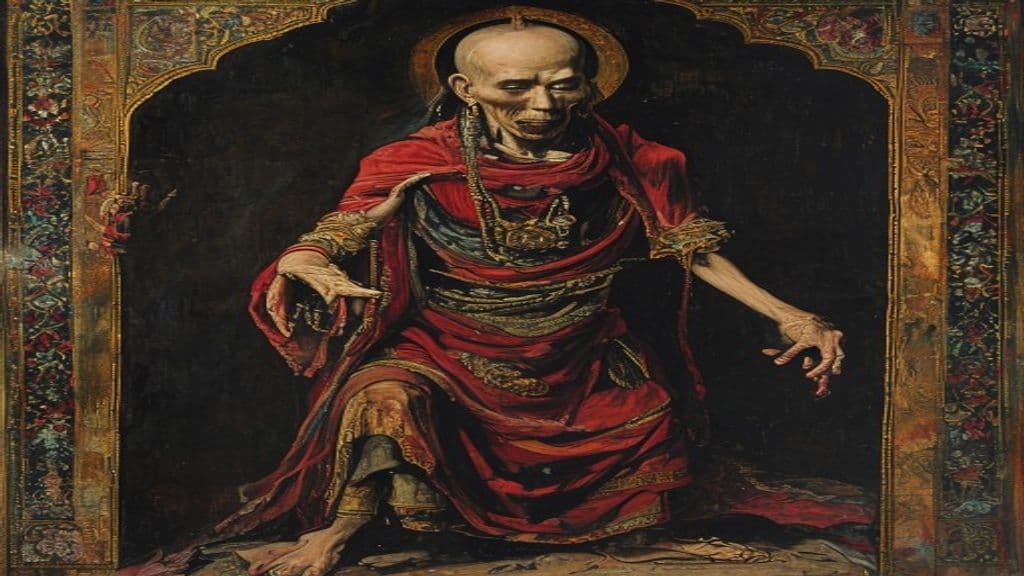
Ro-langs literally means "a risen corpse" (Tibetan ro = corpse; langs = risen). Sources present two principal causal frameworks: (1) tantric or necromantic ritual raising by a sorcerer or tantric practitioner to serve the raiser (the "tantric" type), and (2) occupation of the corpse by an evil spirit (gdon or bgegs) entering before burial producing a demonic, autonomous Ro-langs. Scholarly treatments classify Ro-langs narratives into three storytelling formats — "Legendary," "Epidemic," and "Comatose" (Turrell Wylie as summarized in secondary literature) — which shape how origin and temporality are presented in individual accounts.
Descriptions emphasize corpse-like motor constraints rather than detailed gore: a ro-langs cannot bend any joints (producing a stiff-armed, lurching gait), cannot bend at the waist, cannot speak, and signals victims by wagging its tongue back and forth. Summarized sources do not provide consistent, detailed descriptions of skin color or stages of decomposition; some comatose-type accounts note blue rather than white eyes in waking individuals, a detail linked in sources to misidentified comas.
Ro-langs locomote with a stiff-armed lurch because they cannot bend joints or stoop. The tantric-raised variety is described as created to serve the raising practitioner (analogized in summaries to other ritual servitude motifs), while demonic Ro-langs are described as autonomous and capable of infecting other humans by touching them on the head; epidemic stories depict rapid spread (sometimes within a single night). They cannot speak. Texts and summaries frame neutralization not as ordinary killing but as making the ro-langs "fall over" (Tibetan brgyal-ba) by exploiting specific physical vulnerabilities.
Weaknesses
- conditionbrgyal-ba (made to 'fall over') — general euphemism for neutralizing a ro-langs by causing it to fall
- otherlpags-langs (skin vulnerability) — breaking the skin will make it fall (easiest)
- otherkhrag-langs (blood vulnerability) — causing bleeding will make it fall
- othersha-langs (flesh vulnerability) — deeply cutting or removing flesh will make it fall
- otherrus-langs (bone vulnerability) — fracturing a bone will make it fall
- otherrme-langs (mole vulnerability) — damaging a specific mole on the body will make it fall (small and hard to find; hardest)
Wards
- ritualarchitectural low doorframes (physical prevention)
- conditionexploit motor limitation (prevent entry or force immobility because ro-langs cannot stoop or bend joints)
Acala
Acala (Sanskrit: अचल, 'The Immovable') is a wrathful protective deity (dharmapala) in Vajrayāna and East Asian esoteric Buddhism, classed among the Wisdom Kings (Vidyārāja). He functions as a ritual focus for visualization and mantra practice intended to remove obstacles and bind or destroy hostile forces.
Acalanātha (Acala / Achala)
Acalanātha (also Acala or Achala) is a wrathful deity and dharmapāla — a protector of the Dharma — prominent in Vajrayana and East Asian Mahayana Buddhist contexts. Presented as a fierce, non‑human or semi‑divine protector-figure, Acalanātha functions to defend the teaching and practitioners by removing obstacles and confronting threats to the transmission and practice of Buddhism.
Agni
Agni is the Vedic personification of fire in Hindu tradition: a sacred, mediating principle that manifests as terrestrial fire, atmospheric lightning, and celestial sun, and that receives and conveys sacrificial offerings. Prominent in the Rigvedic corpus, Agni functions as sanctifier, witness of rites of passage, and a transformational inner principle in later Upanishadic literature.
Aizen Myō-ō (Rāgarāja)
Aizen Myō-ō corresponds to the deity Rāgarāja, a wrathful/transformation-oriented figure venerated in Esoteric and Vajrayāna Buddhist traditions. The figure is especially revered in Chinese Esoteric Buddhism in Chinese communities and in the Japanese Esoteric schools Shingon and Tendai.
Akhu Tönpa
A Tibetan trickster figure, sent by Chenrezig to teach the art of being shrewd and witty, while championing the common man against social hierarchies. (Note: - Power tier should be Lesser or Minor Spirit, not Ancient, as it's more aligned with local spirit level of trickster figures. - The ability to outwit those in positions of power suggests Greater or P)
Akshobhya
Akshobhya is a transcendent buddha of Mahāyāna and Vajrayāna Buddhism, one of the Five Wisdom (Dhyāni) Buddhas. He personifies 'mirror knowledge' (ādarśa-jñāna), is conventionally placed in the East, and is lord of the eastern Pure Land Abhirati; in esoteric texts he is associated with the eastern Vajra division and invoked in mantra/mandala ritual contexts.
Akuma
Akuma (悪魔/あくま) in Japanese sources is an evil spirit, devil, or demon associated with misfortune and mental disturbance. The term appears in Buddhist texts and Heian-period literature and was later used to translate the Christian figure of Satan, as well as the Buddhist Mara.
Amanojaku
Amanojaku (天邪鬼 / あまのじゃく) is a Japanese yōkai-type being portrayed as a contrarian, heart-reading trickster. Treated in different contexts as a small ogre (ko-oni), a wicked demon (jaki) in Buddhist iconography, and a folkloric spirit that provokes human vice, it appears across regional tales with variable roles from malicious kidnapper to household oddity.
Amida Nyorai
Amida Nyorai (Amitābha / Amitāyus) is a principal Mahayana Buddha venerated across East Asia as the embodiment of Infinite Light and Infinite Life who presides over a Western Pure Land and is invoked as the savior who receives the dying into rebirth there.
Amitābha
Amitābha is a central celestial Buddha of Mahayana Buddhism who presides over the western Pure Land called Sukhāvatī. Devotional practices invoking his 'measureless' light and life (nianfo/nembutsu) are presented in Pure Land traditions as a path by which beings may be reborn in his buddhafield and quickly attain Buddhahood.
Amitābha Buddha
Amitābha is a principal Mahayana Buddha who presides over the Western Pure Land (the Land of Ultimate Bliss). Devotional practices—most centrally recitation of his name and chanting of Pure Land sutras—are presented in sources as the means by which Amitābha welcomes practitioners for rebirth in his hindrance-free realm.
Amoghapāśa
Amoghapāśa is recorded in the supplied sources as a named manifestation or form of the bodhisattva Avalokiteśvara/Lokeśvara attested in Mahāyāna and Vajrayāna contexts. The evidence in the provided material is archival and bibliographic (sūtra/dhāraṇī/maṇḍala filenames and database entries) rather than descriptive narrative or doctrinal exposition.
Community Record
- [1]Ro-langs (Wikipedia). Wikipedia: 'Ro-langs' article (summary of scholarly and textual sources, including Turrell Wylie)wiki
- [2]Ro-langs (Wikidata). Wikidata entry for Ro-langsother
- [3]Collected works (gsun 'bum) of sen-chen rdo-rje-'chan blo-bzan-bstan-'dzin-dpal-'byor. Archive: collected works showing presence of ro-langs material in Tibetan ritual/literary corpus (excerpted bibliographic evidence)other
- [4]Bstan 'gyur (pe cing). Archive: Bstan 'gyur catalog indicating ro-langs appears in canonical/ritual collectionsother
- [5]Jo nang tā ra na thaʼi gsung 'bum phyogs bsgrigs par blangs par ma. Archive: Jonang collected works showing ro-langs motifs in tantric literatureother