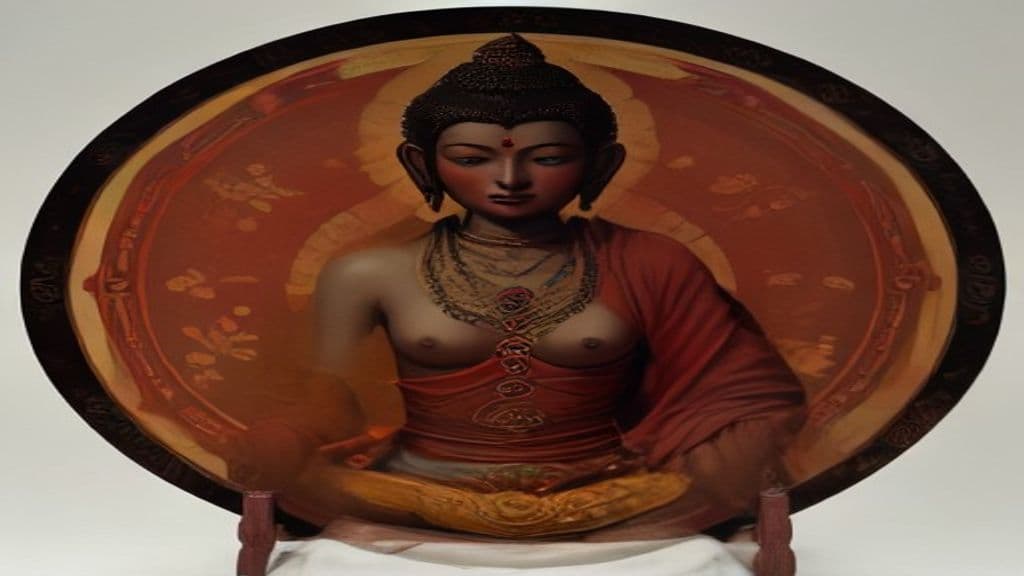
Mahayana textual tradition: Samantabhadra appears in the Avataṃsaka (Flower Adornment) cycle, including the Gandavyūha episode, as a bodhisattva exemplar whose practices and vows are narrated and who is invoked in the sutra literature (see Gandavyūha folios and the Flower Adornment Sutra, Chapter 40 'Practices and Vows of Samantabhadra Bodhisattva'). Tibetan doctrinal usage: in Tibetan Vajrayāna and Dzogchen texts the name Samantabhadra (Tibetan: Kuntu Zangpo) is applied to an Adi‑Buddha or primordial ground principle; this is a doctrinal identification rather than a biographical continuation of the Mahāyāna bodhisattva. Jain tradition: independently, a historical Digambara monk named Samantabhadra lived in the early centuries of the common era and authored Jain works including the Ratnakaranda Gaurav; this is a distinct person who shares the Sanskrit name but occupies a separate sectarian and textual context.
Iconographic and material culture sources show regional variations rather than a single canonical physical description. In East Asian carved and painted representations Samantabhadra is often shown as an adorned bodhisattva, wearing a golden diadem and embroidered robes and sometimes seated upon a richly caparisoned elephant (examples include carved snuff bottles and wood sculptures). Manuscript folios from Gandavyūha cycles depict Samantabhadra in narrative scenes — e.g., 'Samantabhadra purifies the path to enlightenment' and 'Samantabhadra spinning clouds of things' — but the primary sutra texts do not supply a standardized corporeal specification; Tibetan doctrinal treatments that identify Samantabhadra with primordial ground focus on metaphysical status rather than bodily form.
As a Mahāyāna bodhisattva Samantabhadra functions as the patron and exemplar of practice, meditation, vows, and the transfer of merit; Chapter 40 of the Flower Adornment Sutra collects his 'Practices and Vows,' and Gandavyūha narratives and folios depict him performing purificatory and cosmically significant acts (e.g., purifying the path to enlightenment). In Tibetan Vajrayāna/Dzogchen contexts the name denotes an Adi‑Buddha or primordial suchness — a metaphysical ground or source rather than an acting agent described in mundane terms. In Jain tradition the historical Samantabhadra appears as an author and teacher (e.g., Ratnakaranda Gaurav) rather than as a miraculous or adversarial supernatural being. The supplied sources emphasize exemplary, doctrinal, and ritual roles (vows, merit transfer, contemplative invocation) rather than combative or malevolent powers.
Weaknesses
- otherNo traditional weaknesses recorded
Wards
- otherNo traditional warding techniques; Samantabhadra is venerated rather than warded against
Abhinandananātha
Abhinandananātha is the fourth Tīrthaṅkara (ford-maker) of the current Jain cosmic age (avasarpini). Traditional accounts place his birth in Ayodhyā to the Ikshvāku (Solar) dynasty, describe his renunciation and attainment of omniscience beneath a priyangu tree, and record his liberation on Mount Śikharjī.
Acala
Acala (Sanskrit: अचल, 'The Immovable') is a wrathful protective deity (dharmapala) in Vajrayāna and East Asian esoteric Buddhism, classed among the Wisdom Kings (Vidyārāja). He functions as a ritual focus for visualization and mantra practice intended to remove obstacles and bind or destroy hostile forces.
Acalanātha (Acala / Achala)
Acalanātha (also Acala or Achala) is a wrathful deity and dharmapāla — a protector of the Dharma — prominent in Vajrayana and East Asian Mahayana Buddhist contexts. Presented as a fierce, non‑human or semi‑divine protector-figure, Acalanātha functions to defend the teaching and practitioners by removing obstacles and confronting threats to the transmission and practice of Buddhism.
Agni
Agni is the Vedic personification of fire in Hindu tradition: a sacred, mediating principle that manifests as terrestrial fire, atmospheric lightning, and celestial sun, and that receives and conveys sacrificial offerings. Prominent in the Rigvedic corpus, Agni functions as sanctifier, witness of rites of passage, and a transformational inner principle in later Upanishadic literature.
Aizen Myō-ō (Rāgarāja)
Aizen Myō-ō corresponds to the deity Rāgarāja, a wrathful/transformation-oriented figure venerated in Esoteric and Vajrayāna Buddhist traditions. The figure is especially revered in Chinese Esoteric Buddhism in Chinese communities and in the Japanese Esoteric schools Shingon and Tendai.
Ajitanātha
Ajitanātha is the second tirthankara of the current cosmic age in Jainism: an enlightened spiritual teacher who renounced worldly life, attained omniscience (kevalajñāna), and achieved liberation (moksha), and who is credited with establishing a large four-part monastic order in the tradition's hagiography.
Akhu Tönpa
A Tibetan trickster figure, sent by Chenrezig to teach the art of being shrewd and witty, while championing the common man against social hierarchies. (Note: - Power tier should be Lesser or Minor Spirit, not Ancient, as it's more aligned with local spirit level of trickster figures. - The ability to outwit those in positions of power suggests Greater or P)
Akshayavata
In Hindu mythology, Akshayavata is a sacred banyan tree and/or lake that symbolizes eternal life. It is mentioned in both Hindu and Jain traditions and associated with the Puranas. (Note: - The power tier should be "Greater" or at least "Ancient", as it is associated with the Puranas, which are considered ancient texts. - No specific physical description is provided, but that doesn't m)
Akshobhya
Akshobhya is a transcendent buddha of Mahāyāna and Vajrayāna Buddhism, one of the Five Wisdom (Dhyāni) Buddhas. He personifies 'mirror knowledge' (ādarśa-jñāna), is conventionally placed in the East, and is lord of the eastern Pure Land Abhirati; in esoteric texts he is associated with the eastern Vajra division and invoked in mantra/mandala ritual contexts.
Akuma
Akuma (悪魔/あくま) in Japanese sources is an evil spirit, devil, or demon associated with misfortune and mental disturbance. The term appears in Buddhist texts and Heian-period literature and was later used to translate the Christian figure of Satan, as well as the Buddhist Mara.
Amanojaku
Amanojaku (天邪鬼 / あまのじゃく) is a Japanese yōkai-type being portrayed as a contrarian, heart-reading trickster. Treated in different contexts as a small ogre (ko-oni), a wicked demon (jaki) in Buddhist iconography, and a folkloric spirit that provokes human vice, it appears across regional tales with variable roles from malicious kidnapper to household oddity.
Ambika (Jainism)
Ambika is the yakṣiṇī (Śāsana Devī, protector-goddess) and tutelary attendant of the 22nd Tīrthaṅkara Neminatha in Jain tradition. Venerated both as an attendant spirit and an independent goddess (kuladevi) she features in devotional, temple and tantric ritual contexts, and is associated with fertility, prosperity and protection.
Community Record
- [1]Samantabhadra. Wikipedia: Samantabhadra (disambiguation and overview)wiki
- [2]Samantabhadra (Bodhisattva). Wikipedia: Samantabhadra (Bodhisattva) articlewiki
- [3]Wikidata: Samantabhadra. Wikidata entry for Samantabhadrawiki
- [4]Folio 348 from a Gandavyuha-sutra (Scripture of the Supreme Array). Cleveland Museum/Archive folio: 'Bodhisattva Samantabhadra purifies the path to enlightenment'literary
- [5]Leaf from Gandavyuha: Samantabhadra spinning clouds of things (folio 22). Cleveland Museum/Archive folio: 'Samantabhadra spinning clouds of things'literary
- [6]The Flower Adornment Sutra with Commentary, Chapter 40 (new edition). City of Ten Thousand Buddhas: 'Practices and Vows of Samantabhadra Bodhisattva', FAS Chapter 40literary
- [7]The Flower Adornment Sutra with Commentary, Chapter 40 (continuation). City of Ten Thousand Buddhas: FAS Chapter 40 commentarial materialliterary
- [8]The Questions of Samantabhadra. Etymological and interpretive gloss: 'samanta' and 'bhadra' and fuller conceptual glossother
- [9]Examining Samantabhadra by Jakuko Mo Ferrell. Contemporary Dharma talk noting liturgical invocation and chanting practicesother
- [10]Ratnakaranda Gaurav by Samantabhadra (translation/archive). Archive: Jain text attributed to the historical Digambara monk Samantabhadraliterary
- [11]Vision of Samantabhadra - The Dzokchen Anthology of Rindzin Godem. Dzogchen anthology discussing Samantabhadra as primordial ground/Adi‑Buddhaacademic
- [12]E. T. NADA: THE SUNYATAYANA OF SAMANTABHADRA. Essay on Samantabhadra and suchness in Tibetan doctrinal contextsother
- [13]Antique Chinese Carved Samantabhadra Pu Hien on Elephant Snuff Bottle. Museum object description noting diadem, robes, and elephant associationother
- [14]Antique Chinese Carved Samantabhadra Buddha On Elephant. Museum object description of carved Samantabhadra on elephantother
- [15]Samantabhadra (Bodhisattva) - Wikipedia. Wikipedia, 'Samantabhadra (Bodhisattva)'wiki
- [16]Bodhisattva Samantabhadra purifies the path to enlightenment, with Manjushri, folio (Gandavyuha-sutra). Cleveland Museum / Archive folio description (Gandavyūha-sūtra illumination)other
- [17]Caparisoned Elephant (Liao gilt bronze). Cleveland Museum object caption documenting the six-tusked elephant as Samantabhadra's throne/vehicleother
- [18]Dharanis and mantras (Dharanisamgraha citation as in secondary sources). Discussion and citations of Samantabhadra mantras/dhāraṇīs (examples transcribed in secondary sources)other