
Ancient summaries and later reference works present Satyrion as a local nymph 'perhaps from the region of Taranto, Italy' whose union with the god Poseidon produced Taras, the eponymous founder of Taras/Tarentum. The name also appears as the ancient place-name for a locality (Saturo / Satyrion) near Taranto; archaeological notes and references to springs and an oracle at the site connect the toponym with lived cultic and hydraulic features. Sources phrase the geographic origin as tentative ('perhaps') and as an attested ancient toponym rather than giving a detailed primary narrative in the excerpts supplied.
As a mythic nymph: the supplied sources give no corporeal description of Satyrion-as-person; she is identified generically as a nymph and as the mother of Taras by Poseidon without physical detail. As a plant (herbal and materia medica usage): early modern herbals and plates describe 'Satyrion' orchids in morphological terms — large knobbed roots (branched or sectioned), a flowering stalk sometimes brownish, and leaves bright green often spotted with darker marks; one herbal notes plants growing around a foot high with red flowers. These botanical descriptions derive from herbal plates and commentators rather than from any depiction of a humanoid figure.
As a mythic figure, Satyrion's recorded rôle is genealogical/eponymous — she begets Taras with Poseidon; no other supernatural feats or powers are ascribed in the provided materials. As a plant and pharmaceutical label, 'satyrion' (applied to orchids or ragwort in sources) is repeatedly described in literary and early modern medical texts as an aphrodisiac and fertility agent: textual fragments instruct mixing orchid (satyrion) juice with oil to anoint the male organ and report that such preparations 'make the barren women kindle/inflame, with desire/fertility.' These effects are presented as medicinal/folk pharmacology rather than as direct supernatural capacities of the nymph herself.
Weaknesses
- othernone documented in sources
Wards
- othernone documented in sources
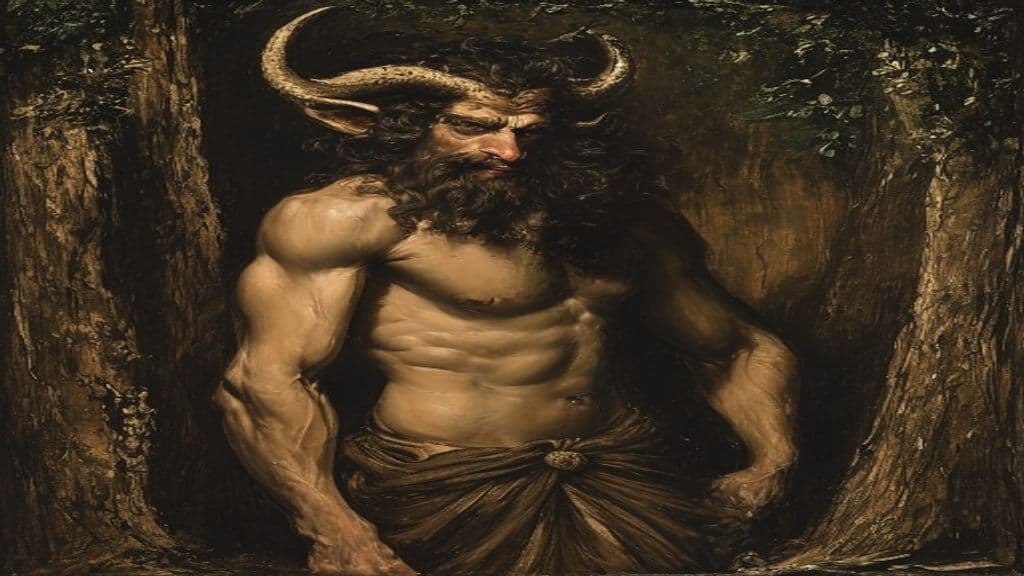
*Perkʷūnos
*Perkʷūnos is the reconstructed Proto-Indo-European thunder‑god hypothesized by comparative linguistics and mythology. Scholarly reconstructions portray him as a storm or thunder figure associated with fructifying rain and as the combatant who fights a multi‑headed water‑serpent to release life‑giving waters; no direct attestations from the Proto‑Indo‑European period survive and the figure is inferred from later Indo‑European traditions.
*Péh₂usōn (reconstructed)
Péh₂usōn is a hypothetical Proto‑Indo‑European pastoral guardian reconstructed by comparative scholars from parallels in Greek and Vedic traditions. Proposed as a Graeco‑Aryan ancestor‑figure, the reconstruction describes a protector of flocks, roads, and travellers rather than an attested historical cultic personality.
57 Mnemosyne
57 Mnemosyne is a large main-belt asteroid (S-type) discovered in 1859 and named after the Greek Titaness Mnemosyne. It is a non-sentient astronomical body studied for its orbital and rotational properties and has been used in dynamical measurements related to Jupiter.
Aamon
Aamon (also Amon) is a named spirit in early modern Western grimoire tradition (Pseudomonarchia Daemonum; the Ars Goetia / Lesser Key of Solomon). He is presented as a high-ranking infernal officer (Marquis/Prince) who governs forty legions and is credited with knowledge of past and future and with affecting human relationships (reconciling or procuring feuds and favor).
Aba (disambiguation / name-form)
Aba is a polyvalent name-form attested across many unrelated contexts (place names, personal names, animal names, and brief mythological listings). The provided sources do not support a single, coherent supernatural entity called "Aba" and offer no descriptive or ritual material for such a being.
Abaddon
In Hebrew scripture Abaddon is primarily a noun meaning 'destruction' or a section/condition of the underworld paired with Sheol; in the New Testament Book of Revelation Abaddon is personified as an angelic figure (Greek Apollyon) described as the king of an army of locusts released from the abyss during the apocalypse.
Aban Yasht
The Aban Yasht is a hymn from the Persian tradition that praises Anahita, a goddess associated with water, fertility, and wisdom. It consists of 132 stanzas and is part of the 21 Yashts collection. (Note: - Power tier should be "Primordial" or possibly "Cosmic", given that it's a hymn of great spiritual significance and associated with a goddess. - The article incorrectly states that Anahita is associa)
Abarbarea
Abarbarea is a name attested in classical Greek and Roman sources for freshwater nymphs (naiads). The name appears for at least two individual mythic figures — a naiad wife of Bucolion and a naiad counted among ancestors of the Tyrians — and Hesychius records plural forms that may indicate the name was also used as a class-name (Abarbareai / Abarbalaiai).
Abas
Abas (Ancient Greek: Ἄβας, gen.: Ἄβαντος) is not a single mythic being but a recurring personal name borne by multiple mortals and minor mythic figures in Greek epic and genealogical traditions — kings, founders, seers, warriors, attendants, a centaur, and a youth transformed by a goddess. The name is glossed in the sources as 'guileless' or 'good-hearted' and appears across Argive, Theban, Trojan, Euboean, and other local cycles.
Abath
No corroborated folkloric entity named "Abath" is documented in the provided sources. The string appears in the supplied material only as a surname/personal name in Aruban/Dutch-Caribbean archival records and as an unrelated taxonomic or encyclopedic hit; no mythic attributes, origin stories, rituals, or apotropaic practices for an entity called Abath are present in the documents reviewed.
Abatur
Abatur is an uthra (celestial emanation) in Mandaeism described as the 'father of the Uthras' and called the Ancient (ʿattīqā). He resides on the boundary between the World of Light and lower regions, functions as a judge who weighs souls (Abatur Muzania), and supplies instructions and materials to the demiurgic uthra Ptahil in accounts from the Diwan (Scroll) of Abatur.
Abatwa (Twa / Batwa)
Abatwa (also recorded as Twa, Batwa, Mutwa; singular forms Barhwa or Murhwa in some transcriptions) are indigenous hunter‑gatherer peoples of the Great Lakes region of Central Africa, historically identified as some of the earliest inhabitants of the area. The available sources treat them as human ethnic groups whose livelihoods, lands, and populations have been severely affected by conservation policies and modern violence.
Community Record
- [1]Satyrion — Wikipedia. Wikipedia article 'Satyrion' (summary of classical identification, place-name, and aphrodisiac use; notes that satyrion appears twice in Petronius's Satyricon).wiki
- [2]Pleiades place: unnamed aqueduct / Satyrion springs (entry). Pleiades place resource noting springs near Satyrion and the phrase aqua nymphalis in classical context (association of water features and nymphs).academic
- [3]Herbal plates — exclassics.com (Male Satyrion Royal description). Herbal descriptive caption: 'The male Satyrion Royal hath large roots, knobbed... branched or cut into sundry sections like an hand.' (herbal plate/notes).other
- [4]Henriette's Herbal — Orchis / Satyrion descriptions. Herbal descriptive lines: 'This Orchis... grows to be a Foot high, the Leaves are a bright Green spotted with Black, and the Flowers, which grow on a brownish Stalk, are a Red...' (early modern herbal description applied to orchids called satyrion).other
- [5]Satisfying Satyrion – Early Modern Medicine (blog / commentary). Discussion of early modern medical references to 'satyrion' as an orchid-based aphrodisiac and its place in materia medica (secondary treatment of sources and recipes).other
- [6]Voynich.ninja thread (translation fragment of satyrion recipe). Secondary-site citation of a translation fragment: 'Anoint the Male Member with the juice of Satyrion, Orchid, mixed with the oil. Smear it, This, Makes the barren women kindle/inflame, with desire/fertility.' (used as attestations of recipe tradition; fragmentary).other
- [7]Partheniae — Wikipedia (archaeological/oracular notes). Referential material noting an oracle and archaeological finds at Satyrion and links to settlement/oracular guidance (used to support place/cult associations).wiki