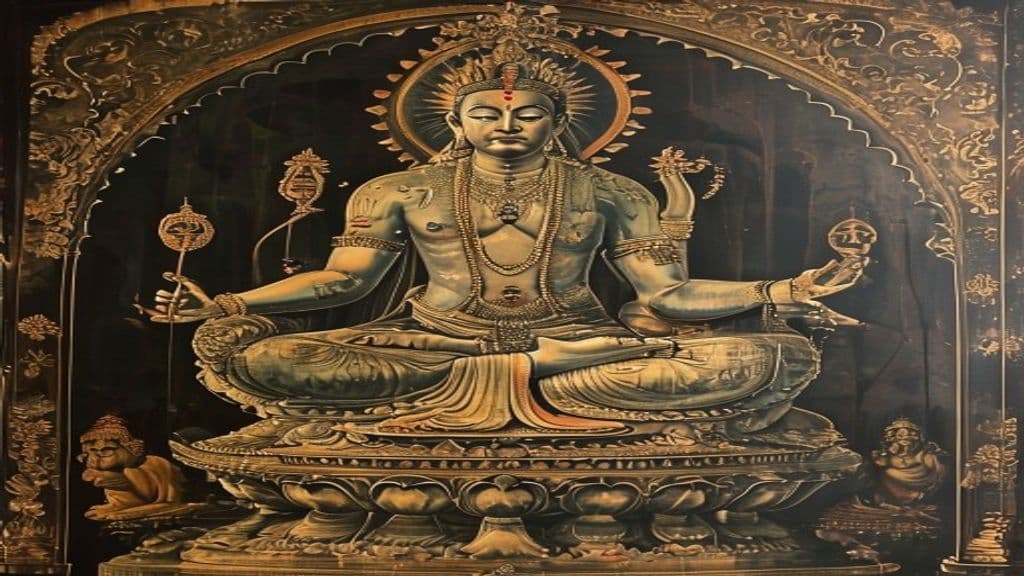
Traditional Jain accounts identify Sumatinātha as the fifth Tīrthaṅkara of the present cosmic age. He was born in the city of Ayodhyā into the Ikshvāku dynasty to King Megha (Meghaprabha) and Queen Mangala (Sumangala). After a period of royal life he renounced the world to become an ascetic; classical-style chronologies note long cosmological intervals between successive Tīrthaṅkaras (one account records his appearance after a large cyclical time-gap following the fourth Tīrthaṅkara, Abhinandana). He attained omniscience beneath a priyangu or sāla tree and finally achieved liberation (nirvāṇa/mokṣa) on the sacred peaks of Mount Śikharjī. As a Tīrthaṅkara he is regarded as a 'ford-maker' who re-establishes the path across saṃsāra for beings seeking liberation.
Sources do not preserve a unique physical portrait of Sumatinātha; he is represented according to standard Jain iconographic conventions for Jinas/Tīrthaṅkaras. In sculpture and temple imagery such figures are commonly shown in kayotsarga (standing ascetic) or seated meditation postures on pedestals that may bear symbolic motifs (for example, museum descriptions note pedestals with carved motifs such as three lions). Museum and temple contexts illustrate the stylized ascetic posture and pedestal treatment that typically mark Tīrthaṅkara images, and Sumatinātha is venerated within that same visual register in Jain art and architecture.
Within Jain soteriology Sumatinātha's primary 'powers' are spiritual and salvific rather than magical: he renounced royal life to undertake ascetic practice, attained kevala jñāna (omniscience), expounded the dharma as a Tīrthaṅkara (a supreme spiritual teacher or 'ford-maker') and thus re-established the path for liberation, and finally achieved mokṣa (final liberation) on Śikharjī. The provided sources do not ascribe other supernatural or hostile behaviors to him; his role is exemplary and redemptive within the Jain cosmological sequence of teachers.
Abhinandananātha
Abhinandananātha is the fourth Tīrthaṅkara (ford-maker) of the current Jain cosmic age (avasarpini). Traditional accounts place his birth in Ayodhyā to the Ikshvāku (Solar) dynasty, describe his renunciation and attainment of omniscience beneath a priyangu tree, and record his liberation on Mount Śikharjī.
Agni
Agni is the Vedic personification of fire in Hindu tradition: a sacred, mediating principle that manifests as terrestrial fire, atmospheric lightning, and celestial sun, and that receives and conveys sacrificial offerings. Prominent in the Rigvedic corpus, Agni functions as sanctifier, witness of rites of passage, and a transformational inner principle in later Upanishadic literature.
Ajitanātha
Ajitanātha is the second tirthankara of the current cosmic age in Jainism: an enlightened spiritual teacher who renounced worldly life, attained omniscience (kevalajñāna), and achieved liberation (moksha), and who is credited with establishing a large four-part monastic order in the tradition's hagiography.
Akshayavata
In Hindu mythology, Akshayavata is a sacred banyan tree and/or lake that symbolizes eternal life. It is mentioned in both Hindu and Jain traditions and associated with the Puranas. (Note: - The power tier should be "Greater" or at least "Ancient", as it is associated with the Puranas, which are considered ancient texts. - No specific physical description is provided, but that doesn't m)
Ambika (Jainism)
Ambika is the yakṣiṇī (Śāsana Devī, protector-goddess) and tutelary attendant of the 22nd Tīrthaṅkara Neminatha in Jain tradition. Venerated both as an attendant spirit and an independent goddess (kuladevi) she features in devotional, temple and tantric ritual contexts, and is associated with fertility, prosperity and protection.
Anantanātha
Anantanātha is the fourteenth Tīrthaṅkara of the present age (Avasarpini) in Jain tradition, a perfected spiritual teacher who became a siddha (liberated soul) after destroying all karma and whose role is to reveal the dharma and provide a ford (tīrtha) across saṃsāra.
Aranātha
Aranātha is the eighteenth Tīrthaṅkara (ford‑maker) in the Jain tradition of the present half‑cycle (Avasarpini). In the provided sources he is presented as a spiritual exemplar born in the Ikshvaku dynasty at Hastinapur who attains siddhahood (liberation) after completing his life.
Arihant
In Jain doctrine an arihant is a soul (jiva) that has conquered inner passions and destroyed the four inimical (ghātiyā) karmas, thereby attaining kevala jñāna (omniscience) while still embodied; on final shedding of remaining karma an arihant attains siddhahood (moksha).
Bahubali
Bahubali is a prominent figure in Jain hagiography: a royal scion who renounces worldly rule, undertakes prolonged standing ascetic meditation (kayotsarga), attains omniscience (kevala jnana) and ultimately liberation (moksha) to become a siddha. He is widely commemorated in Jain art and by monumental monolithic statues (notably the Gommateshwara at Shravanabelagola).
Balarāma
Balarāma (Sanskrit: बलराम) is a major deity in the Indian religious tradition closely associated with the Krishna cycle and the Vrishni hero-cult. He is described as Krishna's elder brother, an agricultural patron identified with the plough (halā) and club (gaḍā), and is later associated with the cosmic serpent Śeṣa/Saṅkarṣaṇa and incorporated into Viṣṇu avatāra lists; his cult is attested in early coinage and sculpture from c. 2nd century BCE onward and in living traditions such as the Jagannātha triad and village devotional practice.
Chaitra
Chaitra (Sanskrit: चैत्र, Caitra) is the name of the first month of the Hindu lunar calendar and the Indian national calendar; it functions as a calendrical period that structures seasonal cognition (spring/Vasanta), new-year reckonings, and a cluster of religious festivals and commemorations across South Asian traditions.
Chakreshvari
Chakreshvari (also Chakreshwari or Apraticakra) is an attendant goddess (yakshini) in Jain cosmology who serves as the guardian or tutelary deity of the first Tirthankara, Rishabhanatha. She is an object of popular devotion in Jain communities and is counted among the three yakshinis—alongside Ambika and Padmāvatī—that attract the most devotional worship.
Community Record
- [1]Sumatinatha - Wikipedia. Wikipedia contributors. "Sumatinatha." Wikipedia, The Free Encyclopedia.wiki
- [2]Sumatinātha - Wikidata. Wikidata entry Q2724631: Sumatinātha.wiki
- [3]Jain sculpture gallery — Government Museum Chennai. Government Museum, Chennai. Jain gallery description (illustrative of Jina iconography).other
- [4]Sumatinatha - Indianetzone. Indianetzone. "Sumatinatha."other
- [5]Jain Legend : Lord Śrī Sumatinātha — HereNow4U. HereNow4U. "Jain Legend : Lord Śrī Sumatinātha."folk
- [6]Tirthankar (definition) — Jain Society of Tampa Bay. Jain Society of Tampa Bay. "Tirthankar."other
- [7]Bhandasar Jain Temple - Wikipedia. Wikipedia contributors. "Bhandasar Jain Temple." (temple context for Tīrthaṅkara imagery.)wiki