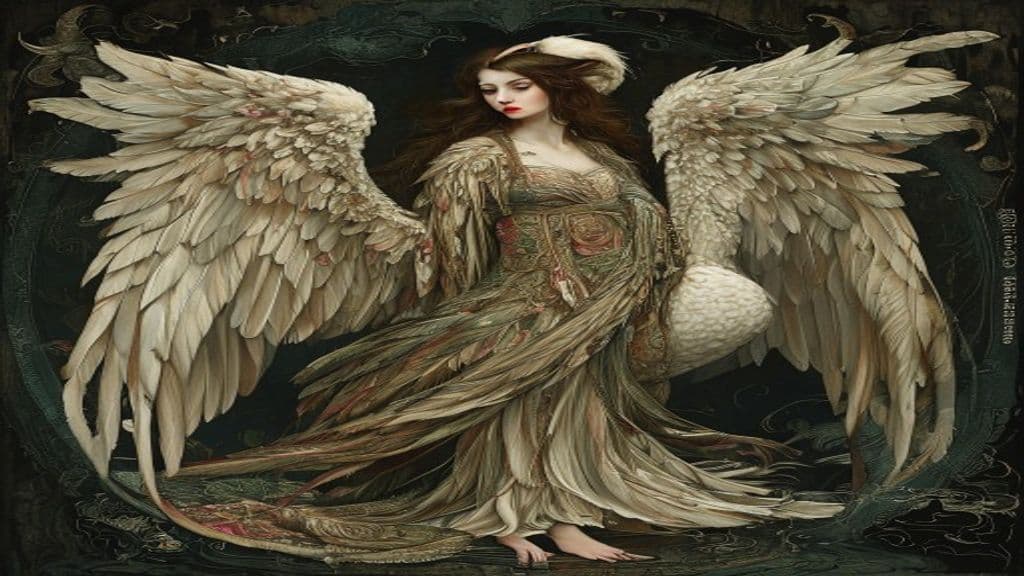
Rather than a single origin, the motif is attested in multiple early textual and oral traditions. Early Chinese collections (e.g., Sou shen ji; Guo Pu's Xuan zhong ji) contain bird‑garment transformation tales, medieval Japanese fudoki preserve hagoromo stories of heavenly women, and Germanic and Celtic materials link analogous feather‑cloak motifs with valkyries and swan‑form goddesses. Folklorists treat the 'swan maiden' as a recurrent narrative type (ATU 400) with wide geographic distribution rather than a unitary mythic origin.
When the feathered garment (feather cloak, swan‑shirt, hagoromo) is removed or hidden the figure appears as a young woman; when wearing it she appears as a bird — commonly a swan, goose, or crane, with regional variants including duck, heron, dove and, more rarely, other birds. Tales often depict several maidens bathing together at a body of water; the captured figure is frequently the youngest. In some traditions (e.g., Celtic material) divine or otherworldly marks such as a metallic chain may persist in avian form.
Narrative‑level abilities hinge on the feathered garment: wearing the cloak restores avian form and allows flight or other avian mobility (swimming, swimming/flight depending on tale). The motif typically enables movement between human and otherworldly domains (for example, heavenly tennyo returning to heaven). Story behaviors include bathing in groups, being compelled into marriage when a human seizes or hides the garment, and later leaving upon recovery of the garment; in Germanic materials the motif overlaps with valkyrie functions in warrior and fate narratives.
Weaknesses
- conditionloss or concealment of feathered garment
Wards
- otherwithholding or seizing the feathered cloak (narrative device)
5 Ronin
5 Ronin is a 2011 Marvel Comics five-issue limited series that reimagines five Marvel superhero archetypes as rōnin (masterless samurai) in a fictionalized post‑Sekigahara feudal Japan. The work places Wolverine, Hulk, Punisher, Psylocke, and Deadpool analogues into period roles to explore displacement, revenge, and identity in an era of political upheaval.
Abraun
Abraun is an attested name in German-language plant-legend scholarship (Der abraun, ein beitrag zur pflanzensagenkunde, 1916) and a short database entry (Wikidata) labels it as a spirit from German mythology. Surviving accessible documentation is extremely limited: the principal academic treatment is a 1916 contribution to pflanzensagenkunde (plant-saga studies), but the excerpts available here contain only bibliographic metadata and do not record tales, descriptions, or rituals.
Abumi-guchi
A Japanese yōkai classed as a tsukumogami: an animated stirrup (abumi) depicted in Sekien Toriyama's Gazu Hyakki Tsurezure Bukuro. Traditional accounts say it is formed from a stirrup that belonged to a soldier who fell in battle and that it waits where the stirrup lies for its dead owner to return.
Abura-akago
An Edo-period yōkai depicted as an oil‑licking infant or a ball of flame. First recorded in illustrated compendia (notably Toriyama Sekien's Konjaku Gazu Zoku Hyakki), the Abura-akago is tied to tales of oil‑stealing fires and functions in part as an etiological warning about wasting or stealing oil.
Abura-sumashi
A yōkai spirit from the Amakusa region of Kumamoto Prefecture, Japan, said to inhabit mountain passes. Traditionally explained as the ghost of a person who stole oil, it appears to surprise travelers and is represented in modern media with a straw-coat body and a potato- or stone-like head.
Aburabō / Abura-bōzu / Aosaginohi (traditions)
Two distinct Japanese traditions appear under related flame imagery: Aosaginohi/Aosagibi is presented as a will-o'-the-wisp type luminous night phenomenon interpreted as reflections from herons; aburabōzu (abura bōzu, "oil monk") appears in a separate anecdote as a reported fire-breathing apparition in a 12th-century Yasaka Shrine tale. The sources treat them as separate portrayals rather than a single unified being.
Acala
Acala (Sanskrit: अचल, 'The Immovable') is a wrathful protective deity (dharmapala) in Vajrayāna and East Asian esoteric Buddhism, classed among the Wisdom Kings (Vidyārāja). He functions as a ritual focus for visualization and mantra practice intended to remove obstacles and bind or destroy hostile forces.
Adils
Adils (Old Norse Aðils; also Eadgils, Adillus, Athisl, Adhel) is a semi‑legendary sixth‑century Swedish king attested in Old Norse saga material and later medieval traditions. He appears in saga episodes as a storied royal figure involved in warfare, court acts, and marriage suits rather than as a supernatural being.
Agaru
Agaru (attested historically as Agarum) appears in the supplied sources as a Bronze Age Near Eastern toponym—often identified with Failaka Island—and as a modern personal or media name. The provided material contains no evidence that Agaru is a supernatural being in any traditional cosmology.
Agilaz (Egil)
Agilaz (reconstructed Proto-Germanic) — commonly recorded in medieval sources as Egil or Ægil — is a legendary archer attested in Germanic heroic tradition. He appears as the brother of Völund (Wayland/Weland) in the Old Norse poem Völundarkviða and in the Thidreks saga, and his name is also inscribed on early medieval objects (Franks Casket, Pforzen buckle). The attested material presents him as a named heroic human archer within saga and inscriptional contexts rather than as a recurrent supernatural species.
Ajisukitakahikone
Ajisukitakahikone is a kami in Japanese mythic literature (Kojiki/Nihon Shoki). He appears in the transfer-of-rule cycle between heaven and earth, is described as a son of Ōkuninushi, associated with the Kamo cult (called Kamo no ōmikami in some modern museum/catalog entries), and features in narratives that explain landscape formation and meteorological genealogy.
Aka Manto
Aka Manto (赤マント, "Red Cloak") is a Japanese urban legend and schoolyard ghost-story about a masked, cloaked figure who appears in public or school toilet stalls and forces occupants to choose between colored toilet paper; each choice in the tale produces a violent supernatural consequence. The legend is part of modern popular folklore recorded in school contexts from the 1930s onward rather than a formal religious myth.
Community Record
- [1]Swan maiden. Wikipedia: 'Swan maiden' (summary of ATU 400 motif, hagoromo, swan‑shirt, global scope).wiki
- [2]Wikidata: swan maiden. Wikidata entry referencing the swan maiden motif and linked identifiers.other
- [3]Maerchenlexikon: Swan‑maiden tales (ATU 400 examples). Folktale index material and exemplars of the swan maiden/ATU 400 cycle (German-language tale corpus).folk
- [4]Ōmi fudoki / hagoromo reference (Japanese tennyo). Summary noting Ōmi fudoki hagoromo tale and tennyo feather garment motif (as cited in the Wikipedia article).wiki
- [5]Sou shen ji; Guo Pu's Xuan zhong ji (Chinese attestations referenced). Wikipedia summary referencing early Chinese attestation in Sou shen ji and Guo Pu's Xuan zhong ji as part of the motif's antiquity.wiki
- [6]Discussion of Germanic valkyrie association. Wikipedia summary noting linkage between the swan‑garment motif and multiple valkyries/swan‑shirt in Germanic materials.wiki