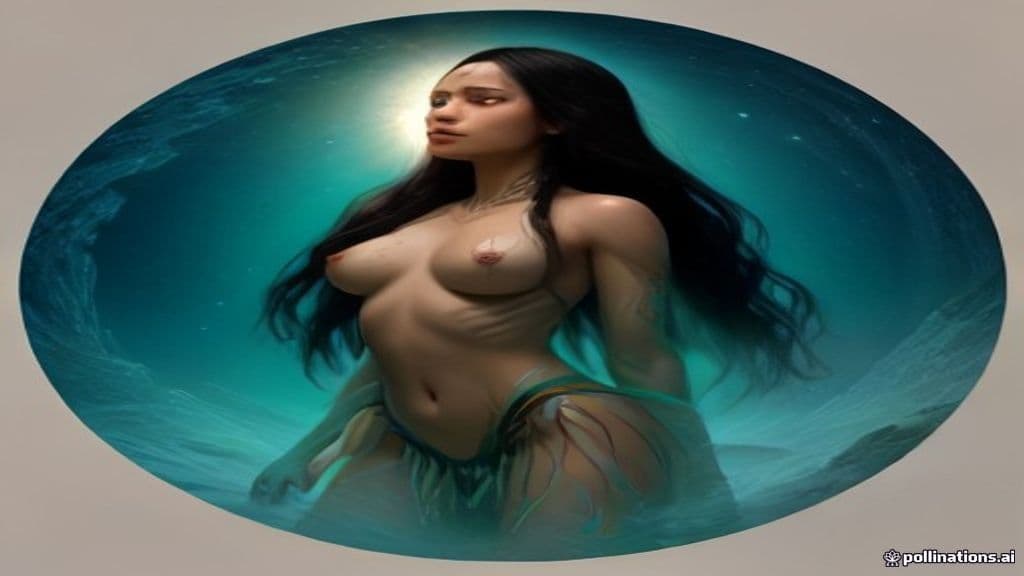
In Society Islands accounts Taʻaroa pre-exists creation, alone in a shell or egg suspended in the empty void. He breaks the shell and uses its fragments and his own body to form the foundations of the world (rocks, sand, mountains, seas, vegetation) and brings forth other gods (for example Tane, Ru, Hina, Maui and numerous others). Some summaries explicitly state that he is 'creator of all, including himself.' Local histories record priestly reshaping of his role (for instance on Raiatea where priests elevated Taaroa from a sea god role to a world-creator), indicating variation in emphasis across islands.
Mythic accounts emphasize a cosmogenic image rather than a fixed cultic anthropomorphism: Taʻaroa initially appears as a solitary being within a shell or egg spinning in the void. In creation narratives natural features are identified as derived from his body—mountains from his backbone, oceans from his tears, fish scales from his nails, trees from his feathers, and rainbow colors from his blood—presented as poetic cosmogenic correspondences rather than a single standardized visual icon.
Taʻaroa's principal power is creative: he breaks his shell and fashions the material world, brings forth living beings and other deities, and institutes the ordering of the cosmos. After creation he delegates specific functions to other gods (for example Tane arranging the sky and setting the sun and moon) but remains described as master of all. Some variant stories record specific nurturing episodes (e.g., a tradition in which Taaroa nurtures a boy within a gourd), presented in the sources as particular narrative variants rather than a generalized recurring behavior.
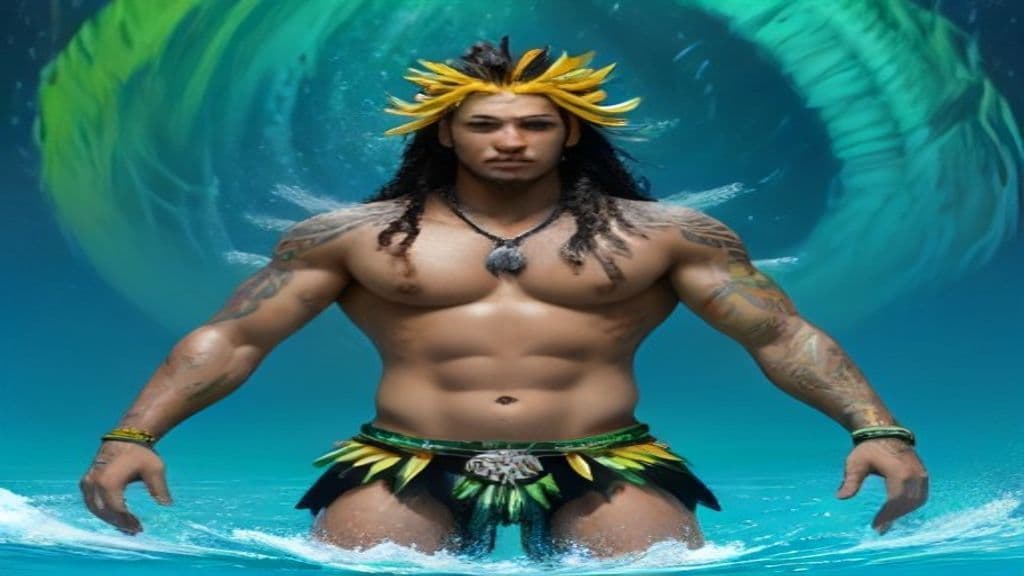
Tangaroa
Tangaroa is a principal Polynesian atua of oceanic realms — in Māori tradition he is the great atua of the sea, lakes, rivers, and creatures within them, especially fish. Cognate figures (Tagaloa, Tangaloa, Taʻaroa, Kanaloa) appear across Polynesia with varying rank and functions from departmental sea-god to supreme creator in regional traditions.

Tagaloa
In Samoan myth Tagaloa (also Tagaloa-Lagi or Tagaloa Lagi) is presented as the supreme ruler and creator who dwells in the heavens and is credited in various traditions with making the heavens, sky, land, seas, fresh water, trees, and people. Tagaloa functions as progenitor of other gods and figures in origin narratives that link divine actions to island formation and human genealogy.
Aitu (Māori)
Malevolent spirits in Māori tradition, often taking the form of plants or animals and associated with trouble-making and mischief. (Note: - Power tier should be Greater, not Lesser (Aitu being lesser gods in some cultures, but also associated with deity-level abilities) - Abilities: Add detail about their role as patrons of specific vil)
Aiwohikupua
Aiwohikupua is a personal name attested once in the supplied corpus of collected Hawaiian-language narrative material. The available sources provide only a short fragmentary occurrence of the name and no corroborating description, role, or attributes.
Akava'ine
Akava'ine is a Cook Islands Māori social and gender category for people assigned male at birth who live or present as women or otherwise occupy a gender-variant/transgender role. The term (Cook Islands Māori) literally means "to behave as a woman" and has both historical ethnographic mentions of gender-variant individuals in the Cook Islands and a contemporary use (since the 2000s) among Cook Islands Māori, including diaspora communities.
Akua
Akua is the Hawaiian common noun for a god, deity, or divine being; in the provided sources it functions as a lexical category applied to indigenous Hawaiian deities and as the translation-term for the Christian God in Hawaiian-language liturgy and scripture.
Ascalapha odorata (Hawaiian)
A nocturnal moth associated with death or misfortune in Hawaiian tradition, possibly tied to Central and South American folklore. (Note: - Summary should note that Ascalapha odorata's association with death/misfortune is found in Central and South American folklore, not explicitly mentioned in Hawaiian tradition. - Power tier: Primordi)
Atanua
Atanua is the Marquesan (Polynesian) goddess of the dawn who, in local cosmogony, is the consort of Atea and mother of the first man; she is also credited in the surviving summary accounts with creating the seas as the result of a miscarriage.
Atea
Atea is a primordial creator-associated being in multiple Polynesian traditions (Marquesas, Tuamotu, and Māori) closely associated with light and the ordering of the cosmos. Variants depict Atea as a self-originating giver of light, a progenitor who fathers gods and humans, or as the cosmic universe that is sex-differentiated into Heaven and Earth in one reported account.
Atua (Māori Deity)
In Māori mythology, Atua are supernatural beings believed to have created the world and all living things. They are considered rulers of the spiritual realm with powers over nature, fertility, and human destiny. (Note: 1. Power tier: Based on the abilities described (controlling nature, fertility, and human destiny), Atua likely belong to the Primordial power tier, not Greater. 2. Weaknesses: Add a specific weakness)
Avatea
Avatea (also spelled Vatea in some sources) is a primordial parent figure in Mangaian (Cook Islands) mythology, described as a lunar deity and god of light whose eyes were thought to be the Sun and the Moon, and who is called the father of gods and men in the island's origin narrative.
Binabinaaine
Binabinaaine (also spelled pinapinaaine) is a culturally specific third-gender role from the Gilbert Islands (now Kiribati) that has been loaned into Tuvaluan usage; it denotes people assigned male at birth who adopt feminine gender expressions, social responsibilities, and roles and are regarded locally as neither men nor women but a distinct social category.
Dakuwaqa
Dakuwaqa is a Fijian shark deity and powerful sea-being who functions in tradition as both a fierce sea monster and a guardian of islands and fishermen. In recorded myths he can threaten islands in specific narratives but also becomes protector of places and is placated by offerings such as kava libations.
Earth deity
An earth deity is the personification or deification of the Earth in a culture's cosmology, often tied to fertility, the ground/land, chthonic or underworld aspects, and communal protection of territory or Dharma. Specific named examples include Papa (Polynesian/Maori), Geb (ancient Egyptian), and Prithivi (in Buddhist textual contexts).
Community Record
- [1]Taʼaroa (Wikipedia). Wikipedia: Taʼaroawiki
- [2]Oceanic Mythology: Part I. Polynesia (Internet Sacred Text Archive). Internet Sacred Text Archive, Oceanic Mythology: Polynesia — chapter summaries on Taaroaother
- [3]Surfresearch: Adams Letters (Raiatea priestly context excerpt). Surfresearch: Adams Letters (excerpt on Raiatea priests elevating Taaroa)other
- [4]Hua Ka Nalu Hawaiian Surf Literature (excerpt referencing mythic motifs). Hua Ka Nalu — excerpt referencing Taaroa mythic imageryother
- [5]LIVING GOD PANDEISM: EVIDENTIAL SUPPORT by William C. Lane (comparative interpretation). William C. Lane, Living God/Comparative remarks referencing Taaroa as primordial creatorother