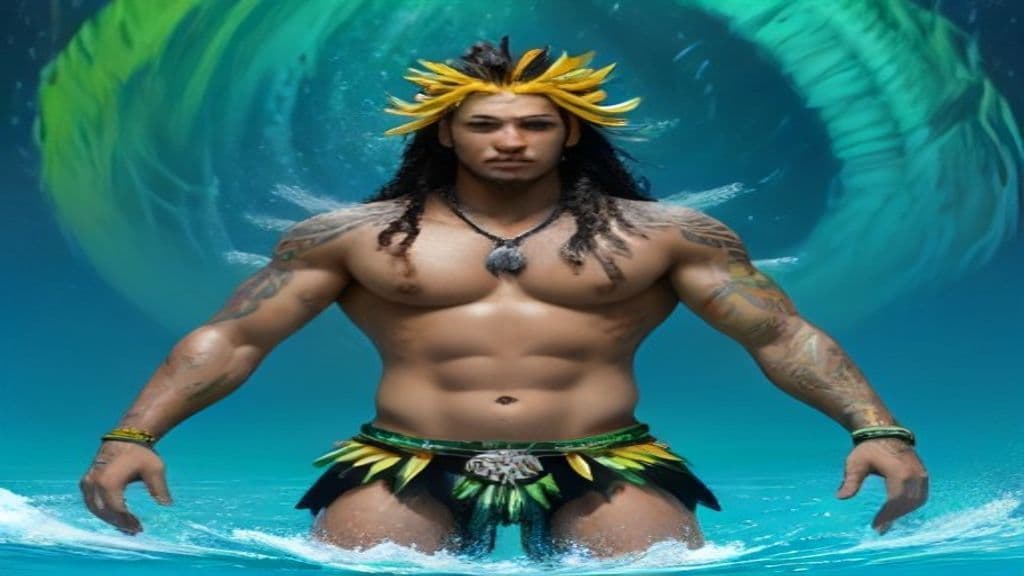
In Māori cosmology Tangaroa is one of the children of the primal parents Ranginui (Sky) and Papatūānuku (Earth) and participated in the generation that separated them. That genealogy identifies him as an ancestral progenitor of marine life; his descendants include figures such as Punga and through Punga the ancestors of fish (Ikatere) and reptiles (Tū-te-wehiwehi / Tū-te-wanawana). Regional variants alter his place in origin narratives: in some Western Polynesian traditions cognates like Tagaloa can be a supreme creator, while in Manihiki Tangaroa is invoked in myths about the origin of fire. Local genealogical arrangements and ranks therefore vary by island.
Descriptions vary by island. In some Māori accounts Tangaroa is represented in whale form. Mangaia tradition records him with yellow hair. In Rennell and Bellona a localized Tangagoa was said to appear as a sparkling flame in the night sky on a coastal cliff and to fly with a flame when taking spirits. There is no single standardized anthropomorphic portrait across the traditions summarized here.
Tangaroa is a domain-holder of the sea and inland waters and is regarded as the progenitor and guardian of marine creatures, especially fish. Under the epithet Tangaroa-whakamau-tai he is associated with control over tides. Mythically he is attacked by Tāwhirimātea after the separation of the parents and driven into the sea, and he is in tension with Tāne over the refuge given to his runaway children — motifs that explain relations between sea and land. In specific island narratives he may hold additional roles: Manihiki myths relate Tangaroa to the origin of fire and Māui's obtaining of fire; Rennell/Bellona material records a psychopomp-like sparkle seen at deaths. Abilities and emphasis vary regionally rather than forming a single uniform power-set.
Weaknesses
None recorded.
Wards
- ritualOffering to Tangaroa before sea expeditions
Abaia
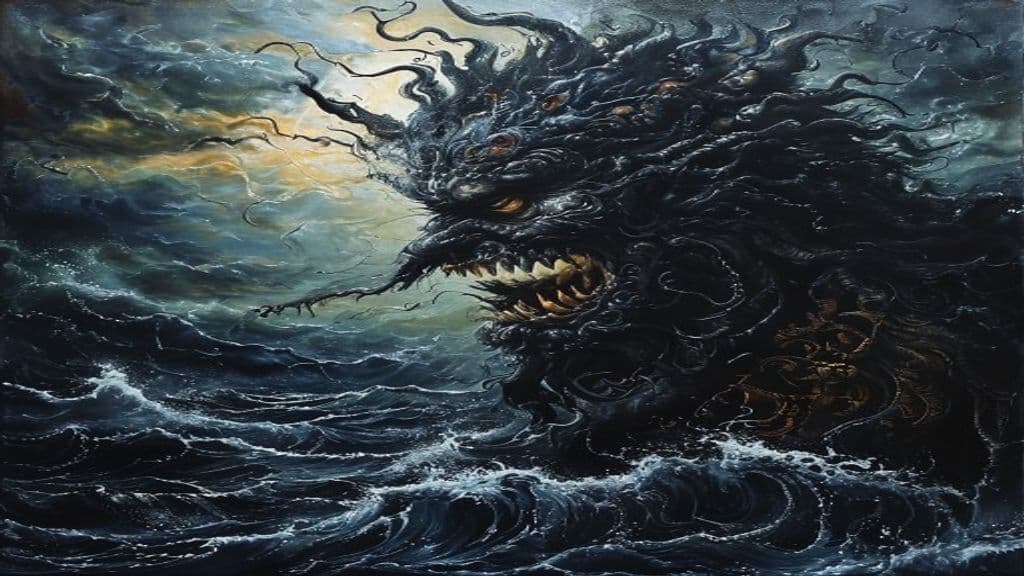
Abaia is a singular, enormous freshwater eel spirit from Melanesian tradition (notably Fiji, the Solomon Islands, and Vanuatu) that dwells in lake depths and protects all aquatic life; when humans harm lake creatures it responds by creating waves, storms, or floods that drown transgressors.
Agunua
Agunua is the chief cosmic-serpent deity of San Cristobal (Makira) in the Solomon Islands, worshiped as a creator and nourisher and associated with the sea. In some accounts the name Hatuibwari is treated as an alternate form emphasizing a dragon-like composite appearance.
Aitu (Māori)
Malevolent spirits in Māori tradition, often taking the form of plants or animals and associated with trouble-making and mischief. (Note: - Power tier should be Greater, not Lesser (Aitu being lesser gods in some cultures, but also associated with deity-level abilities) - Abilities: Add detail about their role as patrons of specific vil)
Aiwohikupua
Aiwohikupua is a personal name attested once in the supplied corpus of collected Hawaiian-language narrative material. The available sources provide only a short fragmentary occurrence of the name and no corroborating description, role, or attributes.
Akava'ine
Akava'ine is a Cook Islands Māori social and gender category for people assigned male at birth who live or present as women or otherwise occupy a gender-variant/transgender role. The term (Cook Islands Māori) literally means "to behave as a woman" and has both historical ethnographic mentions of gender-variant individuals in the Cook Islands and a contemporary use (since the 2000s) among Cook Islands Māori, including diaspora communities.
Akua
Akua is the Hawaiian common noun for a god, deity, or divine being; in the provided sources it functions as a lexical category applied to indigenous Hawaiian deities and as the translation-term for the Christian God in Hawaiian-language liturgy and scripture.
Aotea (Canoe)
Ancestral waka in Māori tradition, significant in the migration of the Māori people to New Zealand. (Note: - Power tier should be at least Greater (deity-level), considering Aotea is associated with significant spiritual and cultural importance to the Māori people's migration. - Abilities should include de)
Aotearoa (Canoe)
An ancestral vessel in Māori tradition, associated with the migration and settlement of New Zealand. (Note: 1. Power tier should be Ancient, not Primordial. 2. Remove "Historical significance" from sensory cues as it is a general statement rather than a specific cue. 3. Add "Its presence is often associated)
Apakura
Female figure in Māori mythology, wife of Tūhuruhuru and/or Tūwhakararo, associated with multiple generations of whānau. (Note: 1. Power tier: Given her association with multiple generations of whānau and the miraculous birth story involving Whakatau, it's likely she should be classified as a Greater entity. 2. Abilities: Add )
Arahura (Māori canoe)
Divine Māori canoe made of pounamu, associated with the Ngāi Tahu tribe and spiritual significance. (Note: * Power tier: Not specified, assume Lower or Lesser as it's associated with the tribe and not described as a deity-level being * Abilities: Remove the mention of spiritual significance and connection )
Arautauta
The Arautauta is a significant waka (canoe) in Māori tradition, playing a key role in the migration of people to New Zealand. (Note: - Power tier: Should be Primordial (as it's a significant waka in Māori tradition) - Abilities: Should mention its use for transporting people and goods as a notable aspect of its significance - Appea)
Arawa (canoe)
In Māori tradition, the Arawa is a supernatural canoe representing the ancestors' journey to New Zealand. (Note: * Power tier: Primordial (or not specified at all, as there's no indication of supernatural powers beyond its symbolic and cultural significance) * Appearance: No physical description mentioned in sou)
Community Record
- [1]Tangaroa - Wikipedia (summary source). Wikipedia contributors, 'Tangaroa', Wikipedia, The Free Encyclopedia.wiki