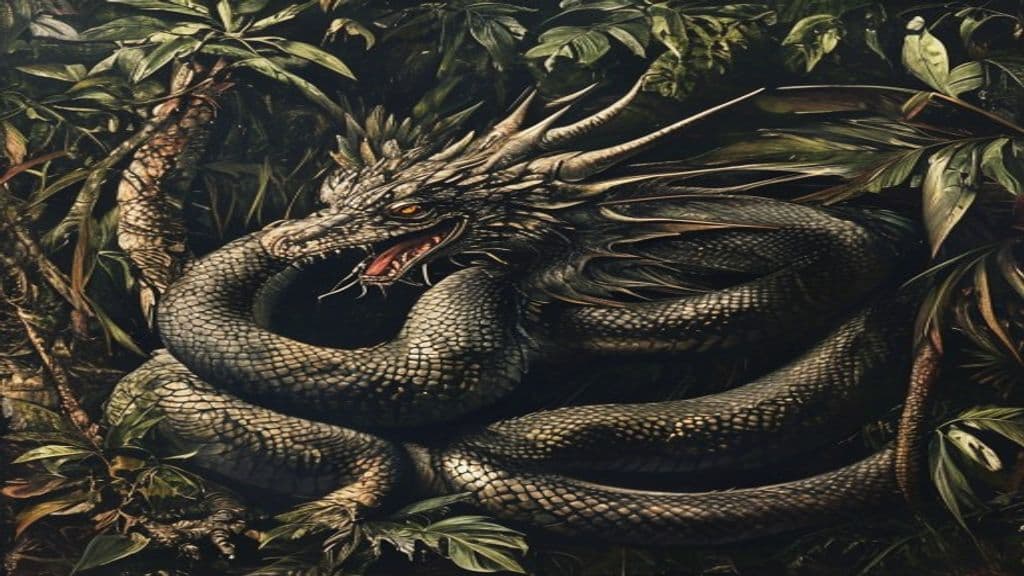
Sources present Agunua as the principal or ruler god of the people of San Cristobal (now Makira). He is described in the available accounts as the creator and nourisher of living things and as occupying the top position in the island pantheon, with other gods regarded as aspects of him. The tradition ties religious obligation to everyday economy: for example, one cited prescription states that the first coconut from each tree is sacred to Agunua, indicating a first-fruit dedication to the deity and a practical link between subsistence activities and the sacred.
Across the cited materials Agunua is consistently identified as a cosmic serpent or serpent-bodied ruler. In some sources the alternate name Hatuibwari is used for a more elaborate description: a dragon-like being with a human head, four eyes, clawed arms, bat-like wings, and a serpent body. Other sources emphasize simply the cosmic-serpent aspect; the more composite, anthropo-ophidian, multi-limbed description appears in those accounts that name Hatuibwari specifically.
The sources describe Agunua primarily in generative and sovereign terms: as creator and nourisher of all living things and as the island's chief god, of whom the other deities are aspects. He is also explicitly associated with the sea and is worshiped by petition for practical needs—notably general good health and rich harvests. The supplied materials do not record hostile or capricious behavior or other specific supernatural powers beyond those life-giving and sea-related roles.
Abaia
Abaia is a singular, enormous freshwater eel spirit from Melanesian tradition (notably Fiji, the Solomon Islands, and Vanuatu) that dwells in lake depths and protects all aquatic life; when humans harm lake creatures it responds by creating waves, storms, or floods that drown transgressors.
Baloma
In Trobriand Islanders' belief as reported by Bronisław Malinowski, baloma are the spirits of deceased lineage members who act to produce new members of a matrilineal line; they are credited with impregnating women (often described as occurring while bathing in the sea) and thereby sustaining matrilineal descent.
Fakafifine
Fakafifine is a Niuean, culturally specific gender category referring to people assigned male at birth who adopt a feminine gender expression and who are understood within Niuean culture as occupying a third gender role. The term is used in contemporary social, cultural, and activist contexts in Niue and Niuean diaspora communities.
Tangaroa
Tangaroa is a principal Polynesian atua of oceanic realms — in Māori tradition he is the great atua of the sea, lakes, rivers, and creatures within them, especially fish. Cognate figures (Tagaloa, Tangaloa, Taʻaroa, Kanaloa) appear across Polynesia with varying rank and functions from departmental sea-god to supreme creator in regional traditions.
Aguano
Aguano is an ethnonym for an indigenous people of Peru (also recorded as Awano, Ahuano, Hilaca, Uguano, Aguanu, Santacrucino, Tibilo). Sources identify them as inhabitants of riverine areas of the Huallaga, Samiria and Marañón and note demographic collapse after European contact; the provided materials do not document Aguano as a supernatural being.
Aguara
Aguara is a mythological fox figure in Ava Guaraní and Chané oral traditions who functions primarily as a trickster and cultural agent; traditions describe him as both malignant and a cultural hero and associate him with the constellation Scorpius.
Aguingay
Aguingay (also Agingay) is a legendary woman from the Bulusan epic of Sorsogon, Philippines. Presented as a mortal of exceptional beauty and tragic fate, her life and death are etiologically linked to local landscape features (Mt. Bulusan and two lakes) and commemorated in an annual festival.
Agum II (Agum‑Kakrime)
Agum II (called Agum‑Kakrime in the inscriptionary tradition) is a Kassite-era Babylonian king known from the Agum‑Kakrime Inscription and later copies. He appears in Akkadian inscriptional and king-list traditions as a royal restorer who recovered and reinstalled the cult statue of Marduk and refurbished the É-sagila, presenting himself as a legitimate shepherd‑king and temple benefactor.
Agur ben Jakeh
Agur ben Jakeh is presented in the Hebrew Bible (Proverbs 30) as a sage and compiler or speaker of a distinct collection of sayings. The figure functions in textual tradition as a named human sage, a possible pedagogical persona, and—in some readings—an oracular voice; there is no evidence in the supplied sources that Agur is a supernatural being.
Agwé
Agwé is a high-ranking lwa in Haitian Vodou associated with the sea, navigation, fishing, and certain funerary conveyances. He is portrayed as a naval officer who lives in a palace beneath the sea, commands attendant spirits, and is propitiated with maritime offerings and ceremonies.
Ah Muzen Cab
Ah Muzen Cab is a Yucatán Maya divine figure associated with bees and honey, attested in summary sources as protector of Melipona bees and as a participant in Chilam Balam creation and ritual chapters. He is also linked in secondary accounts to the upside-down 'Descending' or 'Diving God' image found in Maya iconography at sites such as Tulum.
Ahab
Ahab (Hebrew: אַחְאָב, ʾAḥʾāḇ) is principally the historical/biblical seventh king of the northern Kingdom of Israel, son and successor of Omri, remembered in Hebrew scripture and later rabbinic literature for political activity, promotion of Baal worship, and confrontation with prophets. The name is also reused in later literature (notably Herman Melville's Captain Ahab), but the supplied sources treat these as distinct human figures rather than supernatural beings.
Community Record
- [1]Agunua - Wikipedia. Wikipedia entry 'Agunua'.wiki
- [2]Hatuibwari - Wikipedia. Wikipedia entry 'Hatuibwari'.wiki
- [3]Agunua : The Cosmic Serpent - Mythlok. Mythlok 'Agunua : The Cosmic Serpent'.other
- [4]AGUNUA - the Melanesian Ruler God (Melanesian mythology). Godchecker entry 'AGUNUA'.other
- [5]Melanesian Mythology Of Solomon Islands - Bugbog. Bugbog 'Melanesian Mythology Of Solomon Islands'.other