
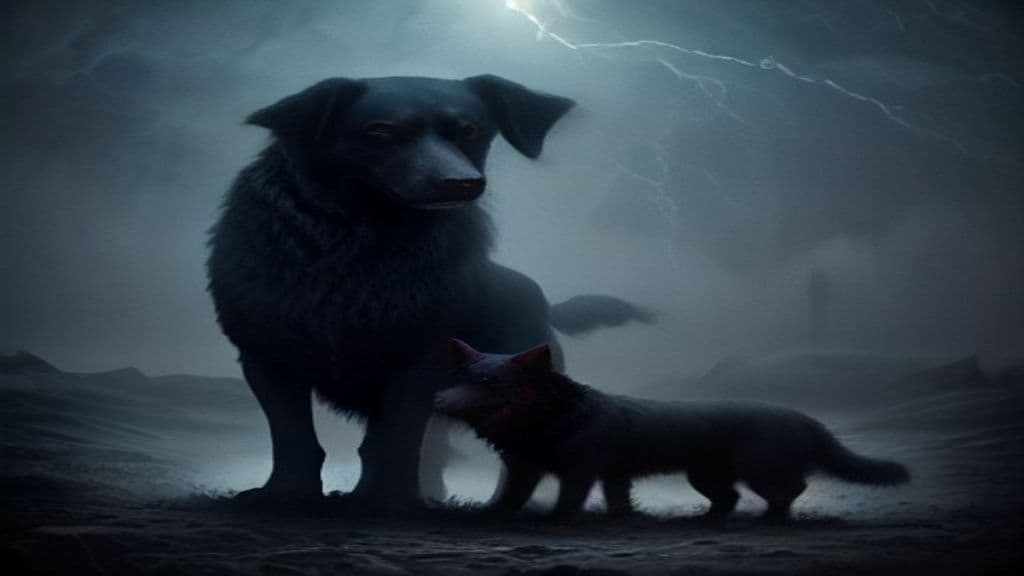
The earliest recorded narrative appears in a late‑sixteenth/early‑seventeenth‑century tract attributed to Luke Hutton (earliest circulation 1596; extant printed copies to 1612). In that account, during a famine and dire prison conditions at Newgate a stranger (described as a scholar/sorcerer in the tract) is murdered and consumed by inmates; the prisoners subsequently report seeing the spectre of a monstrous black dog which they believe to be the murdered man's spirit returning to avenge himself. Hutton's text frames the tale as a morality exemplum condemning the inmates' behaviour; it also contains a skeptical aside in which a narrator later claims the spiritual-dog story may be untrue and that the only 'Black Dog' known at Newgate is a great black stone in the dungeon called 'Limbo.'
The Newgate tract describes the apparition as 'the spectre of a monstrous black dog' walking up and down the prison. Later commentators place that account within the broader English 'Black Dog' archetype—a large, black phantom hound—although specific descriptive details beyond 'monstrous' and 'black' in the Newgate text itself are not supplied in the surviving summaries.
In the Hutton narrative the reported behaviours of the apparition include pursuing and killing those responsible for the stranger's murder: inmates 'began seeing the spectre... which they were convinced was the sorcerers spirit returning to avenge himself upon his murderers,' and the tale records that the spectre 'reportedly killed and consumed those responsible one by one' until survivors fled. The tract presents these events as part of its narrative report while also offering a competing, skeptical explanation (the 'Limbo' stone), so the violent, avenging actions are elements of the recorded story rather than independently verified facts.
Abdiel
Abdiel (Hebrew עֲבְדִּיאֵל) is primarily a theophoric Hebrew personal name meaning "servant of El/servant of God," attested once in the Hebrew Bible (1 Chronicles 5:15). In later literature—most notably John Milton's Paradise Lost—Abdiel is reimagined as a faithful seraph who opposes Satan's revolt. The provided sources do not treat Abdiel as an autonomous folkloric spirit type or record rituals or wards associated with the name.
Abiel
Abiel is attested in the supplied sources only as a male given name — borne by several historical American individuals and listed as two minor biblical figures. The provided materials contain no evidence presenting Abiel as a supernatural, mythological, or folkloric entity.
Abigail
Abigail is a female figure in the Hebrew Bible portrayed in 1 Samuel 25 as the intelligent and beautiful wife of Nabal who intervenes to prevent David from committing violence; later tradition regards her as one of the Tanakh's seven female prophets and as a model of beauty and wisdom.
Accolon
Accolon is a mortal knight of the Arthurian court, presented in the Post-Vulgate Merlin tradition and Malory's Le Morte d'Arthur as Morgan le Fay's paramour and instrument in a plot to supplant King Arthur; his tale centers on enchanted weapons (Excalibur and its scabbard), love-manipulation, and a tragic duel with Arthur.
Adsullata
Adsullata is attested as a Continental Celtic river goddess associated with the River Savus (modern Sava) in the Roman province of Noricum. Later traditions record her presence in Brittany as a goddess of hot springs and present her as an antecedent or origin-form of the Anglo‑Celtic sun goddess Sul.
Afaon fab Taliesin
Afaon fab Taliesin is a medieval Welsh warrior-counsellor, named as a son of the bard Taliesin and recorded among Arthur’s retinue in Welsh tradition. He appears in the Welsh Triads and in the tale Breuddwyd Rhonabwy (The Dream of Rhonabwy) as a notable martial figure and proverb-speaker rather than as a supernatural being.
Aglovale
Aglovale (also Agloval, Aglovan, Aglovaus, Acglavael) is a human knight of Arthurian romance, presented as the eldest legitimate son of King Pellinore and a Knight of the Round Table in the Vulgate/Post‑Vulgate cycles, Malory, and later adaptations. He brings his long‑lost brother Perceval to Camelot, takes part in military actions (including slaying Agrippa in one account), and his death is related in varying ways across traditions (accidental at Gawain's hand, deliberate murder by Orkney kin, or killed during Lancelot's rescue of Guinevere).
Agravain
Agravain is a literary knight of Arthurian romance cycles: one of the sons of King Lot of Orkney, a member of the Round Table, and a recurring figure in French and English medieval prose and verse. He is portrayed as a skilled but morally problematic courtly knight whose jealousy, malice, and intra-familial violence drive key narrative conflicts (notably the slaying of Lamorak and the exposure of Guinevere).
Albanactus
Albanactus is a legendary eponymous founder-king in medieval pseudo-historical chronicles (not a supernatural being). In Geoffrey of Monmouth’s narrative he is the youngest son of Brutus who receives Alba/Albany as his share, rules briefly, and is killed by Humber, king of the Huns; the figure serves as a medieval reverse-etiology to explain the name of the land and to support later political claims.
Aldroen
Aldroen is a legendary early medieval king of the Bretons of Armorica appearing in Geoffrey of Monmouth and later medieval chroniclers. Presented as a dynastic and martial founder-figure (son of Salomon) in pseudo-historical accounts, he is credited in tradition with military action in 5th-century Brittany and involvement in British-Breton affairs rather than any supernatural role.
Alice (Alice's Adventures in Wonderland)
Alice is the fictional little girl protagonist of Lewis Carroll's 1865 novel Alice's Adventures in Wonderland. Portrayed as a curious child who follows a White Rabbit down a rabbit hole, she serves as the reader's point of entry into the dreamlike realm of Wonderland and is not described in the provided sources as a supernatural being.
Allison Gross
A witch-figure from a Scottish/English ballad (Child 35) who courts a man with gifts and, when rebuffed, transforms him into a wyrm bound to a tree; in some versions the Seelie Queen later restores him. Presented in ballad tradition as a powerful but contestable supernatural suitor and punishor.
Community Record
- [1]The Black Dog of Newgate (Wikipedia). Wikipedia entry 'The Black Dog of Newgate'.wiki
- [2]The discouery of a London monster called, the black dog of Newgate (1612 copy). Luke Hutton, The discovery of a London monster called the black dog of Newgate (extant 1612 edition).literary
- [3]MoEML: The discouery of a London monster called, the black dog of Newgate. Map of Early Modern London (MoEML) entry on Hutton's tract.academic
- [4]Black Dog Of Newgate: A Phantom Prisoner's Revenge? | Spooky Isles. Spooky Isles summary of the Black Dog of Newgate legend.folk
- [5]Legend of the Black Dog — Tetrapod Zoology. Tetrapod Zoology discussion placing Newgate story in the wider Black Dog archetype.other
- [6]The Specter of the Black Dog ‹ CrimeReads. CrimeReads essay on the Black Dog motif and its Newgate instance.other
- [7]ShadyOldLady: The Black Dog of Newgate. Local‑lore summary linking the Black Dog legend to Newgate and Amen Court.folk