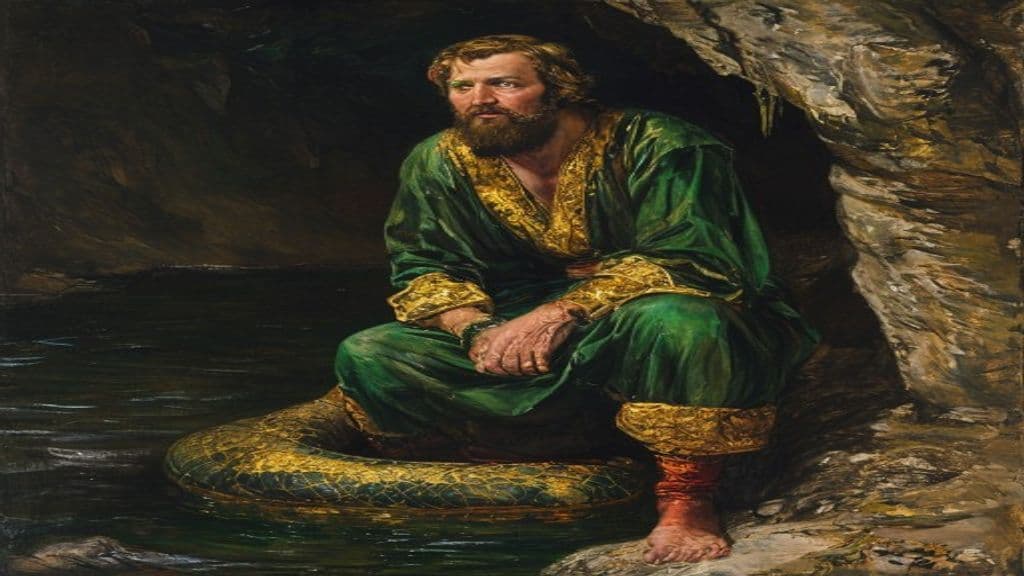
Bazhov's explanatory note frames Poloz as the huge snake who rules the other snakes and holds command over gold. Within miners' lore collected and reworked by Bazhov, Poloz functions as the nonhuman proprietor of subterranean riches rather than a human ancestor or elemental force; his authority explains uneven distribution of mineral wealth in the Ural mining landscape.
In the narrated encounter in Bazhov's tale, the being first appears in the guise of a man described as "a green-eyed man" dressed in golden clothing (a tunic/kaftan and trousers of gold brocade, a greenish shining girdle, a yellow shapka with red flaps and red boots). In that scene the earth is said to sink under him where he stood. He then transforms into the Great Snake: rearing out of the ground, "tall as a tree," growing longer as successive rings or segments appear from the earth. His emergence is accompanied by an unusual bright cold illumination.
Poloz is credited with control over gold: "All the gold was at his disposal" and he could both "take away" and "bring" gold at his will, acting either personally or with assistance from his snake servants. He functions as guardian of veins and as an arbiter who reacts to human conduct: when prospectors quarrel or when a site is confiscated, Poloz may cause a contended vein to disappear. In the tale he selectively rewards those deemed fit (the poor, uncorrupted boys) and withholds or withdraws riches when exposure to the golden trail seems likely to breed greed.
Weaknesses
- conditionhuman quarrel or official confiscation causes withdrawal of gold (behavioral limitation rather than vulnerability)
Wards
- conditionsecrecy about a find (swearing to secrecy and absence of greed keeps Poloz's favor)
- conditionnon-contention and humility among prospectors (avoiding quarrel or forceful seizure of a site)
- conditionmaintaining composure when help arrives (advice given in the tale to not show fear)
3-D Man
3-D Man is a Marvel Comics superhero identity associated with a 1950s-era origin in which the body of Chuck Chandler can materialize in three-dimensional existence when activated by his brother Hal via a pair of glasses. The mantle was later assumed by Delroy Garrett (formerly Triathlon) in modern continuity.
5 Ronin
5 Ronin is a 2011 Marvel Comics five-issue limited series that reimagines five Marvel superhero archetypes as rōnin (masterless samurai) in a fictionalized post‑Sekigahara feudal Japan. The work places Wolverine, Hulk, Punisher, Psylocke, and Deadpool analogues into period roles to explore displacement, revenge, and identity in an era of political upheaval.
A Elbereth Gilthoniel
An Elvish hymn in Sindarin addressed to Elbereth (Varda) from J. R. R. Tolkien's legendarium. Presented in The Lord of the Rings and later musical and dramatic adaptations, the hymn functions as devotional poetic language that evokes Elvish reverence for the star-kindler rather than an independent supernatural agent.
A.R.G.U.S.
A.R.G.U.S. is a fictional clandestine United States government agency in the DC Comics universe that investigates, contains, and manages superhuman, meta-human, and supernatural incidents and assets. Introduced in The New 52 continuity, it functions as an institutional actor providing intelligence, logistical support, covert task forces (notably Task Force X / the Suicide Squad), and a dedicated magic division across comics and media adaptations.
Abaasy
Abaasy (Abaahy, Abasy; Yakut: Абаасы, Abaası) are beings of the Sakha (Yakut) underworld, depicted in sources as destructive underworld spirits or demons associated with the long deceased. They inhabit the lower cosmic layer, serve an underworld ruler, are blamed for disease and madness, and may be appeased by blood sacrifice.
Abin Sur
Abin Sur is a fictional extraterrestrial Green Lantern from the planet Ungara in DC Comics. A former history professor turned Green Lantern of Space Sector 2814, he discovered and investigated a prophecy tied to the "Blackest Night," died wounded on Earth and chose Hal Jordan as his ring-successor, and was later reanimated as a Black Lantern in the Blackest Night storyline.
Absolute Green Lantern (tradition)
A modern comic-book reinterpretation in DC's Absolute Universe in which a giant green lantern-shaped vessel appears above Evergreen, Nevada, generates an impenetrable green dome, judges townspeople and sends the judged into the Lantern to await further adjudication in OA (Omega‑Alpha). The story reframes Green Lantern mythos as cosmic/religious horror with an "Enlightenment Spectrum" of flames (Qard, Rao, Sur, Aur) stewarded by Oans such as Abin Sur.
Absorbing Man
A fictional Marvel Comics character (Carl "Crusher" Creel) whose body acquires the physical properties of materials or energies he touches. Debuting in Journey into Mystery #114 (March 1965), created by Stan Lee and Jack Kirby, he is presented as a mortal supervillain/occasional antihero who challenges heroes such as Thor, Hulk, Spider-Man, and the Avengers.
Ace West
Ace West (Wallace Daniel "Ace" West) is a contemporary American comic-book character in DC Comics continuity, a young speedster who channels the metaphysical Speed Force and occupies legacy-hero roles such as Kid Flash and Ace. Introduced in New 52-era stories as a biracial reinterpretation of Wally West and later retconned in DC Rebirth as a distinct Wallace West, son of Daniel West (Reverse-Flash), he appears across present-day and alternate/future timelines and participates in team and sacrifice narratives tied to the Speed Force.
Acheron
Acheron is a mythological river of the Ancient Greek Underworld, portrayed in classical literature as a boundary or entrance to Hades across which the dead are conveyed. It is also a real river in Epirus whose landscape and nearby cult sites (notably a Necromanteion) were mapped onto the literary river; later Western authors use Acheron metonymically for Hell or the infernal realm.
Achilles and Patroclus
A central heroic dyad in the Homeric Trojan War tradition: two mortal Greek warriors whose close bond—portrayed as deep companionship in the Iliad—drives key events of the epic when Patroclus' death provokes Achilles' rage, return to battle, and the slaying of Hector.
Acoetes
Acoetes is a proper name applied to multiple mortal figures in classical Greco‑Roman mythic narratives. Most famously, an Acoetes is a fisherman who recognizes and testifies to the divinity of Bacchus/Dionysus and recounts how blasphemous sailors were transformed into dolphins; other bearers of the name appear as a Trojan genealogical figure (father of Laocoön), an aged former squire of Evander, and a frightened soldier in Statius' Thebaid.
Community Record
- [1]The Great Snake (Bazhov skaz) — Wikipedia. Wikipedia entry summarizing Pavel Bazhov's skaz "The Great Snake" and including explanatory notes about Poloz's role among snakes and control over gold.wiki
- [2]The Great Snake — Wikidata. Wikidata item for Bazhov's "The Great Snake," linking metadata for the tale.other