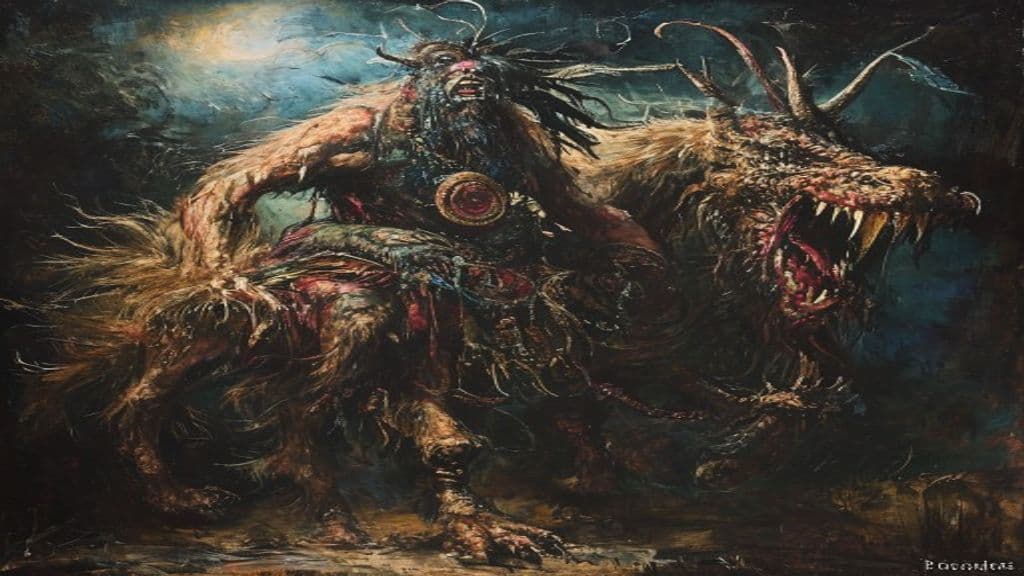
Sources present the abaasy as inhabitants of the lower world or 'kingdom of darkness' in Sakha cosmology. They are alleged to be spirits of the long deceased who dwell near graves or in deserted places and to serve the underworld ruler Arson-Duolai, who is said to swallow people's souls and give diseases. The concept is embedded in Sakha thought and language (the verb абааһы көр- 'to see abaasy' is used idiomatically for 'to hate' or 'to dislike').
Abaasy are described in sources as ugly, horrible, man-eating beings; individually they are portrayed as monstrous (one-eyed, one-armed, one-legged). They are sometimes shown mounted on monstrous steeds described as two-headed, eight-legged, two-tailed dragons. In Olonkho epic poems a named chief (Alyp Khara Aat Mogoidoon) appears as a three-headed, six-armed, six-legged giant with an iron body.
The abaasy are alleged to dwell in the underworld and near graves or deserted places and to travel about causing destruction. They are associated with causing disease, sexual manifestations, and madness, and in epic narratives are man-eaters. They serve Arson-Duolai, who is said to swallow souls and give disease. The sources note that abaasy can be appeased by blood sacrifices.
Weaknesses
None recorded.
Wards
- ritualblood sacrifice (appeasement)
Aiy (Aiy-auk)
Aiy (also rendered Aiy-auk) is a name mentioned in relation to Siberian contexts in the queryer's sources, but the provided documents do not contain usable folkloric descriptions or ethnographic data about the entity. This entry records what the supplied materials do and do not establish and points to the research gap.
Ak Ana
Ak Ana (also Ağ Ana, Ak Ene) is the primordial water-mother of Turkic and some Siberian (Khanty, Mansi) traditions: a holy maternal creator principle associated with the pre-earth expanse of water, fertility of the land, and the threshold to the spirit world.
Ama (Mother of Waters)
No documentation for a Siberian supernatural figure called 'Ama' or 'Mother of Waters' was found in the supplied sources. The reviewed materials either list unrelated senses of the string 'Ama' or are unrelated recordings titled 'AMA.'
Buga
Buga (BUGA) is identified in the consulted sources as an Evenki (Evenk) sky or heaven god, rendered in brief tertiary references as the Evenki 'god of the heaven' and labelled by one popular summary as the 'Evenki Supreme God.' Available documentation in the provided set is fragmentary and supplies no detailed myths, rituals, or iconography for Buga.
Burkut
Burkut (also Bürküt, Merküt) is a sacred eagle figure in Turkic mythic cosmology associated with the sun, rulership, and protective authority. Treated as an emblematic or quasi-divine bird rather than a mundane animal, it appears in shamanic rites, world-tree iconography, folk performance, and modern heraldic motifs.
Burut
Burut (also attested as a clan name Burutia in some modern mentions) is documented in the supplied sources not as a supernatural being but as a social/lineage name attested in Central Asian ethnographic records (Kirghiz / Khakassian contexts). The provided corpus contains no evidence identifying Burut or 'Burutia' as an Assamese folk spirit, nor does it record myths, powers, or rituals for such an entity.
Chud
The Chud (Russian: Чудь) are an ancient, mythic people in Russian and several Finno‑Ugric oral traditions. Presented as a pre‑modern population, they appear in legends as a displaced, assimilated, or subterranean society whose disappearance and former condition help explain features of landscape and cosmology in regional folklore.
Dayak Bahau
Dayak Bahau (Bahau, Kayan Mekam) is an ethnic / sub-ethnic group of the Apo Kayan (Apokayan) family in Borneo, documented in sources as inhabitants of parts of East Kalimantan (notably West Kutai Regency) with living ritual traditions such as Hudoq and locally specific practices like Apang Aruq. The supplied materials do not describe a supernatural being named 'Dayak Bahau.'
Erkliğ Han
Erkliğ Han is a Turkic–Altai celestial lord associated with space, stars, meteorites (falling stars), and the planet Venus. Traditionally titled a Han (ruler), he is described in source material as responsible for visible stellar phenomena, linked in some lists with virility and read as a martial symbol by analogy to his action at sunrise.
Golden Woman (Zolotaya baba / Zlata baba)
A prominent sacred image attested in early modern European accounts of northeastern Europe / northwestern Siberia, described as a large female-form idol or a rock resembling an old woman. Recorded functions include obligatory offerings by passersby and, in some reports, use as an oracle or in local sorcery.
Goose Wife
A bird‑woman figure from Inuit and other Arctic oral traditions who alternates between human and avian form by removing or donning a feathered skin; she may become a human wife when her skin is taken and later return to the bird realm by reclaiming or fashioning feathers.
Hasinaw-uk-kamuy
Hasinaw-uk-kamuy is an Ainu kamuy (deity/spirit) associated with the hunt, hunting tools and success in subsistence activities; she is invoked by hunters and fishermen and is also associated in sources with aid in childbearing.
Community Record
- [1]Abasy. Wikipedia contributors, 'Abasy,' Wikipedia, The Free Encyclopedia, https://en.wikipedia.org/wiki/Abasywiki