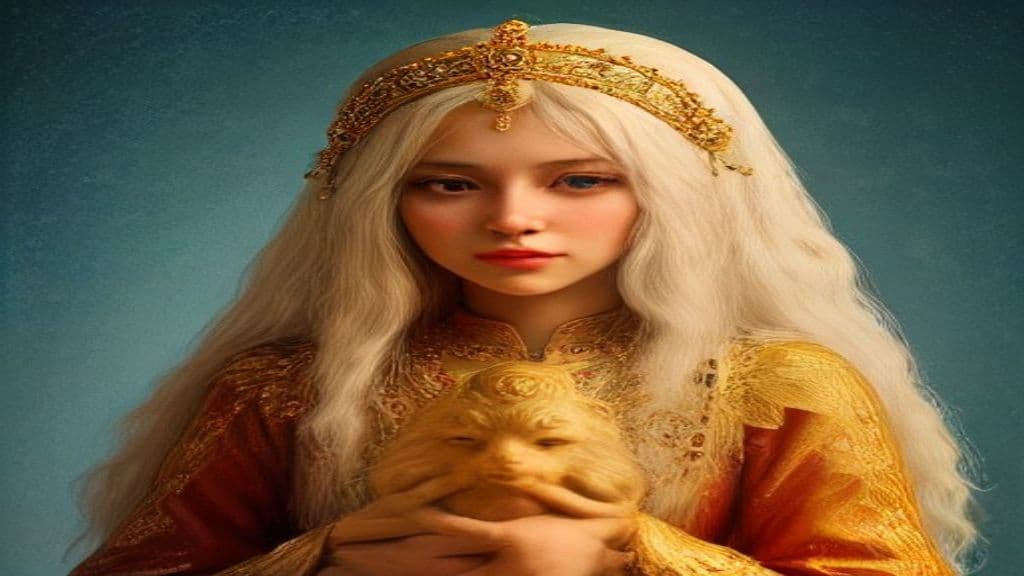
No indigenous origin myth for the Golden Woman survives in the brief early modern European record surveyed here. The figure appears in European sources as an established local cult image: Maciej Miechowita (1517) reports a "great idol Zlota baba" beyond Viatka which neighboring peoples worship and before which travelers make offerings; later authors compiled by Giles Fletcher (1591) cite reports and maps placing a "Slata Baba" in northern regions and recount an example near the Ob River where local people use a rock resembling a woman in ritual practice. These external accounts present the Golden Woman as a longstanding localized cult object rather than providing an origin narrative from native informants.
Descriptions in the surviving sources are brief and differ on material specifics. Miechowita (1517) calls it a "great idol Zlota baba," identifying it as an image in the shape of an old woman (the name itself meaning "golden old woman"). Giles Fletcher (1591), summarizing various travel reports and maps, likewise describes a "Slata Baba, or the golden hagge, an idol in the shape of an old woman," and additionally records a report of a natural rock "of shape resembling a ragged woman bearing a child in her hands" at the Ob River. Thus the figure is consistently rendered as an aged female form, prominent in the landscape; some accounts treat it as a carved or set idol, while at least one report treats it as a sacred natural rock resembling a woman.
The sources do not ascribe overt supernatural powers in modern terms but record ritual functions in human practice. Miechowita states the idol is venerated and that passersby—hunters and travelers—do not pass it empty-handed, making offerings (from noble gifts down to a skin or a hair) and bowing in reverence. Giles Fletcher reports that some authors describe the Slata Baba as serving "as an oracle for indigenous priests," and he relays a report that Obdorian Samoyeds used a rock-form resembling a woman "in their pagan sorcery." These attestations present the Golden Woman as a locus of obligatory propitiation and, in some accounts, a mediatory/oracular focus for ritual specialists.
Weaknesses
None recorded.
Wards
- ritualoffering and reverent passage (per Miechowita)
Abaasy
Abaasy (Abaahy, Abasy; Yakut: Абаасы, Abaası) are beings of the Sakha (Yakut) underworld, depicted in sources as destructive underworld spirits or demons associated with the long deceased. They inhabit the lower cosmic layer, serve an underworld ruler, are blamed for disease and madness, and may be appeased by blood sacrifice.
Ahti (Ahto)
Ahti (also Ahto) is a Finnish water haltija — a named supernatural proprietor of the sea and aquatic resources who appears in Kalevala-derived epic material, regional runic fishing songs, and healing spells. He functions as a sea-king/sea-god figure, provider of fish and other water-given wealth, and a ritual addressee in practical subsistence and healing contexts.
Ahtola (Kalevala) (tradition)
In the supplied sources, no supernatural entity named "Ahtola" is attested in the Kalevala or other Finnish mythic texts. The name Ahtola appears in the source set only as a modern Finnish surname and a place-name; the closely related mythic figure attested in the material is Ahti/Ahto, a Finnish water god associated with the sea.
Aino
Aino is a human female figure in Finnish oral tradition as assembled in the Kalevala; originally appearing in folk poems as “the only daughter” or “the only sister,” she was given the proper name Aino by Elias Lönnrot when he compiled and edited the oral material into the national epic. Her story concerns family pressure, courtship by Väinämöinen, refusal, and a tragic drowning that functions as a moral and social episode within the Kalevala narrative.
Aitia (Baltic Finnic)
Primordial figure representing the creative power of the universe, associated with the creation of the world and emergence of life from chaos. (Note: 1. Power tier: Primordial is plausible, but it would be more accurate to indicate "Primordial" as a default power tier without specifying, since there's no further information about its abilities or b)
Aiy (Aiy-auk)
Aiy (also rendered Aiy-auk) is a name mentioned in relation to Siberian contexts in the queryer's sources, but the provided documents do not contain usable folkloric descriptions or ethnographic data about the entity. This entry records what the supplied materials do and do not establish and points to the research gap.
Ajatar
Ajatar (also Ajattara, Aijotar; runic variants Aattara, Ajaster(i)) is an evil female spirit in Finnish traditional belief associated with wild places, serpents, and the spread of disease and pestilence. She functions in the folk corpus as a dangerous woman-like haltija of forests and mountains who leads people astray and is linked to other hostile powers such as Hiisi and Lempo.
Ak Ana
Ak Ana (also Ağ Ana, Ak Ene) is the primordial water-mother of Turkic and some Siberian (Khanty, Mansi) traditions: a holy maternal creator principle associated with the pre-earth expanse of water, fertility of the land, and the threshold to the spirit world.
Ama (Mother of Waters)
No documentation for a Siberian supernatural figure called 'Ama' or 'Mother of Waters' was found in the supplied sources. The reviewed materials either list unrelated senses of the string 'Ama' or are unrelated recordings titled 'AMA.'
Ancient Kings of Finland
In early literary sources, the Ancient Kings of Finland are described as hypothetical or mythical monarchic systems associated with ancient Finland. (Note: 1. Power tier: Lower to Primordial (given the lack of specific abilities and behaviors) 2. Abilities and behaviors are described as 'generally vague', so this section should be reworded or removed 3. )
Antero Vipunen
A giant in Finnish mythology with valuable spells and knowledge, possibly associated with underworldly powers. (Note: * Power tier should be Ancient (deity-level) due to possessing "very valuable spells and knowledge", which suggests immense magical power but not necessarily cosmic-level. * Appearance should clarify )
Arvoitus (Finnish Riddle Entity)
A supernatural entity embodying the concept of a riddle or puzzle, often used in Finnish folklore to test one's wisdom and knowledge. (Note: 1. Power tier: Minor Spirit (Arvoitus does not interact directly with humans but presents itself as a puzzle, suggesting it's more of a subtle, local entity rather than a powerful regional one.) 2. Ap)
Community Record
- [1]Maciej Miechowita, 1517 (account cited in research notes). Miechowita (1517) — description: 'there stands a great idol Zlota baba... No one passing nearby... goes by empty-handed or without making an offering... if a noble gift is lacking, the person throws even a skin or at least a hair pulled from their clothing as an offering...' (translated excerpt in research notes)literary
- [2]Giles Fletcher, 1591 (compilation of travel reports). Fletcher (1591) — paraphrase: mentions 'Slata Baba, or the golden hagge, an idol in the shape of an old woman who serves as an oracle for indigenous priests' and reports of 'a rock of shape resembling a ragged woman bearing a child in her hands, and Obdorian Samoyeds use it in their pagan sorcery.' (paraphrase in research notes)literary
- [3]Wikipedia: Golden Woman. Wikipedia entry summarizing historical references and disambiguation for 'Golden Woman' (as cited in research notes)wiki
- [4]Wikidata: Golden Woman (Q1982835). Wikidata item linked to historical references for the 'Golden Woman' (as cited in research notes)wiki