
In the cosmogony reported in the available sources, an endless expanse of Water preceded the formation of Earth; Ak Ana is the sacred female presence of that primordial Water. The summary account states that Water had been created earlier than Earth and that Ak Ana was therefore regarded as the elder sister of Earth. In one cited narrative, the sky-creator Kayra (Kaira) Khan — sometimes represented as a pure white goose — flies over the endless Water until Ak Ana appears to urge him to create; from the bottom of the Water a 'sacred duck' named Lura lifts sand, clay and silt from which the Earth is formed. The same source also reports that Ak Ana is described as both consort and daughter of Kayra Han in those traditions.
The provided sources do not give a detailed anthropomorphic description. Rather, Ak Ana is presented by epithet and role: called Ak Ana / Ağ Ana / Ak Ene and translated as the 'Holy Mother' and the goddess of the water. Emphasis in the material is on her status as the primordial mother associated with Water and as elder sister of Earth rather than on clothing, color, or other physical attributes.
Source texts attribute to Ak Ana foundational creative agency and proprietorship over life and fertility: she is said to have urged Kayra/Kaira Khan toward creation and to determine 'the life, fertility and productivity of land.' Water — Ak Ana's domain — is described as the initial state of existence, 'the possessor of spirits and the entrance into the other realm,' and as giving rise 'evenly [to] both foreign and hostile elements.' These phrases in the source portray her as a primordial, liminal power connecting material creation and the spirit realm and as responsible for fertility of the earth.
Weaknesses
- otherNo specific weaknesses recorded in the provided sources
Wards
- otherNo protective wards or counter-rituals recorded in the provided sources
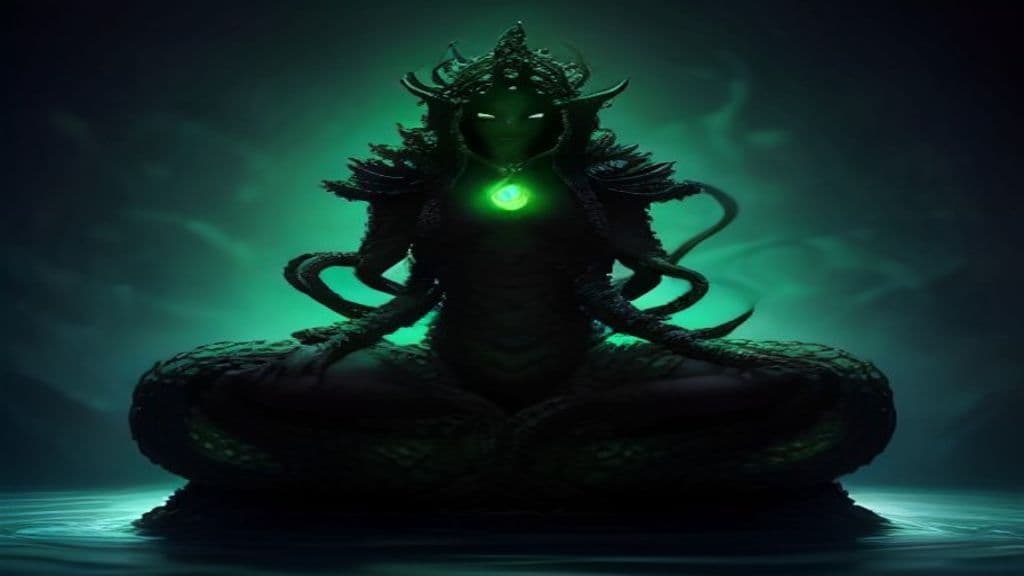
Naga
Divine serpent beings of Hindu, Buddhist, and Jain cosmology — powerful guardians of water, earth, and underground treasures. Revered as deities in South and Southeast Asia.
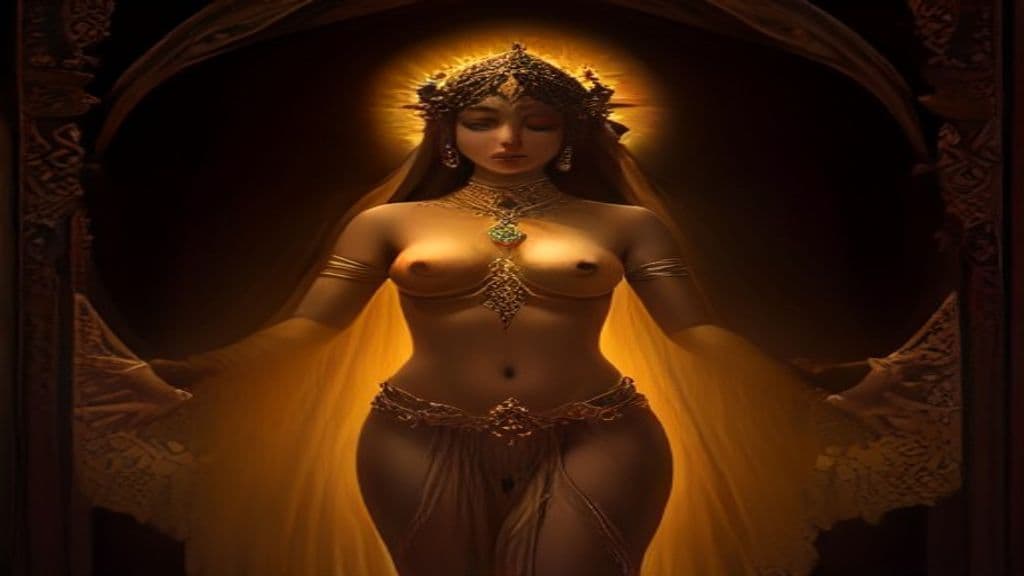
Apsara
Celestial dancers and water nymphs of Hindu cosmology — beautiful semi-divine beings who dance at the court of Indra and, by his command, descend to earth to distract sages from excessive asceticism.
Abaasy
Abaasy (Abaahy, Abasy; Yakut: Абаасы, Abaası) are beings of the Sakha (Yakut) underworld, depicted in sources as destructive underworld spirits or demons associated with the long deceased. They inhabit the lower cosmic layer, serve an underworld ruler, are blamed for disease and madness, and may be appeased by blood sacrifice.
Abzar İyesi
A Turkic iyesi (possessive/guardian spirit) of the courtyard, outbuildings, and farmstead grounds; ambivalent in nature, it protects its domain but may harm livestock and cause mischief, often appearing in animal forms.
Aiy (Aiy-auk)
Aiy (also rendered Aiy-auk) is a name mentioned in relation to Siberian contexts in the queryer's sources, but the provided documents do not contain usable folkloric descriptions or ethnographic data about the entity. This entry records what the supplied materials do and do not establish and points to the research gap.
Al (Alı)
No folkloric or ethnographic evidence for a supernatural entity named "Al" or "Alı" is present in the supplied source set. The available materials are modern biographical, political, linguistic, and religious texts that do not describe a Turkish spirit, demon, or other supernatural being by this name.
Alaz
Alaz is the Turkic god of fire associated with hearths, flame, and the Great Fire (Ulugh Od). He is described as a powerful fire-being who sends protector-spirits (İye) to household hearths and can cause destructive fires when angered; fire under his authority is also a purifying force.
Alp Er Tunga
Alp Er Tunga is a legendary heroic ruler of Turan in early Turkic tradition, remembered as an ideal warrior-king and ancestral figure invoked in medieval dynastic genealogies. He also appears in Iranian epic tradition under the cognate name Afrosiyab/Afrasiab, where the figure is framed differently.
Ama (Mother of Waters)
No documentation for a Siberian supernatural figure called 'Ama' or 'Mother of Waters' was found in the supplied sources. The reviewed materials either list unrelated senses of the string 'Ama' or are unrelated recordings titled 'AMA.'
Amrak
Amrak is not attested in the provided sources as a supernatural being. The lexical string "Amrak" appears across unrelated secular contexts — as a historical regnal name (Amrak Khagan / Ashina Anluo), a Turkish place-name (Çamrak / amrak), titles in modern Arabic-language music, an institutional name/acronym (AMRAK Institute), and as a modern brand/typeface/project name. No folkloric, ritual, or mythological descriptions of an entity called "Amrak" are present in the cited material.
Apa Qaghan
Apa Qaghan (阿波可汗, Ābō Kèhán) is an historical Ashina prince and mid-6th century claimant to the Göktürk khaganate. Sources portray him as a political and military actor involved in the succession disputes after Taspar Qaghan's death, ruling contested steppe territories and engaging with both western Turkic allies and Sui China.
Aq Bars
Aq Bars (Tatar: Ак Барс, 'White Leopard') is an ancient Bulgar tribal totem and heraldic emblem historically used in Volga Bulgaria and the Khanate of Kazan and adopted in the modern era as the official symbol of the Republic of Tatarstan (formally since 7 February 1992). It functions as a dynastic/tribal mark of identity (derived from the Barsil tribe) and as a political-state emblem rather than a personal supernatural being.
Archura
Archura (Arçura) is a Turkic woodland chura — a shapeshifting forest spirit associated with particular woodland tracts and wild animals. Traditions portray Archura as a protector of wildlife and a trickster-like figure that can be dangerous to humans.
Asena
Asena is a mythic she-wolf who functions as the ancestress in the Göktürk foundation myth; she rescues an injured child after a battle, becomes pregnant by him according to the legend, flees across the Western Sea to a cave near the Qocho mountains, and gives birth to progenitors of the Ashina clan. The figure legitimizes the ruling lineage of early Turkic polities and has been revalorized in modern Turkish nationalist symbolism under the related label Bozkurt ('gray wolf').
Community Record
- [1]Ak Ana. Wikipedia, 'Ak Ana' (accessed source summary provided)wiki
- [2]Wikidata entry: Ak Ana (Q4700040). Wikidata item Q4700040 (label and structured data)wiki