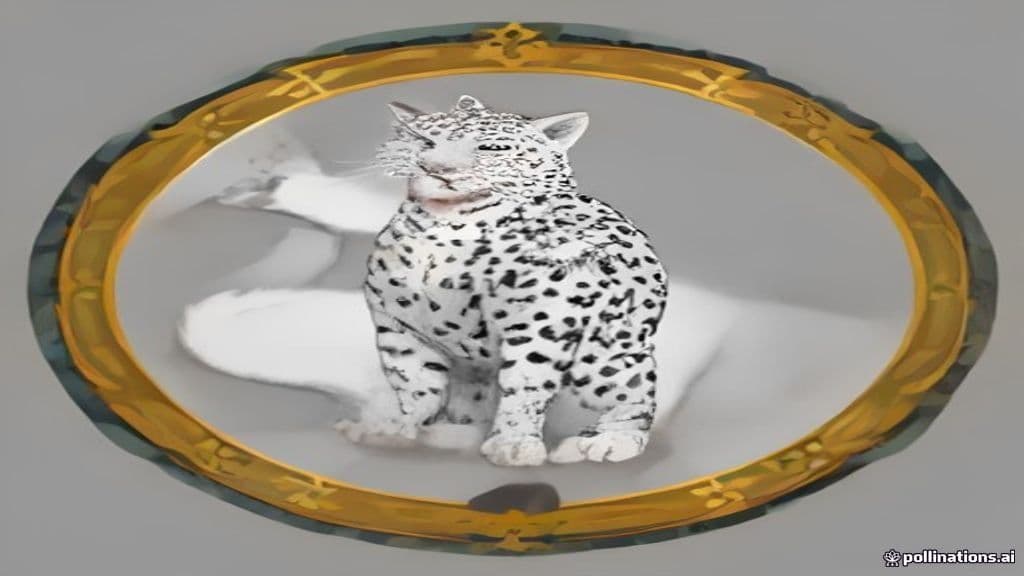
In the available sources Aq Bars is presented as a visual and tribal emblem deriving from the totems of a Bulgar clan known as the Barsil. According to legend cited in the tradition, the Barsils are associated with the founding of the city Bilär in Volga Bulgaria. Over centuries the white-leopard sign was used in the heraldic repertoire of Volga Bulgaria and the later Khanate of Kazan; in the post‑Soviet period the emblem was artistically reworked and formally adopted as the official symbol of the Republic of Tatarstan on 7 February 1992, linking contemporary regional identity to the earlier Bulgar/Kazan past.
Sources identify Aq Bars literally as the 'White Leopard' (a snow leopard) and describe its use as a stylized animal device in coats of arms and emblems of Volga Bulgaria, the Khanate of Kazan, and modern Tatarstan. The provided materials give the animal identity and white/snow-leopard translation but do not supply detailed iconographic specifics (pose, number of heads, or other stylistic features); the modern emblem was created by artist Rif Fäxretdinov (Риф Фәхретдинов).
The corpus does not ascribe any supernatural abilities, volition, or behaviors to Aq Bars. It is treated in the sources as a tribal totem, heraldic signifier, and political symbol rather than an animate spirit or agent that acts on its own; claims of protective or active powers are not documented in the supplied materials.

Abzar İyesi
A Turkic iyesi (possessive/guardian spirit) of the courtyard, outbuildings, and farmstead grounds; ambivalent in nature, it protects its domain but may harm livestock and cause mischief, often appearing in animal forms.
Adže / Adze
No folkloric entity named 'Adže' is documented in the provided sources. The string appears in heterogeneous, non-folkloric contexts (a Bosnian village name, an English woodworking tool entry, a performer pen name, a CIA document fragment) and one modern podcast episode list that mentions 'the Adze' among other vampire-like beings; none of these supply an ethnographic description of a supernatural being called 'Adže'.
Ak Ana
Ak Ana (also Ağ Ana, Ak Ene) is the primordial water-mother of Turkic and some Siberian (Khanty, Mansi) traditions: a holy maternal creator principle associated with the pre-earth expanse of water, fertility of the land, and the threshold to the spirit world.
Al (Alı)
No folkloric or ethnographic evidence for a supernatural entity named "Al" or "Alı" is present in the supplied source set. The available materials are modern biographical, political, linguistic, and religious texts that do not describe a Turkish spirit, demon, or other supernatural being by this name.
Ala
A female weather-being in South Slavic folk cosmology (Bulgaria, Serbia, North Macedonia) associated with hail, destructive storms, and voracious appetite; she is said to lead hail-producing clouds to destroy crops and is sometimes blamed for eclipses by attempting to devour the Sun or Moon.
Alatyr
A sacred world-stone in East Slavic and wider Slavic folklore, described as the "father to all stones" and the "navel of the earth." Located at the world's center (often on Buyan island), it is associated with a miraculous spring, sacred letters, healing properties, and liminality between the human world and other realms.
Alaz
Alaz is the Turkic god of fire associated with hearths, flame, and the Great Fire (Ulugh Od). He is described as a powerful fire-being who sends protector-spirits (İye) to household hearths and can cause destructive fires when angered; fire under his authority is also a purifying force.
Alkonost
The Alkonost is a legendary woman-headed bird of East Slavic folklore, depicted as an individual mythic avian figure who lives in the underworld alongside her counterpart Sirin. Her song enchants listeners into forgetfulness or bliss, she is said to bless fruit during the Apple Feast of the Saviour, and her reproductive actions are causally linked in lore to sudden storms at sea.
Alp Er Tunga
Alp Er Tunga is a legendary heroic ruler of Turan in early Turkic tradition, remembered as an ideal warrior-king and ancestral figure invoked in medieval dynastic genealogies. He also appears in Iranian epic tradition under the cognate name Afrosiyab/Afrasiab, where the figure is framed differently.
Alyosha Popovich
Alyosha Popovich (Алёша Попович / Олешко Попович) is a named human hero (bogatyr) of the East Slavic byliny tradition, remembered as the youngest member of the canonical trio of Kievan Rus' warriors. He is chiefly characterized by slyness, mockery, and trickery, and defeats foes by craft often aided by pious petition rather than mere brute strength.
Amrak
Amrak is not attested in the provided sources as a supernatural being. The lexical string "Amrak" appears across unrelated secular contexts — as a historical regnal name (Amrak Khagan / Ashina Anluo), a Turkish place-name (Çamrak / amrak), titles in modern Arabic-language music, an institutional name/acronym (AMRAK Institute), and as a modern brand/typeface/project name. No folkloric, ritual, or mythological descriptions of an entity called "Amrak" are present in the cited material.
Andrew the Apostle
Andrew the Apostle (Greek Ἀνδρέας, Latin Andreas) is one of the Twelve Apostles in the New Testament, a fisherman from Bethsaida, the brother of Simon Peter, described as the “first-called” who introduced others to Jesus. Post-biblical traditions depict him as an early missionary and founder of Christian communities (notably claims of missions to Thrace, Scythia, and founding the see of Byzantium) and as a martyr crucified at Patras.
Community Record
- [1]Aq Bars. "Aq Bars (Tatar: Ак Барс [ɑq ˈbɑrs]) or Ak Bars (Russian: Ак Барс [ɐg‿ˈbars]) is an ancient Bulgar symbol, which has served as the official symbol of the Republic of Tatarstan since the dissolution of the Soviet Union in 7 February 1992."wiki
- [2]Wikidata: coat of arms of Tatarstan. Wikidata entry for the coat of arms of Tatarstan (links emblem to Republic of Tatarstan and modern usage).other
- [3]CIA Reading Room archive materials (contextual search results). Search/archival materials returned in the research corpus; cited here as contextual archival background included in the provided notes.other
- [4]RIAG Crate 010: 050 Educational Programs (archive). Archive item included in the provided research notes (contextual material within the corpus).other