Sources identify Alaz as a son of Kayra and place him within Turkic theogonic genealogy; the provided material does not give a narrative account of his birth or deeds beyond naming this parentage and his role as the god of fire.
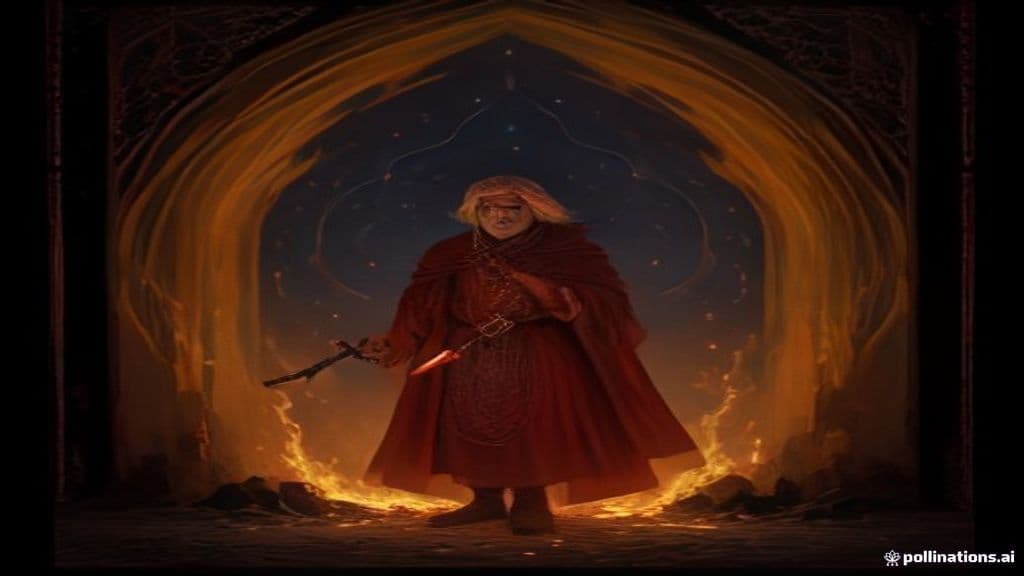
Alaz Khan is depicted in sources as an old man holding a torch and wearing dress made of flames; he is said to live in Ulugh Od (Uluğ Od, the "Great Fire").
Alaz is said to have the power of fire: he governs hearths and stoves, is described as sending spirits (İye) to all hearths, and is said to be able to make and cause fires on earth when angered. Fire under his domain is also described as purifying.
Weaknesses
- conditiondisrespect toward fire or hearths
Wards
- conditionproper respect and reverence for fire and hearth in family and social life
- otherlegal and social sanctions (historical enforcement such as penalties for disrespect described in the Great Law of Genghis Khan)

Abzar İyesi
A Turkic iyesi (possessive/guardian spirit) of the courtyard, outbuildings, and farmstead grounds; ambivalent in nature, it protects its domain but may harm livestock and cause mischief, often appearing in animal forms.
Ak Ana
Ak Ana (also Ağ Ana, Ak Ene) is the primordial water-mother of Turkic and some Siberian (Khanty, Mansi) traditions: a holy maternal creator principle associated with the pre-earth expanse of water, fertility of the land, and the threshold to the spirit world.
Al (Alı)
No folkloric or ethnographic evidence for a supernatural entity named "Al" or "Alı" is present in the supplied source set. The available materials are modern biographical, political, linguistic, and religious texts that do not describe a Turkish spirit, demon, or other supernatural being by this name.
Alp Er Tunga
Alp Er Tunga is a legendary heroic ruler of Turan in early Turkic tradition, remembered as an ideal warrior-king and ancestral figure invoked in medieval dynastic genealogies. He also appears in Iranian epic tradition under the cognate name Afrosiyab/Afrasiab, where the figure is framed differently.
Amrak
Amrak is not attested in the provided sources as a supernatural being. The lexical string "Amrak" appears across unrelated secular contexts — as a historical regnal name (Amrak Khagan / Ashina Anluo), a Turkish place-name (Çamrak / amrak), titles in modern Arabic-language music, an institutional name/acronym (AMRAK Institute), and as a modern brand/typeface/project name. No folkloric, ritual, or mythological descriptions of an entity called "Amrak" are present in the cited material.
Apa Qaghan
Apa Qaghan (阿波可汗, Ābō Kèhán) is an historical Ashina prince and mid-6th century claimant to the Göktürk khaganate. Sources portray him as a political and military actor involved in the succession disputes after Taspar Qaghan's death, ruling contested steppe territories and engaging with both western Turkic allies and Sui China.
Aq Bars
Aq Bars (Tatar: Ак Барс, 'White Leopard') is an ancient Bulgar tribal totem and heraldic emblem historically used in Volga Bulgaria and the Khanate of Kazan and adopted in the modern era as the official symbol of the Republic of Tatarstan (formally since 7 February 1992). It functions as a dynastic/tribal mark of identity (derived from the Barsil tribe) and as a political-state emblem rather than a personal supernatural being.
Archura
Archura (Arçura) is a Turkic woodland chura — a shapeshifting forest spirit associated with particular woodland tracts and wild animals. Traditions portray Archura as a protector of wildlife and a trickster-like figure that can be dangerous to humans.
Asena
Asena is a mythic she-wolf who functions as the ancestress in the Göktürk foundation myth; she rescues an injured child after a battle, becomes pregnant by him according to the legend, flees across the Western Sea to a cave near the Qocho mountains, and gives birth to progenitors of the Ashina clan. The figure legitimizes the ruling lineage of early Turkic polities and has been revalorized in modern Turkish nationalist symbolism under the related label Bozkurt ('gray wolf').
Ashide
Ashide denotes (a) a historical Turkic clan/noble family closely allied with the Ashina ruling house of the Göktürk Khaganate and (b) a Japanese pictorial calligraphic technique (literally "reed-hand") in which cursive characters are disguised within painted natural motifs. Neither usage in the supplied sources describes a supernatural being.
Ashina Buzhen
Ashina Buzhen (Chinese: 阿史那步真) was a 7th-century member of the Ashina ruling house of the Western Turks who acted as a military and political claimant to khaganate authority on the Tang frontier. Recorded in Tang-era sources and modern summaries, he engaged in inter-elite rivalry, participated in Tang military campaigns, received an imperial-bestowed khagan title from Emperor Gaozong, and died in 667.
Ashina Helu
Ashina Helu (阿史那賀魯 / 阿史那贺鲁, āshǐnà hèlǔ) was a mid‑7th century member of the Ashina clan who claimed the title qaγan (khagan) of the Western Turkic polity. Active as a tribal shad and later self‑declared khagan, he contested Tang authority, was defeated by General Su Dingfang in 657, handed over by Chach, spared by Emperor Gaozong, and spent his remaining years in Chang'an.
Community Record
- [1]Alaz - Wikipedia. Wikipedia, entry 'Alaz'wiki
- [2]Alazne - Wikidata. Wikidata item Q12253067other
- [3]Aliazz (archive). Archive.org record 'aliazz'other
- [4]Ah’wal Alambya Fy Tfryh Alaz-kya Jild 2 (archive). Archive.org recordother