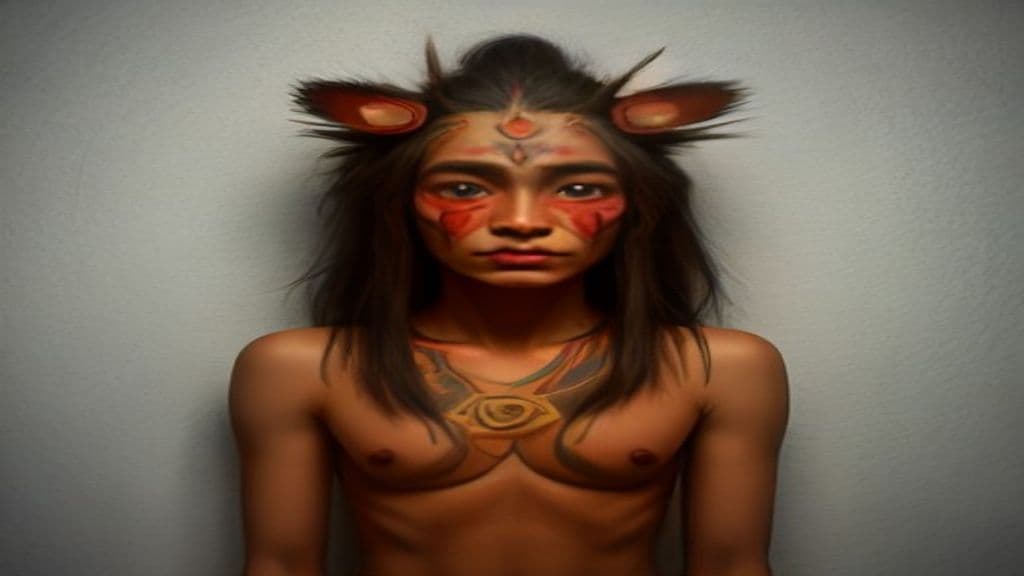
The sources identify Dayak Bahau as a sub-ethnic group within the Apo Kayan (Apokayan) family of peoples in Borneo, inhabiting areas of East Kalimantan (including a documented presence in West Kutai Regency). Scholarly and ethnographic materials treat the group in terms of ethnic classification, territorial distribution, and cultural practices rather than ascribing a mythic cosmogony for a named supernatural entity called 'Dayak Bahau.'
No physical description of a supernatural being called 'Dayak Bahau' is present in the supplied sources. The referenced visual culture of Dayak communities that include Dayak Bahau comprises carved wooden masks associated with Hudoq ritual performance, material objects such as child carriers (documented in auctions), and other ritual paraphernalia discussed in ethnographic and conservation-related literature.
The supplied materials do not document powers or supernatural behaviors attributed to an entity named 'Dayak Bahau.' They do, however, describe communal ritual practices—most notably Hudoq, a masked ritual connected with agricultural activity around the Mahakam River—and local traditions such as Apang Aruq, which are presented as symbolic-philosophical cultural practices among Dayak Bahau communities.
*Perkʷūnos
*Perkʷūnos is the reconstructed Proto-Indo-European thunder‑god hypothesized by comparative linguistics and mythology. Scholarly reconstructions portray him as a storm or thunder figure associated with fructifying rain and as the combatant who fights a multi‑headed water‑serpent to release life‑giving waters; no direct attestations from the Proto‑Indo‑European period survive and the figure is inferred from later Indo‑European traditions.
*Péh₂usōn (reconstructed)
Péh₂usōn is a hypothetical Proto‑Indo‑European pastoral guardian reconstructed by comparative scholars from parallels in Greek and Vedic traditions. Proposed as a Graeco‑Aryan ancestor‑figure, the reconstruction describes a protector of flocks, roads, and travellers rather than an attested historical cultic personality.
57 Mnemosyne
57 Mnemosyne is a large main-belt asteroid (S-type) discovered in 1859 and named after the Greek Titaness Mnemosyne. It is a non-sentient astronomical body studied for its orbital and rotational properties and has been used in dynamical measurements related to Jupiter.
Abaasy
Abaasy (Abaahy, Abasy; Yakut: Абаасы, Abaası) are beings of the Sakha (Yakut) underworld, depicted in sources as destructive underworld spirits or demons associated with the long deceased. They inhabit the lower cosmic layer, serve an underworld ruler, are blamed for disease and madness, and may be appeased by blood sacrifice.
Abaddon
In Hebrew scripture Abaddon is primarily a noun meaning 'destruction' or a section/condition of the underworld paired with Sheol; in the New Testament Book of Revelation Abaddon is personified as an angelic figure (Greek Apollyon) described as the king of an army of locusts released from the abyss during the apocalypse.
Aban Yasht
The Aban Yasht is a hymn from the Persian tradition that praises Anahita, a goddess associated with water, fertility, and wisdom. It consists of 132 stanzas and is part of the 21 Yashts collection. (Note: - Power tier should be "Primordial" or possibly "Cosmic", given that it's a hymn of great spiritual significance and associated with a goddess. - The article incorrectly states that Anahita is associa)
Abath
No corroborated folkloric entity named "Abath" is documented in the provided sources. The string appears in the supplied material only as a surname/personal name in Aruban/Dutch-Caribbean archival records and as an unrelated taxonomic or encyclopedic hit; no mythic attributes, origin stories, rituals, or apotropaic practices for an entity called Abath are present in the documents reviewed.
Abatur
Abatur is an uthra (celestial emanation) in Mandaeism described as the 'father of the Uthras' and called the Ancient (ʿattīqā). He resides on the boundary between the World of Light and lower regions, functions as a judge who weighs souls (Abatur Muzania), and supplies instructions and materials to the demiurgic uthra Ptahil in accounts from the Diwan (Scroll) of Abatur.
Abatwa (Twa / Batwa)
Abatwa (also recorded as Twa, Batwa, Mutwa; singular forms Barhwa or Murhwa in some transcriptions) are indigenous hunter‑gatherer peoples of the Great Lakes region of Central Africa, historically identified as some of the earliest inhabitants of the area. The available sources treat them as human ethnic groups whose livelihoods, lands, and populations have been severely affected by conservation policies and modern violence.
Abellio
Abellio is a theonym attested in Roman‑period inscriptions from the Comminges area of the Pyrenees and reported as worshipped in the Garonne Valley of ancient Gallia Aquitania. Surviving evidence is limited to a small number of inscriptions; scholars have variously hypothesized solar or arboreal associations and compared the name to forms of Apollo or to Celtic Belenus, but the deity's precise role in local cosmology remains uncertain.
Abraham
Abraham (originally Abram) is the foundational patriarchal ancestor in the Hebrew Bible whose life establishes a covenantal relationship between his family/people and God. He functions as an exemplar of faith, the progenitor of promised descendants, and a narrative anchor for claims of land, blessing, and communal identity in later religious traditions.
Abraun
Abraun is an attested name in German-language plant-legend scholarship (Der abraun, ein beitrag zur pflanzensagenkunde, 1916) and a short database entry (Wikidata) labels it as a spirit from German mythology. Surviving accessible documentation is extremely limited: the principal academic treatment is a 1916 contribution to pflanzensagenkunde (plant-saga studies), but the excerpts available here contain only bibliographic metadata and do not record tales, descriptions, or rituals.
Community Record
- [1]Bahau people - Wikipedia. Wikipedia: Bahau peoplewiki
- [2]Wikidata: Bahau. Wikidata entry Q12517196 (Bahau)wiki
- [3]Tradisi Hudoq Masyarakat Dayak Di Kaltim (Archive). Archive.org: Tradisi Hudoq Masyarakat Dayak di Kaltimother
- [4]REDD Alert: World Bank discrimination against Indigenous Peoples in the East Kalimantan jurisdictional REDD project. REDD+ Alert / REDD Monitor coverage of Dayak Bahau grievance to World Bank Grievance Redress Service (Mar 2024)other
- [5]Apo Kayan people - Wikipedia. Wikipedia: Apo Kayan peoplewiki
- [6]MENGENDUS MAKNA TRADISI APANG ARUQ MASYARAKAT DAYAK BAHAU BUSANG: (TINJAUAN FILOSOFIS...). Scholarly article metadata on Apang Aruq tradition among Dayak Bahau Busangacademic
- [7]Dayak Bahau African Child Carrier sold at auction. Artifact auction listing referencing Dayak Bahau material cultureother
- [8]The Hudoq Kita': A Contemporary Reinterpretation of Dayak Kenyah Cosmology.... Article discussing Hudoq and Dayak cosmology (contemporary reinterpretation)academic