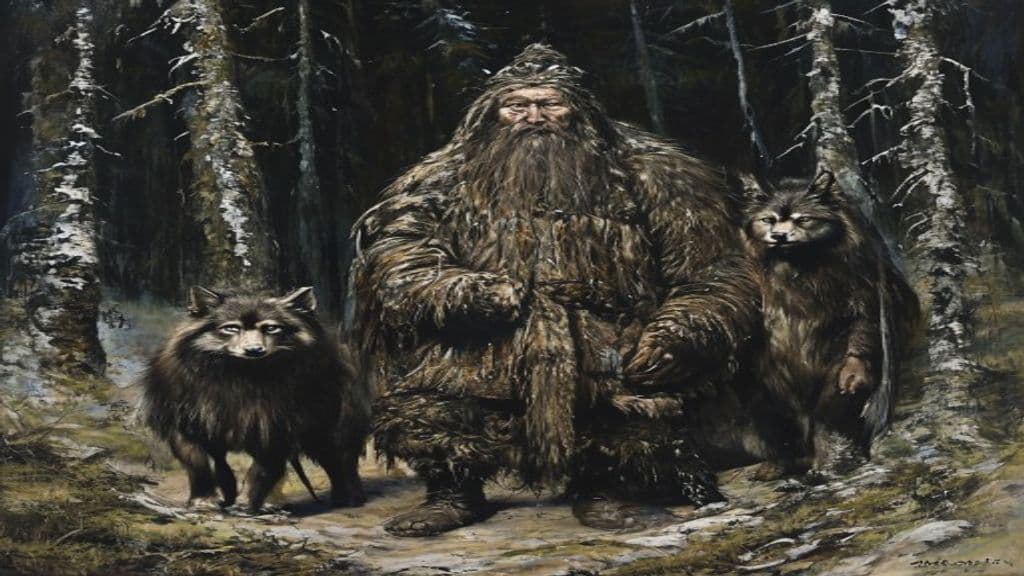
In the collected legends the Chud are narrated as a people of an earlier age who either were displaced by Slavic expansion and Christianization, fled into forests, went underground by digging earthen vaulted chambers and then buried themselves, or were transformed in later memory into other kinds of beings. Komi cosmogonic accounts present the Chud-era as a different order of things—an age in which crops grew by themselves, children spoke at birth, and death was absent—while Russian regional tales preserve motifs of fortification, resistance, flight, and subterranean disappearance that explain their absence from the present landscape.
Descriptions vary by tradition. Russian and northern Russian accounts often describe the Chud as short‑statured, 'white‑eyed' (chud beloglazaya) and exceptionally wealthy. Komi variants depict them living 'like animals' in forests—wearing skins and eating game—and other Komi descriptions characterize them as dark or 'black' anthropomorphic beings with shaggy hair and pig‑like legs. Some Komi cosmologies frame the Chud within a compressed, diminutive world where distances and sizes were smaller; the precise physical traits therefore differ according to local storytelling.
Attributes ascribed to the Chud are primarily collective and cosmological rather than individualized magical powers. Many tales emphasize their great wealth and the presence of hidden riches (sometimes taken underground). Komi cosmogonic motifs portray the Chud age as a world with spontaneously growing crops, early‑capable children, and absence of death—features of a different cosmic order rather than powers of persons. Other narratives record maladaptive or foolish communal behaviors (e.g., improper agricultural or woodworking practices) that provoke cosmic change. Defensive behaviors preserved in legends include building earthen fortresses and, in the face of defeat or contact, flight into forests or deliberate subterranean burial.
Weaknesses
- conditionvulnerability to external invasion and Christianization (narrative vulnerability recorded as defeat, flight, or subterranean withdrawal)
- conditionsocial/technological maladaptation (folktales attribute world‑altering consequences to their foolish communal actions in Komi accounts)
Wards
- otherearthen fortifications and flight into woods (narrative defensive measures attested in regional legends)
- othersubterranean burial by the Chud themselves (story‑motif of digging earthen roofs on pillars and cutting them to go underground)
Abaasy
Abaasy (Abaahy, Abasy; Yakut: Абаасы, Abaası) are beings of the Sakha (Yakut) underworld, depicted in sources as destructive underworld spirits or demons associated with the long deceased. They inhabit the lower cosmic layer, serve an underworld ruler, are blamed for disease and madness, and may be appeased by blood sacrifice.
Adže / Adze
No folkloric entity named 'Adže' is documented in the provided sources. The string appears in heterogeneous, non-folkloric contexts (a Bosnian village name, an English woodworking tool entry, a performer pen name, a CIA document fragment) and one modern podcast episode list that mentions 'the Adze' among other vampire-like beings; none of these supply an ethnographic description of a supernatural being called 'Adže'.
Ahti (Ahto)
Ahti (also Ahto) is a Finnish water haltija — a named supernatural proprietor of the sea and aquatic resources who appears in Kalevala-derived epic material, regional runic fishing songs, and healing spells. He functions as a sea-king/sea-god figure, provider of fish and other water-given wealth, and a ritual addressee in practical subsistence and healing contexts.
Ahtola (Kalevala) (tradition)
In the supplied sources, no supernatural entity named "Ahtola" is attested in the Kalevala or other Finnish mythic texts. The name Ahtola appears in the source set only as a modern Finnish surname and a place-name; the closely related mythic figure attested in the material is Ahti/Ahto, a Finnish water god associated with the sea.
Aino
Aino is a human female figure in Finnish oral tradition as assembled in the Kalevala; originally appearing in folk poems as “the only daughter” or “the only sister,” she was given the proper name Aino by Elias Lönnrot when he compiled and edited the oral material into the national epic. Her story concerns family pressure, courtship by Väinämöinen, refusal, and a tragic drowning that functions as a moral and social episode within the Kalevala narrative.
Aitia (Baltic Finnic)
Primordial figure representing the creative power of the universe, associated with the creation of the world and emergence of life from chaos. (Note: 1. Power tier: Primordial is plausible, but it would be more accurate to indicate "Primordial" as a default power tier without specifying, since there's no further information about its abilities or b)
Aiy (Aiy-auk)
Aiy (also rendered Aiy-auk) is a name mentioned in relation to Siberian contexts in the queryer's sources, but the provided documents do not contain usable folkloric descriptions or ethnographic data about the entity. This entry records what the supplied materials do and do not establish and points to the research gap.
Ajatar
Ajatar (also Ajattara, Aijotar; runic variants Aattara, Ajaster(i)) is an evil female spirit in Finnish traditional belief associated with wild places, serpents, and the spread of disease and pestilence. She functions in the folk corpus as a dangerous woman-like haltija of forests and mountains who leads people astray and is linked to other hostile powers such as Hiisi and Lempo.
Ak Ana
Ak Ana (also Ağ Ana, Ak Ene) is the primordial water-mother of Turkic and some Siberian (Khanty, Mansi) traditions: a holy maternal creator principle associated with the pre-earth expanse of water, fertility of the land, and the threshold to the spirit world.
Ala
A female weather-being in South Slavic folk cosmology (Bulgaria, Serbia, North Macedonia) associated with hail, destructive storms, and voracious appetite; she is said to lead hail-producing clouds to destroy crops and is sometimes blamed for eclipses by attempting to devour the Sun or Moon.
Alatyr
A sacred world-stone in East Slavic and wider Slavic folklore, described as the "father to all stones" and the "navel of the earth." Located at the world's center (often on Buyan island), it is associated with a miraculous spring, sacred letters, healing properties, and liminality between the human world and other realms.
Alkonost
The Alkonost is a legendary woman-headed bird of East Slavic folklore, depicted as an individual mythic avian figure who lives in the underworld alongside her counterpart Sirin. Her song enchants listeners into forgetfulness or bliss, she is said to bless fruit during the Apple Feast of the Saviour, and her reproductive actions are causally linked in lore to sudden storms at sea.
Community Record
- [1]Chud (folklore) — Wikipedia. Wikipedia entry 'Chud (folklore)'wiki
- [2]Chud (Wikidata). Wikidata item Q4517715other
- [3]Aether Hour Ep. 12 Preview — Archive.org (mentions 'Land of Chud'). Archive.org preview for Aether Hour episode referencing 'Land of Chud' and related legendsother
- [4]WWN Ep. 36 Preview — Archive.org (mentions 'Land of Chud'). Archive.org preview for WWN episode referencing 'Land of Chud' in promotional materialother