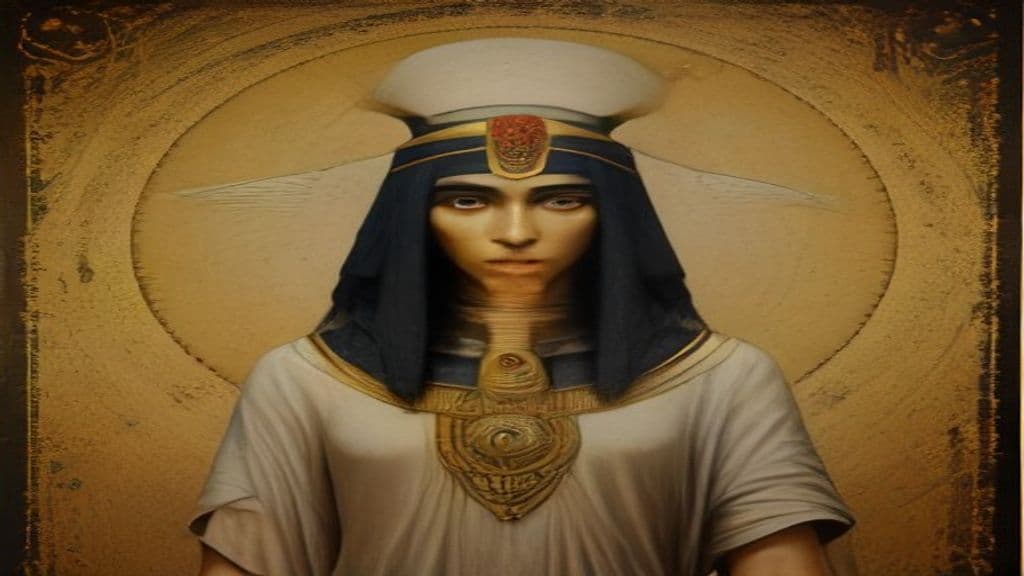
In Egyptian mythic cosmology Thoth is presented as a primordial divine figure credited with having originated essential arts of knowledge and measurement; sources state the ancient Egyptians regarded him as "One, self-begotten, and self-produced," and he is credited with making the calculations that established the heavens, stars, and the reckoning of time (as in the tale told by Plutarch, preserved in later summaries, where he wins five days from the Moon enabling Nut's children to be born).
Thoth is most commonly depicted as a man with the head of an ibis or as a full ibis, often shown with lunar symbolism such as a lunar disk on a crescent or headdress; in his ape/baboon aspect he appears as a dog-faced baboon or man with a baboon head, an aspect named Aani or A'an associated with equilibrium and underworld functions. He is frequently shown bearing scribal regalia (writing implements) and may hold the ankh or wear crowns appropriate to specific aspect-names.
Thoth is portrayed as inventor and patron of writing (hieroglyphs), sciences, arts, magic, music, counting, measurement (including of time and stars), and as divine scribe and counsellor to the gods. In funerary mythic contexts he records or reports the weighing of the heart against Ma'at's feather in the Duat, and in mythic narrative he provides counsel and ritual words (for example aiding Isis in the Osiris cycle). Greek and later writers expand his attributions to include astronomy, mathematics, medicine, and related arts; he functions broadly as a cosmic maintainer who preserves Ma'at through measurement, record-keeping, and wisdom.
*Péh₂usōn (reconstructed)
Péh₂usōn is a hypothetical Proto‑Indo‑European pastoral guardian reconstructed by comparative scholars from parallels in Greek and Vedic traditions. Proposed as a Graeco‑Aryan ancestor‑figure, the reconstruction describes a protector of flocks, roads, and travellers rather than an attested historical cultic personality.
57 Mnemosyne
57 Mnemosyne is a large main-belt asteroid (S-type) discovered in 1859 and named after the Greek Titaness Mnemosyne. It is a non-sentient astronomical body studied for its orbital and rotational properties and has been used in dynamical measurements related to Jupiter.
Aamon
Aamon (also Amon) is a named spirit in early modern Western grimoire tradition (Pseudomonarchia Daemonum; the Ars Goetia / Lesser Key of Solomon). He is presented as a high-ranking infernal officer (Marquis/Prince) who governs forty legions and is credited with knowledge of past and future and with affecting human relationships (reconciling or procuring feuds and favor).
Aani
Aani (ancient Egyptian jꜥnr) is the lexical term for the baboon in ancient Egyptian language and functions in religious contexts as an animal icon and theophoric epithet. Attested repeatedly in Egyptian texts and images, the baboon image is used to represent or denote aspects of gods such as Thoth, Hapy, Khonsu, and Osiris rather than implying the animal itself is an independent deity.
Aati
Aati (also rendered Ati) is one of the 42 judges of the dead in ancient Egyptian funerary literature, attested in the Book of the Dead tradition (notably the Papyrus of Nebsemy). Described as originating 'from Heliopolis', Aati's documented function is to question the deceased about a specific moral accusation during the Duat judgment; the funerary texts supply a formulaic denial the soul must recite.
Aba (disambiguation / name-form)
Aba is a polyvalent name-form attested across many unrelated contexts (place names, personal names, animal names, and brief mythological listings). The provided sources do not support a single, coherent supernatural entity called "Aba" and offer no descriptive or ritual material for such a being.
Abadiu of Antinoe
Abadiu of Antinoe was a fourth‑century bishop of Antinoe (Antinoopolis, in Roman Egypt) commemorated as a martyr and saint in the Coptic Orthodox Church, with a feast day on 26 December. Sources record that he was killed during a theological dispute with Arian opponents and reference him in collections of Egyptian martyrs.
Abarbarea
Abarbarea is a name attested in classical Greek and Roman sources for freshwater nymphs (naiads). The name appears for at least two individual mythic figures — a naiad wife of Bucolion and a naiad counted among ancestors of the Tyrians — and Hesychius records plural forms that may indicate the name was also used as a class-name (Abarbareai / Abarbalaiai).
Abas
Abas (Ancient Greek: Ἄβας, gen.: Ἄβαντος) is not a single mythic being but a recurring personal name borne by multiple mortals and minor mythic figures in Greek epic and genealogical traditions — kings, founders, seers, warriors, attendants, a centaur, and a youth transformed by a goddess. The name is glossed in the sources as 'guileless' or 'good-hearted' and appears across Argive, Theban, Trojan, Euboean, and other local cycles.
Abaset
Abaset is a localized ancient Egyptian goddess attested in tomb decoration at El‑Bawiti in the Bahariya Oasis during the 26th Dynasty. She is depicted anthropomorphically with a hedgehog motif incorporated into her headdress and appears on the walls of Qarat Qasr Salim, including twice in the Tomb of Bannentiu. No cult texts, myth narratives, or ritual prescriptions for her are recorded in the cited corpus.
Abderus
Abderus (Ancient Greek: Ἄβδηρος, romanized Ábdēros) is a mortal heroic figure in Greek myth closely associated with Heracles, remembered as the youth left in charge of the Mares of Diomedes who was killed by them. He functions as an eponymous local/divine-hero ancestor for the city of Abdera and received funerary commemoration and athletic agones at his tomb.
Abib and Apollo
Abib and Apollo are Christian ascetics and hagiographic saints of Akhmim (Upper Egypt) attested in Coptic sources and the Historia Monachorum. Remembered for extreme asceticism, monastic leadership, angelic encounters, and inclusion in the Coptic Synaxarion (feast day November 4).
Community Record
- [1]Thoth. Wikipedia article 'Thoth' (summary and excerpts provided in research notes)wiki
- [2]Thoth - in ancient sources @ attalus.org. Attalus name-index reference for Thoth (etymology and name forms)other
- [3]Thoth (Temple/Cult notes) - marvunapp. Cult location and temple notes for Thoth at Hermopolis (marvunapp summary referenced in research notes)other
- [4]Thoth, Divine Scribe — N. A. Lewis. Theosophical reception reference (noted as later esoteric appropriation in research notes)other
- [5]Gods and Monkeys (podcast episode listing). Podcast episode listing Thoth among bird-related deities (used as corroborating cultural context in research notes)other
- [6]The Language Of The Birds (podcast episode listing). Podcast episode referencing Thoth in cultural context (research notes)other
- [7]Thrice-Greatest Hermes, Vol. 1: III. Thoth the Master of Wisdom. Gnostic/Hermetic reception material cited in research notes (illustrating Greek identification with Hermes/Hermes Trismegistus)other