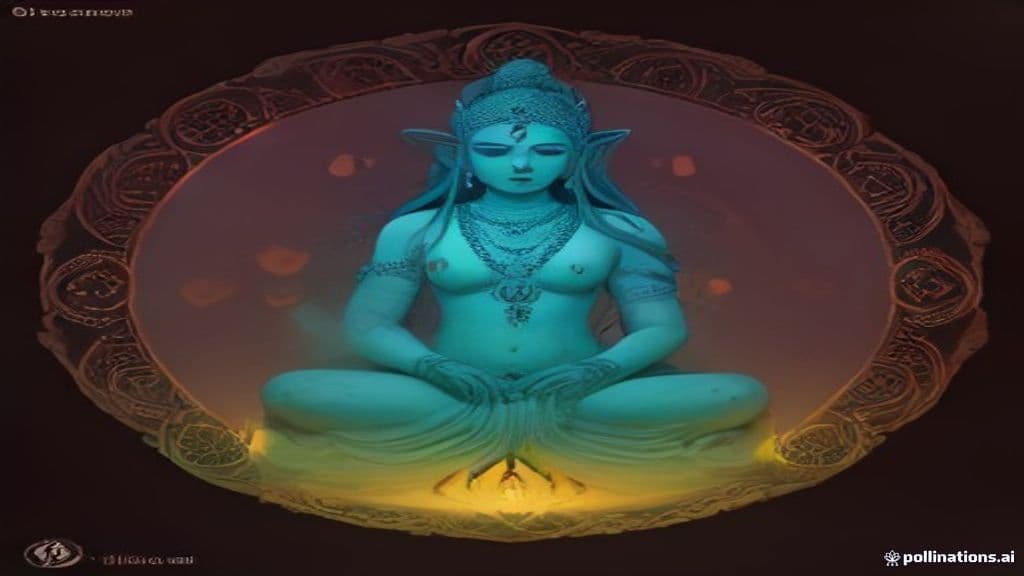
Vāmadeva appears in multiple strata of Sanskrit literature. He is credited with composing Mandala 4 of the Rigveda (Vedic layer). He is named in Upanishadic texts such as the Bṛhadāraṇyaka and the Aitareya (philosophical/teaching layer). In epic literature he serves as priest to King Daśaratha in the Valmiki Rāmāyaṇa (Ayodhyā Kāṇḍa) and appears in narratives of the Mahābhārata (Vana, Sabhā, and Śānti Parvas). Later Purāṇic material (e.g., the Ganeśa Purāṇa) recounts additional episodes. Sources describe him as belonging to the line of seers (son of Gotama; associated with the Angiras lineage) and as an authoritative ritual figure across these textual periods.
The sources do not provide a sustained physical description. Literary episodes place Vāmadeva in settings such as an ashrama/hermitage, royal assemblies, and forests; narratives describe him as present and active in these contexts (for example, keeper of horses in the Vana Parva episode and physically confronted by a gandharva in the Ganeśa Purāṇa), but no detailed corporeal features are given in the cited summaries.
Textual attestations present Vāmadeva as a composer of ṛc (author of Rigveda Mandala 4), a teacher and Upanishadic interlocutor, and a priest/adviser to kings. Epic and Purāṇic narratives ascribe to him the ritual authority to pronounce curses and benedictions that have tangible social and narrative consequences (e.g., cursing King Śala to be slain by rakṣasas in the Mahābhārata episode; cursing a gandharva to become a mouse, later made Ganesha's vahana, in the Ganeśa Purāṇa). He acts as an arbiter of social-ritual order, prescribing remedies, granting boons, and negotiating restitution in stories involving transgression and expiation. The tradition also records a personal transgressive act—his admitted eating of a dog's intestines as noted in Manusmṛti and a self-confession in the Rigveda—showing textual complexity regarding his sanctity.

Gandharva
A class of non-human celestial or semi-celestial beings in Indic religions associated principally with music, song, dance, fertility, and an escort/guardian role for liminal arrivals (such as Soma or beings). In Hinduism they are minor deities and musicians of the devas; in Buddhist cosmology they are a low rank of devas and the term (gandhabba in Pāli/commentary) is also used doctrinally for a sentient intermediate state between death and rebirth.
Rakshasa (Himalayan variants)
A Himalayan reception of the pan-Indian rakshasa motif: hostile or disruptive non‑human beings known from Sanskrit epic and Puranic literature, here noted where Himalayan sources and discussions intersect with the broader epic tradition. The supplied sources do not document distinct, well‑attested Himalayan folklore variants; the entry therefore presents primarily the epic/legendary profile as transmitted into Himalayan contexts in general references.

Angiras
Angiras (Sanskrit Aṅgiras/Aṅgirāḥ) is primarily a Vedic rishi (sage) and eponymous lineage (Angirasa) associated with authorship of Vedic hymns, priestly/fire functions, and transmission of mantras; later Puranic accounts multiply his identities in genealogies and lists of sages.
*Péh₂usōn (reconstructed)
Péh₂usōn is a hypothetical Proto‑Indo‑European pastoral guardian reconstructed by comparative scholars from parallels in Greek and Vedic traditions. Proposed as a Graeco‑Aryan ancestor‑figure, the reconstruction describes a protector of flocks, roads, and travellers rather than an attested historical cultic personality.
Abhimanyu
Abhimanyu is a youthful Kuru/Pandava warrior-hero in the Sanskrit epic Mahābhārata. Son of Arjuna and Subhadra, he is famed for entering the Chakravyuha battle formation on the thirteenth day of the Kurukshetra War and dying at age sixteen; his posthumous son Parikshit continues the Kuru line.
Achyuta
Achyuta (Sanskrit: अच्युत, acyuta) is primarily an epithet/theonym in Vaishnava Hindu tradition applied to Vishnu and Krishna, signifying the divine quality of being 'not fallen' — immutable, infallible, and imperishable. It functions as a devotional name in scripture, liturgy, and Pancharatra lists of divine emanations rather than as an autonomous folkloric spirit.
Acintya
Acintya is an Indonesian Hindu theological-symbolic representation of the ineffable supreme divine principle. In Balinese and Javanese practice it functions as a way to make ultimate reality present in ritual and art—often aniconically as an empty throne (padmasana) or anthropomorphically as a naked, flame-surrounded figure—rather than as a narrative, intervening deity.
Adi (asura)
Adi is attested in modern reference works as the name of an Asura who 'appears in the Matsya Purāṇa.' Beyond this single-line citation in secondary sources, no descriptive material about the figure is provided in the supplied research notes.
Adi Shakti
Adi Shakti (also Adi Parashakti, Mahadevi, Adya Shakti) is the primordial feminine power in Hindu/Shakta theology, regarded as the ultimate reality (Para Brahman) and the source from which all goddesses and gods manifest. She is both an impersonal cosmic principle (Mulaprakriti) and a focus of devotional invocation in temples, mantras, and pilgrimage sites such as Shakti Peethas.
Adi Vinayaka
Adi Vinayaka (Ādi Vināyaka; also called Nara Mukha Vinayaka) is a named iconographic and devotional form of the Hindu god Ganesha portraying the deity with a human head, described in sources as the form before the episode of decapitation by Shiva. It is rarely worshipped and appears in a small number of South Indian shrines and in devotional/musical repertoires.
Aditi
Aditi is a major Vedic goddess in Hindu tradition who personifies the boundless, infinite cosmic principle and functions as the maternal matrix from which many celestial deities (the Ādityas and other groups) are born. In the Vedic hymns she is invoked as a protective liberator who guards petitioners, provides wealth and safety, and frees devotees from hindrances such as sin and sickness.
Agastya
Agastya (also Agathiyar/Agasti) is a revered Vedic and later-period Indian rishi (sage) figure credited in textual traditions as an inspired seer, ascetic, teacher, culture-founder, and attributed author of Vedic, Puranic and Tamil works; in South Indian tradition he is associated with origins of Tamil grammar and Siddha medicine and is identified astronomically with the star Canopus.
Aghasura
Aghasura is an asura from the Vaishnava/Hindu narrative tradition (notably the Srimad‑Bhāgavatam) who, at the command of Kamsa, assumed the form of a vast serpent to ambush Kṛṣṇa and the cowherd boys in Vṛndāvana. The episode demonstrates Kṛṣṇa’s protective, divine power as he enters and destroys the demon from within.
Agiya Baital
The fire-form of the Vetala — a cremation ground spirit of UP and Bihar that manifests as a wandering flame rather than a corpse-inhabitor, leading night travellers off roads and into marshland or flames with a dancing fire that seems always just ahead.
Agneya / Āgneyī
Āgneyī (feminine) or Āgneya (masculine adjective) is a Vedic–Puranic divine figure and ritual principle tied to the fire-god Agni and the southeastern direction. In textual traditions she appears both as a personified daughter/shakti of Agni and as an adjectival/technical term applied to fire-consecrated things (direction, astra, etc.). She also occurs as the name Agneya (or Anala) among items revealed in a Shaiva-Agamic list associated with the Aghora face of Sadashiva.
Community Record
- [1]Vamadeva - Wikipedia. Wikipedia, article 'Vamadeva'.wiki
- [2]Valmiki Rāmāyaṇa - Ayodhyā Kāṇḍa Sarga 3 (prose). Valmiki Rāmāyaṇa, Ayodhyā Kāṇḍa, Sarga 3 (online translation/transliteration).literary
- [3]Valmiki Rāmāyaṇa - Ayodhyā Kāṇḍa Sarga 3 (alternate). Valmiki Rāmāyaṇa, Ayodhyā Kāṇḍa, Sarga 3 (alternate edition).literary
- [4]Valmiki Rāmāyaṇa - Ayodhyā Kāṇḍa Sarga 3 (text). Valmiki Rāmāyaṇa, Ayodhyā Kāṇḍa, Sarga 3 (Sanskrit text resource).literary
- [5]Ganeśa Purāṇa (summary reference in sources). Summary reference to Ganeśa Purāṇa episode in secondary source (Wikipedia).literary
- [6]Mahābhārata (episodes summarized in secondary sources). Summary references to Mahābhārata Vana Parva, Śānti Parva, and Sabhā Parva episodes (Wikipedia).literary
- [7]Wikidata: Vamadeva. Wikidata entry for Vamadeva.other