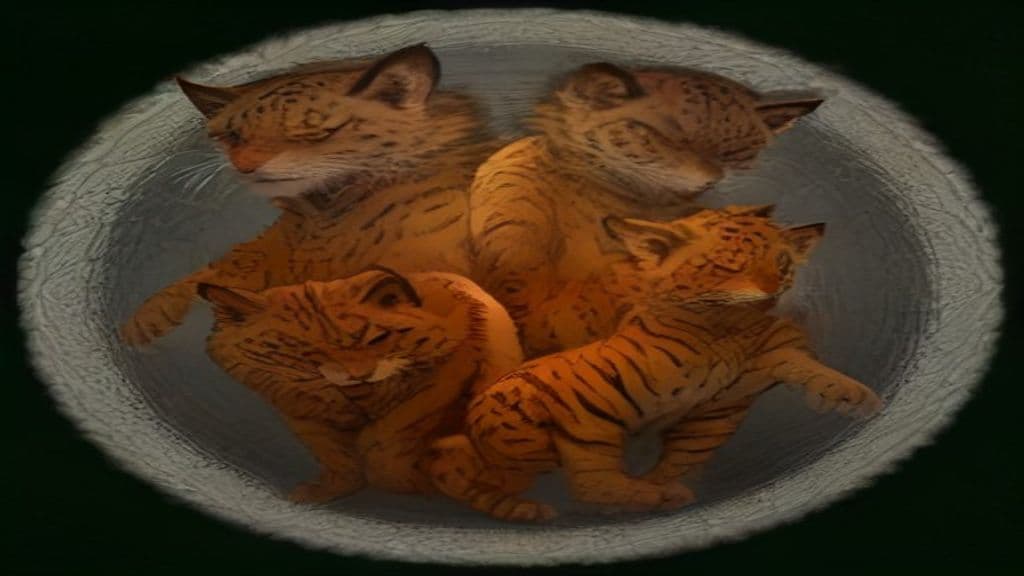
Werecat beliefs do not form a single unified origin story but a family of locally specific explanations. In European contexts the category was often conflated with witchcraft during witch-trial eras (shapeshifters identified socially and legally as witches). African variants (werelion, wereleopard, werepanther) may be described as manifestations, offspring, or masquerades of leopard or lion deities and can be linked to royal lineage or divine agency. In South and Southeast Asia and China, weretiger accounts are variously attributed to sorcery (e.g., oil made by sorcerers in Thailand that produces a Suea Saming), hereditary curse, or vindictive ghosts; Chinese narratives also describe 'Chang' (伥) — ghosts of people killed by tigers — who drive tigers to kill and can result in man-eating weretigers.
Reported forms vary by region. European tales commonly describe people who become domestic cats or occasionally very large cat-like domestic forms. African accounts emphasize big cats — lions, leopards, or panthers — sometimes indistinguishable from ordinary large felids and in some reports exceptionally large (e.g., Nunda/Mngwa phenomena). South and Southeast Asian and Chinese traditions center on tigers: humans who become tigers or tigers that are also people (weretigers); Japanese material mentions bakeneko as shapeshifting felines with humanlike behaviors. Modern fictional depictions expand visual variety but are separate from traditional descriptions.
Core behaviours recorded across traditions are transformation between human and feline forms and predation on humans or livestock. European material often associates transformation with witchcraft rather than additional supernatural powers. African variants link feline transformation to political and sacred power. In Indian and Southeast Asian contexts weretigers are often portrayed as dangerous sorcerers or man-eaters; Thai Suea Saming can be created by topical 'Saming oil' applied by sorcerers and are reported to stalk and kill people. Chinese traditions describe hereditary weretigers or those caused by vengeful ghosts (Chang) that compel tigers to kill more humans. Sources in the corpus note localized attributions of sorcery, curse, ancestral/divine origin, or ghostly agency rather than uniform capabilities beyond shapeshifting and predation.
Weaknesses
- conditionThai-Specific — reversion-interruption before human-eating
Wards
- ritualThai Suea Saming countermeasure (shoulder pole hit or covering footprints with coconut shells)

*Perkʷūnos
*Perkʷūnos is the reconstructed Proto-Indo-European thunder‑god hypothesized by comparative linguistics and mythology. Scholarly reconstructions portray him as a storm or thunder figure associated with fructifying rain and as the combatant who fights a multi‑headed water‑serpent to release life‑giving waters; no direct attestations from the Proto‑Indo‑European period survive and the figure is inferred from later Indo‑European traditions.
*Péh₂usōn (reconstructed)
Péh₂usōn is a hypothetical Proto‑Indo‑European pastoral guardian reconstructed by comparative scholars from parallels in Greek and Vedic traditions. Proposed as a Graeco‑Aryan ancestor‑figure, the reconstruction describes a protector of flocks, roads, and travellers rather than an attested historical cultic personality.
57 Mnemosyne
57 Mnemosyne is a large main-belt asteroid (S-type) discovered in 1859 and named after the Greek Titaness Mnemosyne. It is a non-sentient astronomical body studied for its orbital and rotational properties and has been used in dynamical measurements related to Jupiter.
A ƭat Roog
A term attested in the vocabulary surrounding Roog within the Serer religious system; the provided sources do not supply a clear definitional account of an entity by this exact name. Material available situates the term in the wider context of Serer cosmology in which Roog is the universal supreme deity and ancestor cult (pangool) and priestly mediation (o yaal pangool) structure ritual life.
Abada (unicorn)
Mythical creature in Central African tradition with two crooked horns, possessing healing properties. (Note: 1. Power tier: Primordial (Abada has cosmic, deity-level healing properties) 2. Sensory cues: physical presence and possibly an aura or energy emanating from the horns 3. Weaknesses: should be mention)
Abaddon
In Hebrew scripture Abaddon is primarily a noun meaning 'destruction' or a section/condition of the underworld paired with Sheol; in the New Testament Book of Revelation Abaddon is personified as an angelic figure (Greek Apollyon) described as the king of an army of locusts released from the abyss during the apocalypse.
Aban Yasht
The Aban Yasht is a hymn from the Persian tradition that praises Anahita, a goddess associated with water, fertility, and wisdom. It consists of 132 stanzas and is part of the 21 Yashts collection. (Note: - Power tier should be "Primordial" or possibly "Cosmic", given that it's a hymn of great spiritual significance and associated with a goddess. - The article incorrectly states that Anahita is associa)
Abath
No corroborated folkloric entity named "Abath" is documented in the provided sources. The string appears in the supplied material only as a surname/personal name in Aruban/Dutch-Caribbean archival records and as an unrelated taxonomic or encyclopedic hit; no mythic attributes, origin stories, rituals, or apotropaic practices for an entity called Abath are present in the documents reviewed.
Abatur
Abatur is an uthra (celestial emanation) in Mandaeism described as the 'father of the Uthras' and called the Ancient (ʿattīqā). He resides on the boundary between the World of Light and lower regions, functions as a judge who weighs souls (Abatur Muzania), and supplies instructions and materials to the demiurgic uthra Ptahil in accounts from the Diwan (Scroll) of Abatur.
Abatwa (Twa / Batwa)
Abatwa (also recorded as Twa, Batwa, Mutwa; singular forms Barhwa or Murhwa in some transcriptions) are indigenous hunter‑gatherer peoples of the Great Lakes region of Central Africa, historically identified as some of the earliest inhabitants of the area. The available sources treat them as human ethnic groups whose livelihoods, lands, and populations have been severely affected by conservation policies and modern violence.
Abellio
Abellio is a theonym attested in Roman‑period inscriptions from the Comminges area of the Pyrenees and reported as worshipped in the Garonne Valley of ancient Gallia Aquitania. Surviving evidence is limited to a small number of inscriptions; scholars have variously hypothesized solar or arboreal associations and compared the name to forms of Apollo or to Celtic Belenus, but the deity's precise role in local cosmology remains uncertain.
Abena Mansa
A name attested in a single contemporary Ghanaian blog anecdote as a 'mysterious being'; available sources do not establish Abena Mansa as a coherent, traditional supernatural figure or provide corroborating ethnographic detail.
Community Record
- [1]Werecat — Wikipedia. Wikipedia, 'Werecat' (summary of regional traditions, etymology, and Thai Suea Saming material)wiki
- [2]Wikidata entry — werecat. Wikidata item Q2093615 (database record noting the concept of werecat)other
- [3]Archive: Toralei Stripe Dress Up (character described as daughter of a Werecat). Archive.org character description referencing modern fictional usageliterary
- [4]Ghostbusters Wiki — Werecat Ghost. Fan-wiki page documenting a fictional werecat ghost (modern fictional portrayal, not primary folklore)literary