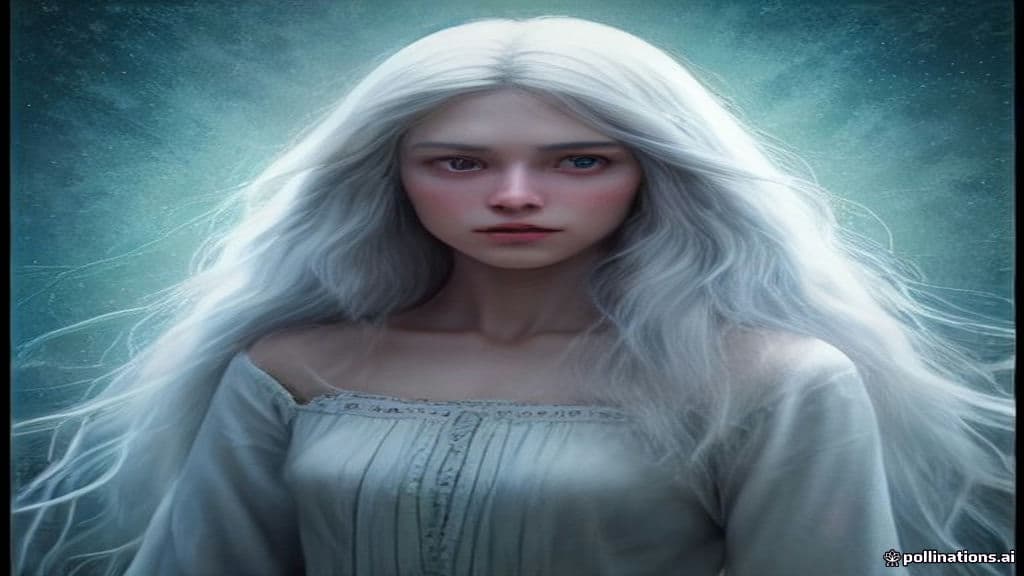
Witte Wiwer is a spirit in Germanic folklore, from Northern Germany. Witte Wiwer are place-bound supernatural women of Low German and north German folklore tied to subterranean and liminal domestic sites. They engage in reciprocal household exchanges (borrowing brewing copper and repaying with beer), musical activity, changeling abductions of unbaptized infants, and are integrated into wider motifs such as the wild hunt and prophetic tree-omens.
No single cosmogonic creation myth is recorded in the provided sources; rather, the witte Wiwer are presented as a longstanding layer of local supernatural beings in Low and north German folk belief. Regional accounts place their dwellings in the earth and liminal natural features: under shrubs and the roots of old trees, in small hills and forest clearings, beneath cow stables (in parts of Mecklenburg), in pits with clear fountains surrounded by groves (the Wittewiwerskule in Westphalia), in caves with doors, in mountains, and—on Rügen—using subterranean tunnels to traverse the landscape. They are treated as indigenous, place-attached female entities whose presence is signaled by connected natural features (for example an oak tied to the witte Wiwer of Mönchgut that withered when they were driven away and whose future sprouting they prophesied).
Sources describe the witte Wiwer as women-like supernatural beings rather than giving detailed, consistent physical descriptions. Narrative details indicate they can appear with long, flying hair when fleeing the wild hunt and are sometimes described as unkempt, unwashed, and sweaty in the context of pursuit. Otherwise they are referenced generically as 'women' of the supernatural sort (Low German: witte Wiwer, singular witt Wif or weißes Weib).
The witte Wiwer are musical and social: they 'play merry music and have very fine voices.' They participate in domestic reciprocity by asking to borrow the household brewing copper every new moon during the twilight hour; if granted they take it unseen and return it three evenings later at the same hour filled with cans of beer brewed by them as payment, and they may request sweet porridge at weddings. They enact changeling abductions, exchanging unbaptized newborn children for changelings (Wechselbälge) when no light burns beside the cradle at night. They may abduct women just out of childbed and bring them to their dwellings, threatening to wring the woman's neck if she attempts to leave. In Rügen accounts they use subterranean tunnels to move between places. They are also connected to the wild hunt, from which they flee with flying hair and may be captured by a female wild huntswoman (de oll Fru Waur). Finally, they have prophetic associations tied to particular trees, as when the Mönchgut witte Wiwer prophesied their return when a withered oak should sprout again.
Weaknesses
- conditionpresence of a burning light beside the cradle
Wards
- ritualkeep a light burning beside the cradle

Wild Hunt
A fearsome spectral cavalcade of the dead sweeping through the winter sky — those who see it risk being carried off or killed, and its passage foretells war, plague, or catastrophe.

Wechselbalg
The Changeling of Germanic and Norse tradition — a fairy or demonic child substituted for a stolen human infant, identifiable by its voracious appetite, failure to thrive, and uncanny behavior.
Abraun
Abraun is an attested name in German-language plant-legend scholarship (Der abraun, ein beitrag zur pflanzensagenkunde, 1916) and a short database entry (Wikidata) labels it as a spirit from German mythology. Surviving accessible documentation is extremely limited: the principal academic treatment is a 1916 contribution to pflanzensagenkunde (plant-saga studies), but the excerpts available here contain only bibliographic metadata and do not record tales, descriptions, or rituals.
Adils
Adils (Old Norse Aðils; also Eadgils, Adillus, Athisl, Adhel) is a semi‑legendary sixth‑century Swedish king attested in Old Norse saga material and later medieval traditions. He appears in saga episodes as a storied royal figure involved in warfare, court acts, and marriage suits rather than as a supernatural being.
Agent Liberty
Agent Liberty is a fictional human operative persona in DC Comics and its television adaptation (Arrowverse). The identity—most prominently used by Benjamin 'Benjy/Ben' Lockwood—functions as a costumed, paramilitary/enforcer role tied to political movements (Sons/Children of Liberty) or official security details, driven by ideological 'liberty' rhetoric rather than supernatural agency.
Agilaz (Egil)
Agilaz (reconstructed Proto-Germanic) — commonly recorded in medieval sources as Egil or Ægil — is a legendary archer attested in Germanic heroic tradition. He appears as the brother of Völund (Wayland/Weland) in the Old Norse poem Völundarkviða and in the Thidreks saga, and his name is also inscribed on early medieval objects (Franks Casket, Pforzen buckle). The attested material presents him as a named heroic human archer within saga and inscriptional contexts rather than as a recurrent supernatural species.
Agropelter
A North American "fearsome critter" of lumbercamp tall-tale tradition said to dwell in hollow conifer trees and hurl broken branches and splinters at unwary people; presented in folklore as an animal-like, mischievous or predatory woodland creature rather than a deity or spirit of formal cosmology.
Alaisiagae
A group of Germanic female deities attested in Roman Britain, worshipped by continental auxiliary troops at a shrine near Vercovicium (Housesteads) on Hadrian's Wall. Epigraphic evidence records dedications to named members (Beda, Fimmilena, and in other lists Baudihillia and Friagabis) alongside Mars Thincsus and the numen of the emperor; modern scholarship interprets them variously as war/victory goddesses, as goddesses associated with assembly/justice, or as part of Matronae‑type fertility/ancestor cults.
Alberich
In Germanic heroic legend, Alberich is a dwarf associated with elven qualities and power. (Note: 1. Power tier: Reduce to Ancient as Alberich's abilities are not described beyond being a dwarf with elven qualities. 2. Origin story: Clarify that Alberich is mentioned in multiple Germanic texts, bu)
Alcis
A pair of youthful brother-deities worshipped by the Naharvali, attested only in Tacitus' Germania (c. 98 CE). They were venerated in a sacred grove under the care of a priest in female attire and are compared by Roman ethnography to the Graeco‑Roman Dioscuri (Castor and Pollux).
Ale the Strong
Ale the Strong (Old Norse: Áli hinn frækni; Latin: Olo Vegetus) is a legendary human king in medieval Scandinavian saga and chronicle tradition. Portrayed as a vigorous and fearsome warrior-king, he appears in Heimskringla, Gesta Danorum and the Codex Runicus cycle and is consistently slain by the hero Starkad.
Alf and Alfhild
Alf and Alfhild are legendary human figures from Old Norse/early Scandinavian narrative tradition preserved principally in Saxo Grammaticus' Gesta Danorum. The tale presents Alf as a Danish prince and Alfhild as a Geatish princess who becomes a shieldmaiden and leader of a fleet of female raiders; their story includes combat, recognition, marriage, and later dynastic conflict.
Alfred Bulltop Stormalong
A New England maritime tall-tale hero and giant seafarer, Stormalong functions in sailors' oral tradition and early-20th-century tall-tale collections as a repository for exaggerated seamanship, prodigious physical size, and impossible nautical exploits rather than as a literal supernatural being.
All-Flash
All-Flash (originally All-Flash Quarterly) is a Golden Age American comic-book magazine series published 1941–1947 that served as the first solo magazine vehicle for Jay Garrick, the original Flash. The title is a commercial/branding name later used as an English lexical phrase in unrelated technical and web contexts.
Community Record
- [1]Witte Wiwer (Wikipedia). Wikipedia: Witte Wiwer (article text provided)wiki
- [2]Witte Wiwer (Wikidata). Wikidata: Witte Wiwer (entity summary)wiki