
Geographical origin: The river Yamunā rises at the Yamunotri Glacier on the southwestern slopes of Bandarpunch in the Lower Himalaya (Uttarakhand), flows through Himachal Pradesh and the Indo‑Gangetic plains (Uttar Pradesh and Haryana) for approximately 1,376 km and merges with the Ganges at the Triveni Sangam, Prayagraj (source: geographic/encyclopedic accounts). Mythological/genealogical origin: In Hindu textual traditions the river is personified as a goddess; early texts refer to her as Yami and later literature also calls her Kalindi. Some accounts describe Yamunā as a daughter of the Sun and as sister to other solar offspring, and certain devotional (Vaishnava) sources identify her as the younger sister of Yamaraja and portray Krishna as intimately associated with the river (sources: textual and devotional summaries).
The supplied sources do not provide a sustained anthropomorphic or iconographic description of Yamunā-as-goddess. What the record does show is the river/goddess' visible presence in ritual spaces along its banks: ghats (for example Geeta Ghat in Delhi) where public festivals and immersion rites take place, and pilgrimage congregations at the Triveni Sangam. Photographic and archival references document ritual activity on the riverbank but not a canonical bodily iconography in the provided excerpts (sources: festival/archival notes; devotional texts).
The sources frame Yamunā primarily as a sacred, worshipped river-goddess with ritual and devotional functions rather than as a being of explicitly described magical attacks or malefic action. She is treated as sacral water—associated with purification and pilgrimage practices by virtue of being a holy river (sources: encyclopedic and ritual geography summaries). Mythic texts and devotional accounts situate her in relational networks with other deities: she is portrayed as a daughter of the Sun (textual/genealogical tradition) and, in Vaishnava accounts, Krishna is described as 'the life of the river' because of his pastimes on her banks; Indra is also mentioned in narratives affecting the river's waters (sources: mythological summaries; Vaishnava material).
*Péh₂usōn (reconstructed)
Péh₂usōn is a hypothetical Proto‑Indo‑European pastoral guardian reconstructed by comparative scholars from parallels in Greek and Vedic traditions. Proposed as a Graeco‑Aryan ancestor‑figure, the reconstruction describes a protector of flocks, roads, and travellers rather than an attested historical cultic personality.
Abhimanyu
Abhimanyu is a youthful Kuru/Pandava warrior-hero in the Sanskrit epic Mahābhārata. Son of Arjuna and Subhadra, he is famed for entering the Chakravyuha battle formation on the thirteenth day of the Kurukshetra War and dying at age sixteen; his posthumous son Parikshit continues the Kuru line.
Achyuta
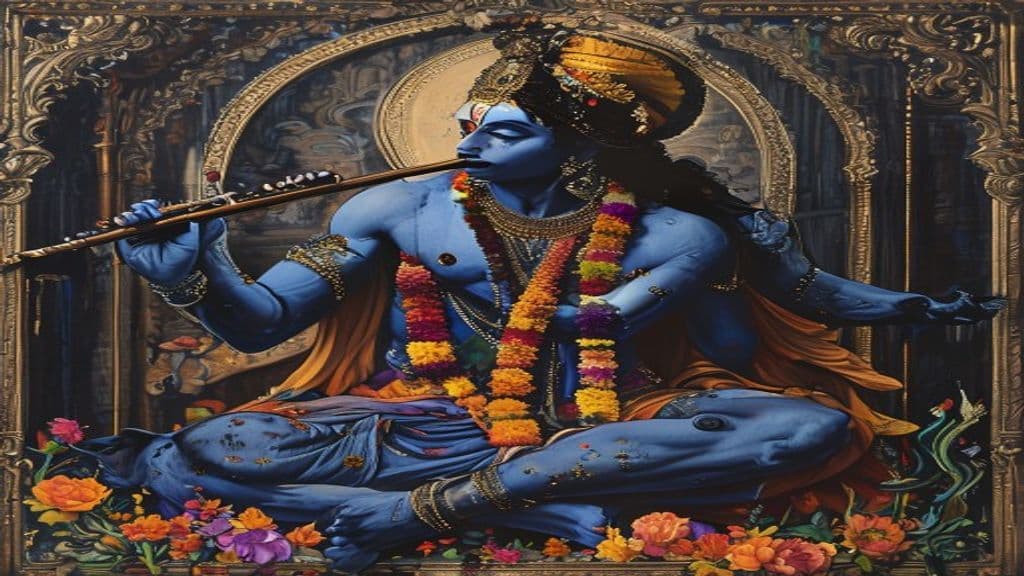
Achyuta (Sanskrit: अच्युत, acyuta) is primarily an epithet/theonym in Vaishnava Hindu tradition applied to Vishnu and Krishna, signifying the divine quality of being 'not fallen' — immutable, infallible, and imperishable. It functions as a devotional name in scripture, liturgy, and Pancharatra lists of divine emanations rather than as an autonomous folkloric spirit.
Acintya
Acintya is an Indonesian Hindu theological-symbolic representation of the ineffable supreme divine principle. In Balinese and Javanese practice it functions as a way to make ultimate reality present in ritual and art—often aniconically as an empty throne (padmasana) or anthropomorphically as a naked, flame-surrounded figure—rather than as a narrative, intervening deity.
Adi (asura)
Adi is attested in modern reference works as the name of an Asura who 'appears in the Matsya Purāṇa.' Beyond this single-line citation in secondary sources, no descriptive material about the figure is provided in the supplied research notes.
Adi Shakti
Adi Shakti (also Adi Parashakti, Mahadevi, Adya Shakti) is the primordial feminine power in Hindu/Shakta theology, regarded as the ultimate reality (Para Brahman) and the source from which all goddesses and gods manifest. She is both an impersonal cosmic principle (Mulaprakriti) and a focus of devotional invocation in temples, mantras, and pilgrimage sites such as Shakti Peethas.
Adi Vinayaka
Adi Vinayaka (Ādi Vināyaka; also called Nara Mukha Vinayaka) is a named iconographic and devotional form of the Hindu god Ganesha portraying the deity with a human head, described in sources as the form before the episode of decapitation by Shiva. It is rarely worshipped and appears in a small number of South Indian shrines and in devotional/musical repertoires.
Aditi
Aditi is a major Vedic goddess in Hindu tradition who personifies the boundless, infinite cosmic principle and functions as the maternal matrix from which many celestial deities (the Ādityas and other groups) are born. In the Vedic hymns she is invoked as a protective liberator who guards petitioners, provides wealth and safety, and frees devotees from hindrances such as sin and sickness.
Agastya
Agastya (also Agathiyar/Agasti) is a revered Vedic and later-period Indian rishi (sage) figure credited in textual traditions as an inspired seer, ascetic, teacher, culture-founder, and attributed author of Vedic, Puranic and Tamil works; in South Indian tradition he is associated with origins of Tamil grammar and Siddha medicine and is identified astronomically with the star Canopus.
Aghasura
Aghasura is an asura from the Vaishnava/Hindu narrative tradition (notably the Srimad‑Bhāgavatam) who, at the command of Kamsa, assumed the form of a vast serpent to ambush Kṛṣṇa and the cowherd boys in Vṛndāvana. The episode demonstrates Kṛṣṇa’s protective, divine power as he enters and destroys the demon from within.
Agiya Baital
The fire-form of the Vetala — a cremation ground spirit of UP and Bihar that manifests as a wandering flame rather than a corpse-inhabitor, leading night travellers off roads and into marshland or flames with a dancing fire that seems always just ahead.
Agneya / Āgneyī
Āgneyī (feminine) or Āgneya (masculine adjective) is a Vedic–Puranic divine figure and ritual principle tied to the fire-god Agni and the southeastern direction. In textual traditions she appears both as a personified daughter/shakti of Agni and as an adjectival/technical term applied to fire-consecrated things (direction, astra, etc.). She also occurs as the name Agneya (or Anala) among items revealed in a Shaiva-Agamic list associated with the Aghora face of Sadashiva.
Community Record
- [1]Yamunā. Wikipedia, 'Yamuna'.wiki
- [2]Yamuna in Hinduism. Wikipedia, 'Yamuna in Hinduism'.wiki
- [3]Myth and Folklore entry: Yamuna. Mythfolklore.net, 'Yamuna' (encyclopedic summary).folk
- [4]The Hare Krsnas - Yamuna (Demigods and Controlling Deities). Hare Krsna/ISKCON devotional material, 'Yamuna'.other
- [5]Photograph: Durga immersion at Geeta Ghat, Yamuna, Delhi (captioned). Archival photograph caption noting singing and dancing prior to Durga immersion at Geeta Ghat (2005).other
- [6]Impact of Covid-19 on Yamuna River water quality: Possible ways to rejuvenate the riverine ecosystem in national capital. Academic article addressing Yamuna water quality and riverine ecosystem (environmental study referenced).academic
- [7]How Vedāntic was Yāmuna? | Elisa Freschi. Scholarly/blog discussion of Yamuna in Vedāntic context (supplementary interpretive material).other