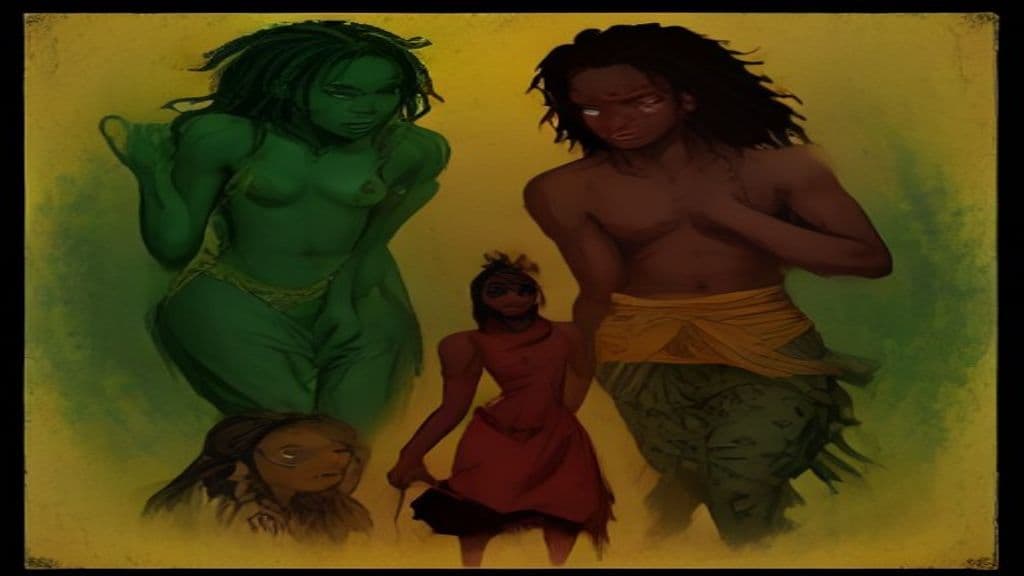
No traditional origin story or cosmogonic account for the Zimwi is recorded in the supplied sources. Within the available materials the Zimwi appears as a tale-figure in Swahili/Zanzibari narrative cycles and in cross-cultural anthologies: its role is that of a cautionary or fearsome antagonist in stories transmitted for children and general audiences rather than as a being embedded in a documented ritual or cosmological genealogy in the provided documents.
The provided sources do not supply a consistent physical description. The Zimwi is presented as a generic monstrous antagonist in tale summaries and anthology listings; where narrative detail exists it emphasizes the creature's actions (abduction and compelling a girl to be a drum's voice) rather than specific bodily traits. Therefore no reliable catalogue of size, form, or distinguishing features can be extracted from the supplied material.
In the attested tale material the Zimwi abducts a Swahili girl and compels her to be 'the voice inside his singing drum,' which implies abilities of abduction and of binding or transforming a human into an instrumental or enchanted role. Beyond this single narrative instance—abduction and enforced service as the animate voice of a drum—no further magical powers, shapeshifting, or cosmological functions are documented in the provided sources.

Aicha Qandicha
Aicha Qandicha is a female seductress spirit in northern Moroccan folklore, often associated with bodies of water and implicated in harmful encounters with men. She appears both as a wild liminal monster and as a named spirit incorporated into local ritual systems (Hamadsha, Zār, Buffi Sufi orders).
Buda
In Ethiopian and Eritrean popular religion, buda (Ge'ez: ቡዳ) is a socially-located hostile power associated with the evil eye and the ability of its bearer to change into a hyena. It is attributed to particular social groups (for example Beta Israel and metalworking castes) and is countered by amulets, debtera-made protections, and Christian exorcism.
Dingonek
A large aquatic or semi-aquatic 'beast' reported in early 20th-century European hunter accounts from the Lake Victoria region. Described by eyewitness John Alfred Jordan (as recorded by Edgar Beecher Bronson) as a 4.3–4.6 m scaled, leopard-marked reptilian with a broad fin-like tail and large fangs; colonial-era commentators and later compendia treat it as a cryptid associated in some reports with local ritual practice.
Hamadryas baboon (tradition)
The hamadryas baboon (Papio hamadryas) is an Old World primate native to the Horn of Africa and southwestern Arabian Peninsula. In ancient Egyptian religious and archaeological contexts baboons are attested as sacred animals kept in temple precincts and represented in votive statuary and funerary catacombs (the Sacred Animal Necropolis at North Saqqara included baboons among its interments and monuments). The cited materials document the species' biological ecology and its institutional cultic treatment in temple and necropolis contexts but do not supply mythic origin narratives or ritual liturgies specific to the species.
Nandi bear
The Nandi bear is a folkloric cryptid reported from East Africa, particularly the western Kenya highlands associated with the Nandi people. Described in oral reports and later popular literature as a ferocious, shaggy carnivore (also called Chemosit, Kerit, Ngoloko, Koddoelo, or Duba), the Nandi bear features in 19th–early 20th century sighting reports and modern cryptozoological discussion; scientific sources cited in the available material argue sightings are best explained as misidentifications of known animals.
Nyikaya
Nyikaya is a female river spirit in Shilluk (Silluk) cosmology who is described as the mother of the culture-hero Nyikang and as the river-dwelling recipient of the king's spirit at death. She is depicted in the sources as a hybrid figure — described explicitly as “half-woman, half-crocodile” — and functions in Shilluk ritual and ideology as the maternal river-spirit who must be petitioned to restore or accept the royal spirit during succession rites.
Popobawa
Popobawa is a recent folkloric shetani (malicious spirit) from Zanzibar and coastal Tanzania, blamed for nocturnal assaults, poltergeist-like disturbances and episodes of community panic. Reports describe it as a shapeshifting, night-attacking spirit whose sightings have episodically risen since the mid-20th century and that is met locally with charms, exorcisms and communal vigilance.
Zhong Kui
Zhong Kui (鍾馗) is a Chinese Taoist protective figure and vanquisher of ghosts and evil beings, invoked and depicted in court ritual and popular practice to repel, seize, and punish harmful spirits. Originating in Tang-era dream narratives and later literary and ritual accretions, his image and invocation function as official and household protective measures, especially at New-Year liminal moments.
Zhrets (Slavic Tradition)
A zhrets is a priest in the Slavic religion, responsible for mediating between humans and gods. (Note: 1. Power tier should be Primordial, as zhrets are described as possessing cosmological knowledge and playing a significant role in resisting Christianity, indicating a level of power that aligns with )
Zilant
A legendary Tatar/Idel‑Ural snake‑dragon figure associated with foundation legends (notably Kazan). Descriptions range from enormous serpents to winged dragon‑like hybrids; in tales it threatens settlements, takes tribute, or is overcome by heroes often with magical counsel.
Zin (Water Spirits)
Mythical water spirits in West African Songhai mythology. (Note: * Power tier should be Lesser or Minor Spirit, as there is no mention of their powers or abilities. * Appearance description is missing; however, since it's not provided in the source material, it can)
Zinariya (Jinayana)
No verifiable information about an entity called Zinariya or Jinayana is present in the provided source materials. The available sources do not mention this name, nor do they contain Central African folklore data relevant to the entity.
Community Record
- [1]Bimwili & the Zimwi : a tale from Zanzibar (archive listing). Verna Aardema, Bimwili & the Zimwi (archive listing)literary
- [2]The zimwi (Africa--from the Swahili) (anthology table of contents entry). Dell Yearling anthology listing: 'The zimwi (Africa--from the Swahili)'literary
- [3]Zimwi Likujualo Halikuli Likakuisha (Wikidata entry). Wikidata: serialized novella title referencing 'Zimwi Likujualo Halikuli Likakuisha' (E. Ganzel)other
- [4]La Guardia Del León 1 X 20 Cuidado Con El Zimwi (TV episode listing). Spanish-language TV episode listing referencing 'Zimwi'other
- [5]Bogeyman (comparative framing). Wikipedia: bogeyman (used in source set to frame comparative narrative function)wiki
- [6]Myths and Legends of the Bantu. Alice Werner, Myths and Legends of the Bantu (background on Bantu folktale contexts)academic