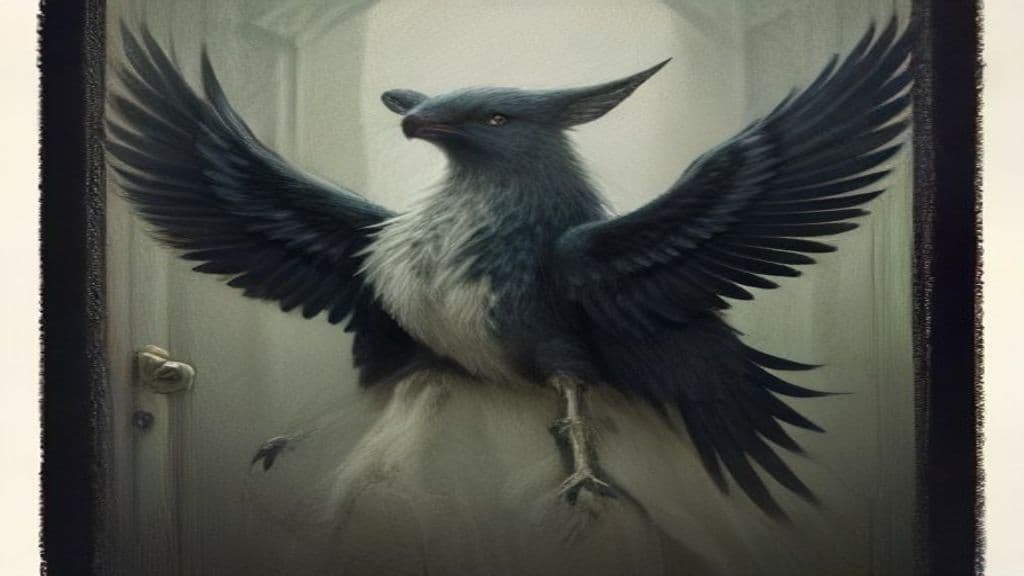
The available sources place Aderyn y Corff within Welsh vernacular and textual contexts rather than as a mythic progeny tale: the name appears in Welsh-language tradition and is referenced twice in the Welsh-language Bible, a fact which some authors cite as influential to the superstition. Folkloric treatments and modern overviews of Welsh ghosts include the corpse-bird among phenomena that portend death, situating the motif within a broader corpus of Celtic bird-lore and domestic death-omen beliefs rather than attributing a single creation myth or originating narrative in the supplied material. Thus its 'origin' in the collected material is the convergence of Welsh-language textual mention and oral tradition treating an avian figure as a harbinger at the threshold of death.
Sources describe the Aderyn y Corff as a bird-like supernatural being yet explicitly note unusual physical features: it is said to have no feathers or wings while still being identified as a 'bird' in tradition. When it does not manifest at a dying person's door, it is described as living on another plane of existence, implying that its visible corporeal appearance may be limited to the moment of omen-calling. Beyond these characteristics, no further consistent physical description (such as size, color, or precise form) is attested in the provided material.
The principal attributed ability of Aderyn y Corff is to announce imminent death: it chirps outside the door of a soon-to-be deceased person with a cry reported to resemble the Welsh word dewch ('come'). Ontologically, it alternates between manifesting at domestic thresholds to call and residing on another plane when not calling, indicating an ability to traverse or inhabit an unseen realm and make itself perceptible at critical moments. Modern commentators and some contemporary accounts also interpret the reports naturalistically, identifying the corpse-bird with a screech owl drawn to lights in a sick person's room; this naturalizing view appears in the available summaries but is treated as an explanatory hypothesis rather than a contradictory tradition.
Abandinus
Abandinus is a locally attested Romano‑Celtic theonym known from a single inscribed bronze feather (votive object) dedicated at Godmanchester (the Roman fort Durovigutum) in Cambridgeshire. Scholars interpret him as a local god or male spirit tied to a specific place and possibly associated with a nearby spring or stream; this association is tentative and based on etymological readings of the name.
Abarta (Ábartach)
Abarta (also Ábartach) is a figure of Irish myth who, in surviving accounts, tricks Fionn mac Cumhaill's warriors by giving them a supernatural grey horse that bears them into the Otherworld. Sources variably identify him as a member of the Tuatha Dé Danann or as a Fomorian; after the incident he is compelled to release the captured warriors and is refused entry to the Fianna.
Abcán (Abhcán)
Abcán (modern spelling Abhcán) is a named dwarf poet and musician of the Tuatha Dé Danann in Irish myth. He appears in a small number of narratives as a musician whose art has soporific power and as the ferryman who brings the goddess Ruad from the Otherworld to the human world.
Abhean
Abhean is a named poet of the Tuatha Dé Danann in medieval Irish literature, described as a poet in particular of Lugh and recorded as having been killed by Óengus before Midir in a poem by Fland Mainistreach preserved in the Lebor Gabála Érenn.
Abnoba
Abnoba is a Gaulish theonym and toponym attested in Roman-era sources and inscriptions: a localized deity associated with woods, springs and the sources of rivers (notably the Danube) and simultaneously the name applied to a mountain or mountain range in the Black Forest/Baar/Odenwald region. Roman altars equate her with Diana, reflecting syncretic cult practice in frontier provinces.
Accolon
Accolon is a mortal knight of the Arthurian court, presented in the Post-Vulgate Merlin tradition and Malory's Le Morte d'Arthur as Morgan le Fay's paramour and instrument in a plot to supplant King Arthur; his tale centers on enchanted weapons (Excalibur and its scabbard), love-manipulation, and a tragic duel with Arthur.
Achall
Achall is an eponymous mortal woman in the Ulster Cycle of early Irish literature whose grief-induced death is given as the origin of the hill-name Achall (identified with the modern Hill of Skryne). She appears as a genealogical and etiological figure tied to Tara and later legendary events at the hill, rather than as a recurring supernatural agent.
Achtland
Achtland is a figure from Irish tradition who, according to the surviving account, was a mortal woman famed for rejecting mortal suitors who married a member of the Tuatha Dé Danann and crossed into the síde to become immortal as his wife.
Adar Llwch Gwin
Legendary large, intelligent birds from Welsh tradition said to understand human speech and obey their master's commands; best known for tearing their master Drudwas ap Tryffin to pieces when bound by a literal order in an Arthurian battle narrative. The term later came to be applied to raptors and metaphorically to brave men in medieval Welsh poetry.
Adar Rhiannon
Adar Rhiannon ('birds of Rhiannon') are a set of three magical birds in medieval Welsh narrative (the Mabinogi) whose song can 'wake the dead and lull the living to sleep.' They appear as otherworldly song‑beings tied to the figure Rhiannon and function within tales as providers of enchanted music that sustains and consoles characters.
Adhene
A class of Manx fairies (Cloan ny moyrn) described in Isle of Man tradition as a social people of beings said to be "fallen angels cast from heaven but too good for hell," who interact with human livelihoods and families, sometimes benevolent but often mischievous.
Adna mac Uthidir
Adna mac Uthidir (also spelled Adhna) is attested in early Irish tradition as a historical or legendary poet and sage who held the office of Chief Ollam of Ireland (and in some accounts Chief Poet of Ulster) and who is credited, with Forchern and Atharne, with collecting the axioms of Irish law into a single volume. He is placed by medieval tradition around the time of King Conchobar mac Nessa (traditionally c. 1st century AD), and fragments of laws attributed to him are reported in later manuscript collections.
Community Record
- [1]Aderyn y Corff. Wikipedia, 'Aderyn y Corff' (summary and quotations on the corpse-bird, physical traits, call, and modern identifications).wiki
- [2]Aderyn y corph. Wikidata entry classifying Aderyn y corph as a bird from Welsh mythology.other
- [3]Review: The Folklore of Wales: Ghosts. Review noting placement of the corpse-bird motif among Welsh ghost and omen traditions.folk
- [4]Celtic bird-lore overview (Arcanaverba). Overview of Celtic bird-lore used for contextual background linking Aderyn y Corff to wider omen-bearing bird traditions.other