
The Ādi‑Buddha concept appears in Indian tantric and Mahāyāna discussions of the dharmakāya or root Buddha (terms such as Dharmabuddha, Dharmatā‑buddha, Mūlatathāgata and Tathatājñāna‑buddha are cited in earlier literature). Specific tantric texts named in modern secondary sources as referencing an Ādibuddha include the Kalachakra Tantra and the Guhyasamāja Tantra; in Nyingma Dzogchen the Kunjed Gyalpo Tantra presents Samantabhadra in paradigmatic terms (calling Samantabhadra the 'All‑Creating King' in that tantra). Tibetan schools subsequently personified or identified the Ādi‑Buddha in tradition‑specific ways (Samantabhadra in Nyingma/Bön, Vajradhāra in Kagyu/Gelug/Sakya, and Kalachakra in Jonang), while some commentarial strands and later receptions (e.g., certain Indian commentaries that associate Mañjuśrī with an Ādibuddha role, and modern syncretic uses) expand the semantic field.
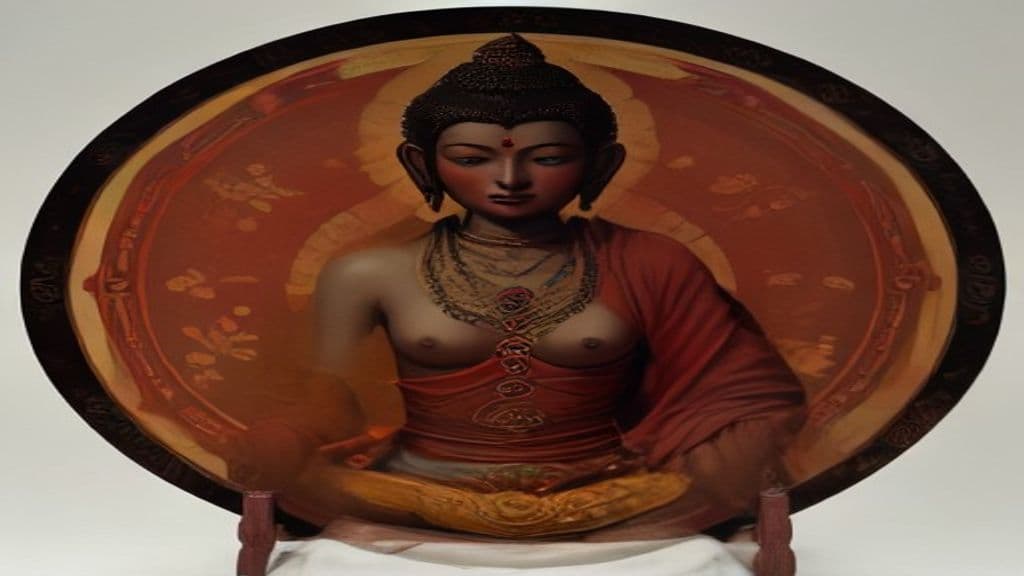
Presentation varies by tradition: Nyingma Dzogchen iconography commonly depicts the Ādi‑Buddha as Samantabhadra, often shown as a naked blue Buddha; Dzogchen teachers interpret this imagery symbolically (for example, Dzogchen Ponlop is quoted as interpreting the color blue as symbolizing spacious, unchanging quality and nakedness as an interpretive sign of the genuine reality beyond conceptual clothing). Other Tibetan identifications (Vajradhāra, Kalachakra) are named in the sources but detailed iconographic descriptions for those personifications are not provided in the supplied material.
Sources consistently describe the Ādi‑Buddha in ontological and epistemic terms rather than as an agent performing miraculous deeds. It is framed as the dharmakāya, the primordial ground or innate gnosis that pervades minds and stands as the basis for both samsara and nirvana (a reading emphasized in summaries of the Kalacakra tradition by Vesna Wallace). The Kunjed Gyalpo Tantra calls Samantabhadra the 'All‑Creating King' and describes phenomena as manifestations or displays of Samantabhadra, but commentators like Namkhai Norbu stress this wording is metaphorical and not a literal theistic creation claim—Samantabhadra denotes the unconditioned state from which appearances arise. Practically, the Ādi‑Buddha functions as the focus of tantric sadhana and Dzogchen instruction rather than as a hostile or intervening supernatural agent.
Weaknesses
- conditionNot applicable — traditional sources do not attribute vulnerabilities to the Ādi‑Buddha; it is presented as the primordial ground or innate gnosis rather than a being to be overcome
Wards
- otherNot applicable — sources do not give protections or warding rituals against the Ādi‑Buddha; the literature emphasizes recognition/realization rather than defense
3-D Man
3-D Man is a Marvel Comics superhero identity associated with a 1950s-era origin in which the body of Chuck Chandler can materialize in three-dimensional existence when activated by his brother Hal via a pair of glasses. The mantle was later assumed by Delroy Garrett (formerly Triathlon) in modern continuity.
5 Ronin
5 Ronin is a 2011 Marvel Comics five-issue limited series that reimagines five Marvel superhero archetypes as rōnin (masterless samurai) in a fictionalized post‑Sekigahara feudal Japan. The work places Wolverine, Hulk, Punisher, Psylocke, and Deadpool analogues into period roles to explore displacement, revenge, and identity in an era of political upheaval.
58 Concordia
58 Concordia is a fairly large main-belt asteroid orbiting the Sun, discovered in 1860 and named after the Roman goddess Concordia. Astronomical sources classify it as a C-type (carbonaceous) body with a multi-year orbital period and measurable rotation and pole orientations.
9MOTHER9HORSE9EYES9
An anonymous Reddit screen name and online persona used by the author of the Interface series, a multipart speculative-horror narrative posted in short installments across Reddit in 2016. The name functions as the signature of an authorial identity and as a focal label for a fandom that created archives, a subreddit, and a wiki documenting the story and its fictional phenomena (notably entities called "flesh interfaces").
A.R.G.U.S.
A.R.G.U.S. is a fictional clandestine United States government agency in the DC Comics universe that investigates, contains, and manages superhuman, meta-human, and supernatural incidents and assets. Introduced in The New 52 continuity, it functions as an institutional actor providing intelligence, logistical support, covert task forces (notably Task Force X / the Suicide Squad), and a dedicated magic division across comics and media adaptations.
Abena Mansa
A name attested in a single contemporary Ghanaian blog anecdote as a 'mysterious being'; available sources do not establish Abena Mansa as a coherent, traditional supernatural figure or provide corroborating ethnographic detail.
Abin Sur
Abin Sur is a fictional extraterrestrial Green Lantern from the planet Ungara in DC Comics. A former history professor turned Green Lantern of Space Sector 2814, he discovered and investigated a prophecy tied to the "Blackest Night," died wounded on Earth and chose Hal Jordan as his ring-successor, and was later reanimated as a Black Lantern in the Blackest Night storyline.
Abishai
Abishai is a personal name attested in several distinct sources: a biblical individual described as the eldest son of Zeruiah (sister of King David); a Semitic chief named in an inscription at Beni-Hasan in Middle Egypt; and modern cultural uses including a named monster in Dungeons & Dragons and as an artist/stage name. The supplied materials do not present Abishai as a supernatural being within a living cosmology.
Abraham Cornelius
Abraham Cornelius is a fictional human scientist in Marvel Comics, a senior Weapon X technician who helped develop the technique to bond adamantium to bone and who features in Wolverine's origin and later storylines, including Death of Wolverine.
Absorbing Man
A fictional Marvel Comics character (Carl "Crusher" Creel) whose body acquires the physical properties of materials or energies he touches. Debuting in Journey into Mystery #114 (March 1965), created by Stan Lee and Jack Kirby, he is presented as a mortal supervillain/occasional antihero who challenges heroes such as Thor, Hulk, Spider-Man, and the Avengers.
Acala
Acala (Sanskrit: अचल, 'The Immovable') is a wrathful protective deity (dharmapala) in Vajrayāna and East Asian esoteric Buddhism, classed among the Wisdom Kings (Vidyārāja). He functions as a ritual focus for visualization and mantra practice intended to remove obstacles and bind or destroy hostile forces.
Acalanātha (Acala / Achala)
Acalanātha (also Acala or Achala) is a wrathful deity and dharmapāla — a protector of the Dharma — prominent in Vajrayana and East Asian Mahayana Buddhist contexts. Presented as a fierce, non‑human or semi‑divine protector-figure, Acalanātha functions to defend the teaching and practitioners by removing obstacles and confronting threats to the transmission and practice of Buddhism.
Community Record
- [1]Adi-Buddha — Wikipedia. Wikipedia: 'Adi‑Buddha' entry (summarizes tantric and Tibetan usages, iconography, and scholarly comments)wiki
- [2]Kalacakra summaries & commentary (as cited). Vesna Wallace quoted in the Wikipedia entry summarizing Kalacakra usage of Ādibuddha as 'innate gnosis' and 'beginningless and endless Buddha'wiki
- [3]Dzogchen interpretive remarks (Dzogchen Ponlop & Namkhai Norbu citations). Wikipedia entry cites Dzogchen Ponlop on Nyingma iconography and Namkhai Norbu on metaphorical meaning of Samantabhadrawiki
- [4]Sang Hyang Adi Buddha — Wikipedia (modern reception). Article on Indonesian use of Sanghyang Adi Buddha as a modern syncretic reception (cited in research notes)wiki
- [5]Adi-buddha [Chapter I] — The Gods of Northern Buddhism (wisdomlib). Discussion of terminology and historical references to root/dharmakāya Buddhas (cited among research materials)other
- [6]Adibuddhas and the Five Tathāgatas — Fabrizio Musacchio (referenced). Modern scholarly/interpretive treatment cited in research notes on adibuddha identificationsother
- [7]Bibliographic and reception references (Biblical Cyclopedia; Theosophical Glossary) — modern receptions. Examples of later non‑canonical receptions and interpretive appropriations (not used as canonical tantric sources)other