
Ancient recensions vary. In Pausanias' account the god Zeus' spilled semen on the earth produced a daimon with both male and female sexual organs called Agdistis; Pausanias links the figure to a mountain near Pessinus called 'Mount Agdistis'. In Arnobius' retelling of Timotheus a related Phrygian tradition identifies a nourishing rock called Agdus as the place-name source for Agdistis and narrates that Liber/Dionysus intoxicated and bound Agdistis, producing the loss of the male organ. Both strands function as aetiologies for later cult practices surrounding Cybele and Attis, and multiple recensions link the severing of Agdistis's male organ to the origin of trees/fruit and to the emergence of Attis in the myth cycle.
Ancient descriptions focus on Agdistis' ambisexual physicality: born with both male and female reproductive organs. Accounts do not provide a standardized pictorial iconography; Arnobius (quoting Timotheus) emphasizes Agdistis' overwhelming physical might and ferocity, while Pausanias treats Agdistis as a daimon born of a divine emission tied to local topography. The most detailed bodily motif in the texts is the later removal/severing of the male genitals as a transforming event.
In the mythic narratives Agdistis embodies potent, transgressive force: ambisexuality and irresistible physical power (Arnobius) that provoke fear among the gods and ecstatic frenzy among humans. Agdistis falls passionately for the youth Attis and, by appearing at the wedding hymn in the Attis story, precipitates frenzied madness that leads Attis (and in some tellings others) to castrate themselves. The myths also attribute regenerative transformations to the severed organ (trees or fruit arising from the blood and severed member) and report Agdistis interceding with the chief sky-god on Attis's behalf to secure that Attis' body will not decay.
Weaknesses
- othermythic severing of male organ by the gods / loss of male potency (narrative limitation)
Wards
- othercollective divine action to remove male potency (mythic restraint enacted by the gods)

Attis
Attis is a mythic consort and semi-divine cult figure associated with the Anatolian Mother Goddess (Cybele / Agdistis). He functions as a vegetation-associated beloved whose self-castration, death, and ritual rebirth form the core myth enacted by his priests and festivals, especially around the vernal equinox in Phrygia, Greece and later Rome.
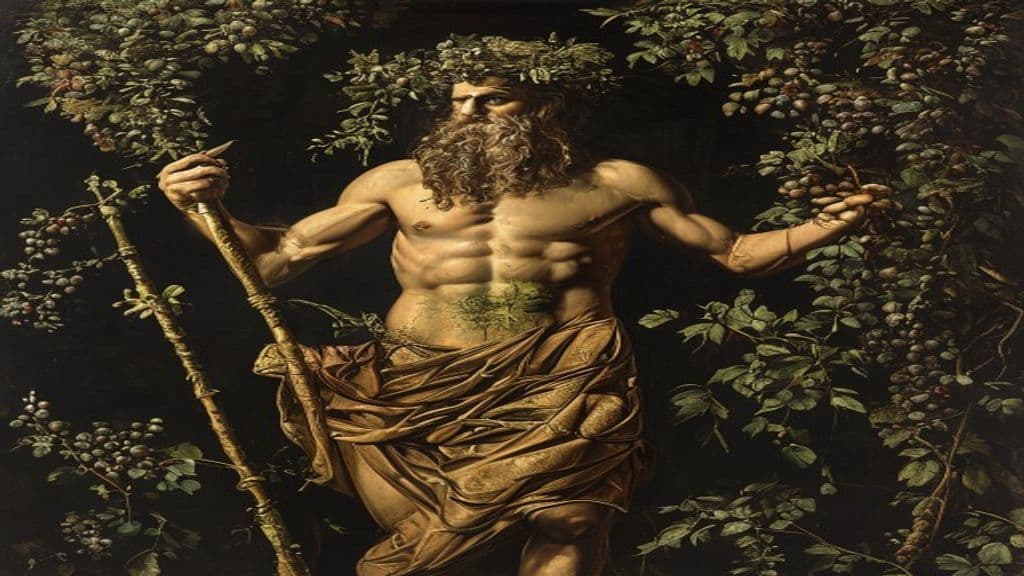
Dionysus
Dionysus (Ancient Greek: Διόνυσος) is a major ancient Greek deity associated with wine and winemaking, vegetation and fertility, festivity and theatre, ritual ecstasy and possession, and liminal links with death and the underworld. He is an epiphany-god who travels between worlds, whose cult includes ecstatic rites and mystery initiation.
*Perkʷūnos
*Perkʷūnos is the reconstructed Proto-Indo-European thunder‑god hypothesized by comparative linguistics and mythology. Scholarly reconstructions portray him as a storm or thunder figure associated with fructifying rain and as the combatant who fights a multi‑headed water‑serpent to release life‑giving waters; no direct attestations from the Proto‑Indo‑European period survive and the figure is inferred from later Indo‑European traditions.
*Péh₂usōn (reconstructed)
Péh₂usōn is a hypothetical Proto‑Indo‑European pastoral guardian reconstructed by comparative scholars from parallels in Greek and Vedic traditions. Proposed as a Graeco‑Aryan ancestor‑figure, the reconstruction describes a protector of flocks, roads, and travellers rather than an attested historical cultic personality.
57 Mnemosyne
57 Mnemosyne is a large main-belt asteroid (S-type) discovered in 1859 and named after the Greek Titaness Mnemosyne. It is a non-sentient astronomical body studied for its orbital and rotational properties and has been used in dynamical measurements related to Jupiter.
Aba (disambiguation / name-form)
Aba is a polyvalent name-form attested across many unrelated contexts (place names, personal names, animal names, and brief mythological listings). The provided sources do not support a single, coherent supernatural entity called "Aba" and offer no descriptive or ritual material for such a being.
Abaddon
In Hebrew scripture Abaddon is primarily a noun meaning 'destruction' or a section/condition of the underworld paired with Sheol; in the New Testament Book of Revelation Abaddon is personified as an angelic figure (Greek Apollyon) described as the king of an army of locusts released from the abyss during the apocalypse.
Aban Yasht
The Aban Yasht is a hymn from the Persian tradition that praises Anahita, a goddess associated with water, fertility, and wisdom. It consists of 132 stanzas and is part of the 21 Yashts collection. (Note: - Power tier should be "Primordial" or possibly "Cosmic", given that it's a hymn of great spiritual significance and associated with a goddess. - The article incorrectly states that Anahita is associa)
Abandinus
Abandinus is a locally attested Romano‑Celtic theonym known from a single inscribed bronze feather (votive object) dedicated at Godmanchester (the Roman fort Durovigutum) in Cambridgeshire. Scholars interpret him as a local god or male spirit tied to a specific place and possibly associated with a nearby spring or stream; this association is tentative and based on etymological readings of the name.
Abarbarea
Abarbarea is a name attested in classical Greek and Roman sources for freshwater nymphs (naiads). The name appears for at least two individual mythic figures — a naiad wife of Bucolion and a naiad counted among ancestors of the Tyrians — and Hesychius records plural forms that may indicate the name was also used as a class-name (Abarbareai / Abarbalaiai).
Abas
Abas (Ancient Greek: Ἄβας, gen.: Ἄβαντος) is not a single mythic being but a recurring personal name borne by multiple mortals and minor mythic figures in Greek epic and genealogical traditions — kings, founders, seers, warriors, attendants, a centaur, and a youth transformed by a goddess. The name is glossed in the sources as 'guileless' or 'good-hearted' and appears across Argive, Theban, Trojan, Euboean, and other local cycles.
Abath
No corroborated folkloric entity named "Abath" is documented in the provided sources. The string appears in the supplied material only as a surname/personal name in Aruban/Dutch-Caribbean archival records and as an unrelated taxonomic or encyclopedic hit; no mythic attributes, origin stories, rituals, or apotropaic practices for an entity called Abath are present in the documents reviewed.
Abatur
Abatur is an uthra (celestial emanation) in Mandaeism described as the 'father of the Uthras' and called the Ancient (ʿattīqā). He resides on the boundary between the World of Light and lower regions, functions as a judge who weighs souls (Abatur Muzania), and supplies instructions and materials to the demiurgic uthra Ptahil in accounts from the Diwan (Scroll) of Abatur.
Abatwa (Twa / Batwa)
Abatwa (also recorded as Twa, Batwa, Mutwa; singular forms Barhwa or Murhwa in some transcriptions) are indigenous hunter‑gatherer peoples of the Great Lakes region of Central Africa, historically identified as some of the earliest inhabitants of the area. The available sources treat them as human ethnic groups whose livelihoods, lands, and populations have been severely affected by conservation policies and modern violence.
Community Record
- [1]Agdistis (Wikipedia). Wikipedia: Agdistis (summary of Pausanias and Arnobius/Timotheus traditions)wiki
- [2]Pausanias (summary as cited). Pausanias' local tradition on the birth of Agdistis and Mount Agdistis (as summarized in the supplied materials)literary
- [3]Arnobius quoting Timotheus (summary as cited). Arnobius' recounting of Timotheus' narrative describing Agdistis' might, intoxication by Liber/Dionysus, self-severing of the genitals, and the growth of a pomegranate/almond tree (as summarized in supplied materials)literary
- [4]The Miraculous Birth of Mithras (Vermeeren) — rock-birth motif (archive). Vermeeren, comparative study noting rock-birth motifs in Anatolian traditions (supplied for context on the Agdus/rock motif)academic