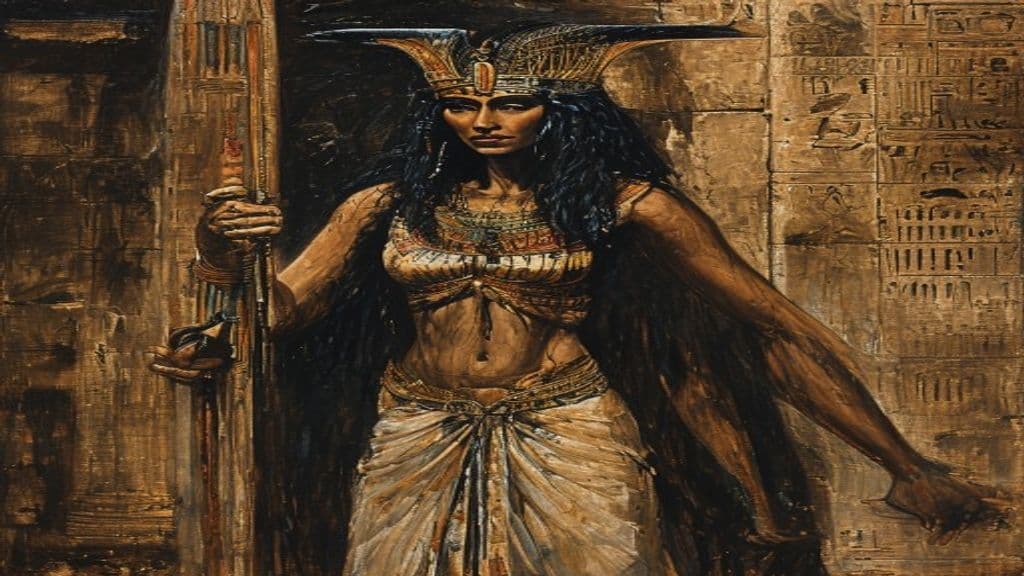
Anat appears in the mythic corpus of Ugarit as a principal goddess who intervenes directly in divine affairs. In the Baal Cycle she is portrayed as a staunch ally of the weather god Baal: she assists him in his struggle for kingship, helps him obtain permission to secure a dwelling, and when Baal is slain by Mot she mourns and later avenges his death. Scholars generally trace Anat's historical origins to Amorite cultural contexts in Bronze Age upper Mesopotamia, where a goddess Ḫanat is attested in Mari and Suhum; the identification between Anat and Ḫanat is plausible and widely argued but not without scholarly dispute. Across the late second and early first millennium BCE Anat is adopted and adapted in Hurrian ritual lists, at Emar and Hazor, in Egyptian contexts beginning in the Hyksos/Ramesside period and persisting into the Roman period in Egypt, and in Phoenician/Cypriot inscriptions, showing a deity whose cult and mythic role traveled across linguistic and political boundaries.
The supplied textual evidence emphasizes Anat's active, martial character in myth rather than a fixed pictorial type. Ugaritic narratives portray her as an aggressive and effective divine warrior and hunter—an agent who enters battles, pursues enemies, and executes vengeance on behalf of allies. While iconographic details (specific attire, weapons, or animal companions) are not preserved in the provided excerpts, later reception in Cyprus led to an association with Athena on account of shared martial attributes, and Egyptian adoption implies integration into Egyptian temple cult imagery. Overall, the sources present Anat as a full deity with established cult and mythic presence rather than as an ambiguous or purely local spirit.
Textual sources present Anat as a powerful martial deity: she participates in divine combat, pursues and slays enemies, and performs vengeance (for example avenging Baal's death at Mot's hands). She functions as a warrior and a huntress and is an active political actor within the pantheon—securing Baal's aims, negotiating on his behalf, and enforcing justice through violence when required. Cultic evidence shows she 'regularly received offerings' at Ugarit and appears in Hurrian ritual contexts alongside martial Hurrian gods (Šimige, Aštabi, Nupatik), indicating she could be invoked in cultic/martial ritual ensembles. In later receptions she was identified with similar martial goddesses (e.g., Athena in Cyprus), demonstrating the adaptability of her martial persona across cultures.
Weaknesses
- otherNo weaknesses recorded in supplied sources
Wards
- otherNo apotropaic wards or counter-rituals against Anat are described in the provided material; interaction is attested primarily through offerings and petitionary cult
Baal
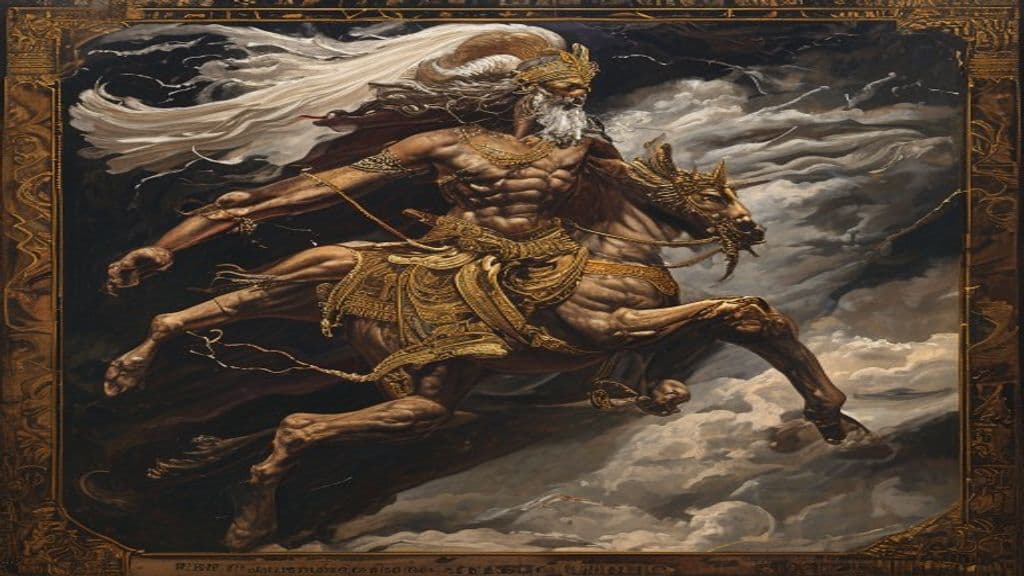
Baal (bāʿal) is a Northwest Semitic title meaning 'owner' or 'lord' that served as a theonym in the ancient Levant; in Ugaritic and Canaanite texts it appears as the name/title of a prominent storm and fertility god (often rendered Baʿal Haddu) who features centrally in the Baal Cycle and in regional cults tied to rain, fertility, and kingship. In later monotheistic literatures the term becomes a polemical label for rival or foreign deities and is reinterpreted in various receptions.
Athena
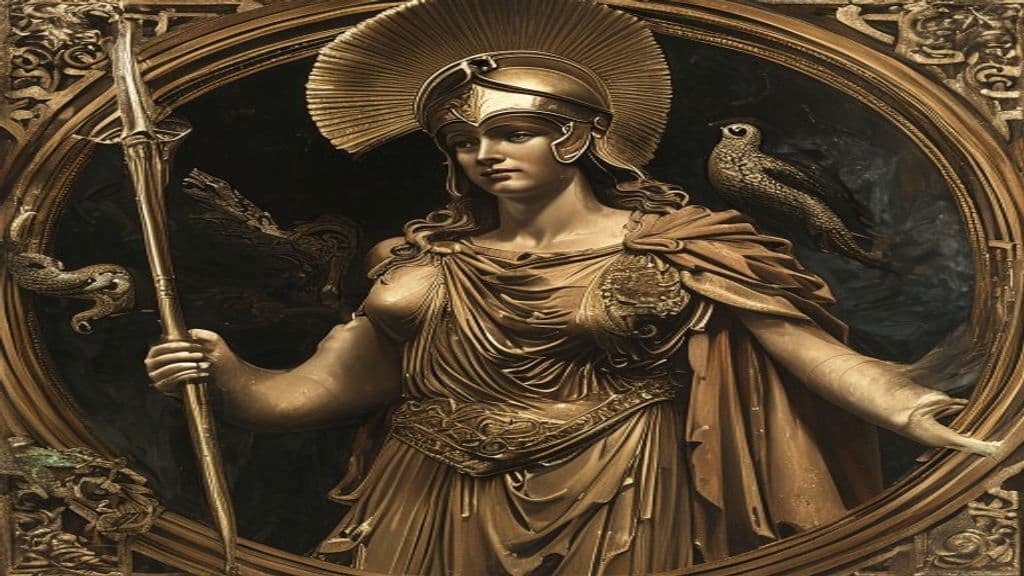
Athena is a major ancient Greek goddess associated with wisdom, handicraft (notably weaving), and warfare; she serves as a tutelary protector of cities—most prominently Athens—and is central to myth, cult, and civic identity in the Greek world.
'Ain Samiya Goblet
Silver cup from the Middle Bronze Age I, discovered in a tomb at Ain Samiya. (Note: 1. Power tier should be "None", but add a note explaining that historical artifacts don't fit into the typical power tier classification. 2. Add a description of its appearance based on it being a sil)
*Perkʷūnos
*Perkʷūnos is the reconstructed Proto-Indo-European thunder‑god hypothesized by comparative linguistics and mythology. Scholarly reconstructions portray him as a storm or thunder figure associated with fructifying rain and as the combatant who fights a multi‑headed water‑serpent to release life‑giving waters; no direct attestations from the Proto‑Indo‑European period survive and the figure is inferred from later Indo‑European traditions.
*Péh₂usōn (reconstructed)
Péh₂usōn is a hypothetical Proto‑Indo‑European pastoral guardian reconstructed by comparative scholars from parallels in Greek and Vedic traditions. Proposed as a Graeco‑Aryan ancestor‑figure, the reconstruction describes a protector of flocks, roads, and travellers rather than an attested historical cultic personality.
57 Mnemosyne
57 Mnemosyne is a large main-belt asteroid (S-type) discovered in 1859 and named after the Greek Titaness Mnemosyne. It is a non-sentient astronomical body studied for its orbital and rotational properties and has been used in dynamical measurements related to Jupiter.
A'annepada
A'annepada (Sumerian cuneiform 𒀀𒀭𒉌𒅆𒊒𒁕; also romanized Aanépàdda) is attested as a historical ruler of the First Dynasty of Ur, flourishing c. 2350 BC. He is recorded in dedicatory and foundation inscriptions as king of Ur and as son of Mesannepada, credited with temple-building and dedication to deities such as Ninhursag and Inanna.
Abaddon
In Hebrew scripture Abaddon is primarily a noun meaning 'destruction' or a section/condition of the underworld paired with Sheol; in the New Testament Book of Revelation Abaddon is personified as an angelic figure (Greek Apollyon) described as the king of an army of locusts released from the abyss during the apocalypse.
Abadir
Abadir is a polysemous name attested in distinct cultural contexts: a legendary founding saint and clan ancestor in eastern Ethiopia (Sheikh Abadir Umar Al‑Rida / Aw Abadir), a term applied to cone‑shaped cult stones in Phoenician religious description, and a personal name of a martyr (Abadir/Apater) in the Coptic Synaxarium. The attestations are independent usages of the same name rather than a single supernatural being.
Aban Yasht
The Aban Yasht is a hymn from the Persian tradition that praises Anahita, a goddess associated with water, fertility, and wisdom. It consists of 132 stanzas and is part of the 21 Yashts collection. (Note: - Power tier should be "Primordial" or possibly "Cosmic", given that it's a hymn of great spiritual significance and associated with a goddess. - The article incorrectly states that Anahita is associa)
Abath
No corroborated folkloric entity named "Abath" is documented in the provided sources. The string appears in the supplied material only as a surname/personal name in Aruban/Dutch-Caribbean archival records and as an unrelated taxonomic or encyclopedic hit; no mythic attributes, origin stories, rituals, or apotropaic practices for an entity called Abath are present in the documents reviewed.
Abatur
Abatur is an uthra (celestial emanation) in Mandaeism described as the 'father of the Uthras' and called the Ancient (ʿattīqā). He resides on the boundary between the World of Light and lower regions, functions as a judge who weighs souls (Abatur Muzania), and supplies instructions and materials to the demiurgic uthra Ptahil in accounts from the Diwan (Scroll) of Abatur.
Abatwa (Twa / Batwa)
Abatwa (also recorded as Twa, Batwa, Mutwa; singular forms Barhwa or Murhwa in some transcriptions) are indigenous hunter‑gatherer peoples of the Great Lakes region of Central Africa, historically identified as some of the earliest inhabitants of the area. The available sources treat them as human ethnic groups whose livelihoods, lands, and populations have been severely affected by conservation policies and modern violence.
Abellio
Abellio is a theonym attested in Roman‑period inscriptions from the Comminges area of the Pyrenees and reported as worshipped in the Garonne Valley of ancient Gallia Aquitania. Surviving evidence is limited to a small number of inscriptions; scholars have variously hypothesized solar or arboreal associations and compared the name to forms of Apollo or to Celtic Belenus, but the deity's precise role in local cosmology remains uncertain.
Community Record
- [1]Anat. Wikipedia contributors. 'Anat.' Wikipedia, The Free Encyclopedia.wiki