
Within Gnostic mythic frameworks the archons arise as a class of intermediate beings responsible for the creation and administration of the material cosmos. Different sectarian systems deploy the category in varied mythic genealogies: some narratives place a chief figure (often identified with the demiurge or as a leader of a Hebdomad of rulers) who fashions the visible world and appoints subordinate archons to govern its orders. Basilidian and other Gnostic configurations reuse Hellenistic and scriptural vocabulary (the Greek term ἄρχων, 'ruler') to map political metaphors onto cosmic hierarchies, giving rise to systems in which archons and named angelic intelligences (e.g., figures like Abrasax or Caulacau in certain schools) function as the makers and keepers of the material realm and its limitations.
Gnostic texts and summaries personify archons in a variety of ways rather than providing a single standardized corporeal portrait: some traditions portray them as angelic or intelligential rulers, while other accounts in the broader corpus and later summaries supply animalistic, blind, or astral motifs for particular archons. The surveyed sources emphasize that descriptions vary between sects and texts — archons are often presented as hierarchical powers or cosmic rulers rather than as a uniform physical type — and popular modern sources sometimes attribute quasi-extraterrestrial imagery to them, a speculative reception not grounded in the canonical Gnostic summaries consulted.
Archons are described primarily as builders and rulers of the physical universe: they construct and maintain the visible world-order and exercise dominion over the present aeon. Scriptural engagement (for example, the New Testament language noted in the Gospel of John that refers to 'the archon of this world') is invoked in Gnostic interpretation to identify archons as principal opposing powers shaping the material age. Functionally they enforce the constraints of the created order, obstruct or obscure spiritual knowledge, and act as cosmic gatekeepers that a soul must bypass or transcend. Specific roles, names, and hierarchies differ across Archontic, Ophite, Sethian, and Basilidian configurations.
Weaknesses
- ritualspiritual knowledge / gnosis
- conditionsoul's awakening and ascent (attainment of gnosis permitting bypass of archontic control)
Wards
- ritualgnostic rites and salvific knowledge
- othersecret passwords, baptismal or initiatory formulas (attested in broader Gnostic practice as protections enabling passage past cosmic rulers)

Demiurge
A craftsman-like cosmic artisan who fashions and governs the sensible, material universe. In Platonic traditions the Demiurge is a benevolent ordering intelligence that shapes preexisting matter by imitating eternal Forms; in Gnostic systems the Demiurge is a lower ruler of the material realm whose moral status varies from ignorant/foolish to oppressive.
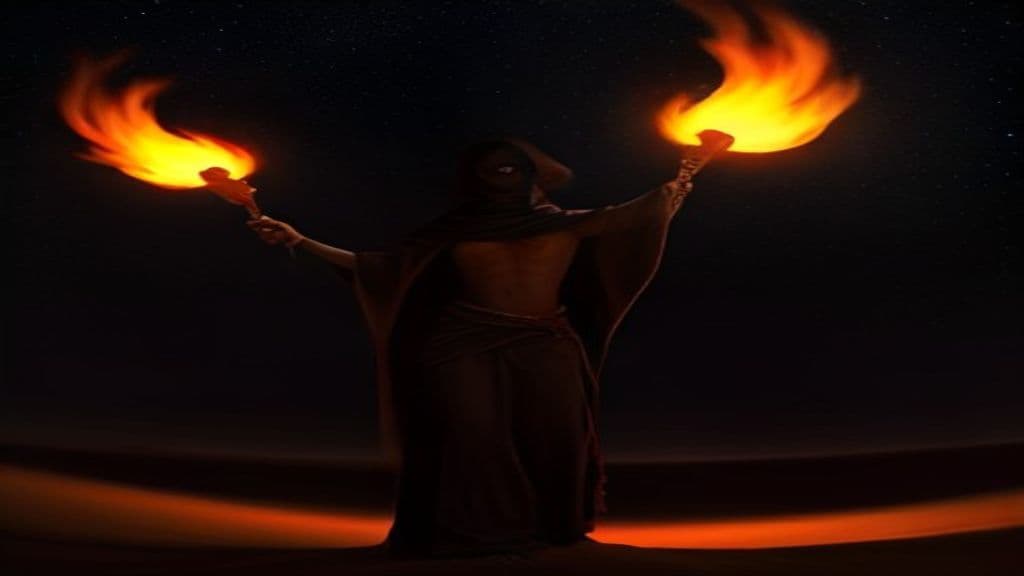
Djinn
The class of supernatural beings created from smokeless fire in Islamic cosmology — a parallel civilization to humanity, capable of belief or unbelief, with their own prophets, society, and judgment before God.
*Perkʷūnos
*Perkʷūnos is the reconstructed Proto-Indo-European thunder‑god hypothesized by comparative linguistics and mythology. Scholarly reconstructions portray him as a storm or thunder figure associated with fructifying rain and as the combatant who fights a multi‑headed water‑serpent to release life‑giving waters; no direct attestations from the Proto‑Indo‑European period survive and the figure is inferred from later Indo‑European traditions.
*Péh₂usōn (reconstructed)
Péh₂usōn is a hypothetical Proto‑Indo‑European pastoral guardian reconstructed by comparative scholars from parallels in Greek and Vedic traditions. Proposed as a Graeco‑Aryan ancestor‑figure, the reconstruction describes a protector of flocks, roads, and travellers rather than an attested historical cultic personality.
57 Mnemosyne
57 Mnemosyne is a large main-belt asteroid (S-type) discovered in 1859 and named after the Greek Titaness Mnemosyne. It is a non-sentient astronomical body studied for its orbital and rotational properties and has been used in dynamical measurements related to Jupiter.
Aamon
Aamon (also Amon) is a named spirit in early modern Western grimoire tradition (Pseudomonarchia Daemonum; the Ars Goetia / Lesser Key of Solomon). He is presented as a high-ranking infernal officer (Marquis/Prince) who governs forty legions and is credited with knowledge of past and future and with affecting human relationships (reconciling or procuring feuds and favor).
Abaddon
In Hebrew scripture Abaddon is primarily a noun meaning 'destruction' or a section/condition of the underworld paired with Sheol; in the New Testament Book of Revelation Abaddon is personified as an angelic figure (Greek Apollyon) described as the king of an army of locusts released from the abyss during the apocalypse.
Abadir
Abadir is a polysemous name attested in distinct cultural contexts: a legendary founding saint and clan ancestor in eastern Ethiopia (Sheikh Abadir Umar Al‑Rida / Aw Abadir), a term applied to cone‑shaped cult stones in Phoenician religious description, and a personal name of a martyr (Abadir/Apater) in the Coptic Synaxarium. The attestations are independent usages of the same name rather than a single supernatural being.
Abadiu of Antinoe
Abadiu of Antinoe was a fourth‑century bishop of Antinoe (Antinoopolis, in Roman Egypt) commemorated as a martyr and saint in the Coptic Orthodox Church, with a feast day on 26 December. Sources record that he was killed during a theological dispute with Arian opponents and reference him in collections of Egyptian martyrs.
Abagtha
Abagtha (Hebrew: אבגתא, ’Ǎḇaḡṯā) is a named human court official in the Hebrew Bible’s Book of Esther, listed among seven chamberlains who ministered before King Ahasuerus and were commanded to bring Queen Vashti before the king. He is attested only in Esther 1:10 and is presented as an institutional palace attendant rather than a supernatural being.
Aban Yasht
The Aban Yasht is a hymn from the Persian tradition that praises Anahita, a goddess associated with water, fertility, and wisdom. It consists of 132 stanzas and is part of the 21 Yashts collection. (Note: - Power tier should be "Primordial" or possibly "Cosmic", given that it's a hymn of great spiritual significance and associated with a goddess. - The article incorrectly states that Anahita is associa)
Abanoub
Abanoub is a 4th‑century Egyptian Christian child martyr venerated in the Coptic tradition. Remembered for his public confession of Christ, miraculous healings associated with his passion, and the translation and veneration of his relics, his feast is observed on July 31 (Epip 24) and his cult centers include Nehisa and Samanoud.
Abaskhiron the Soldier
A Coptic Orthodox martyr venerated for refusing imperial idolatry during the Diocletian persecution; reputedly healed by the Archangel Michael, preserved in monastery relics, and commemorated on 14 June (7 Paoni).
Abath
No corroborated folkloric entity named "Abath" is documented in the provided sources. The string appears in the supplied material only as a surname/personal name in Aruban/Dutch-Caribbean archival records and as an unrelated taxonomic or encyclopedic hit; no mythic attributes, origin stories, rituals, or apotropaic practices for an entity called Abath are present in the documents reviewed.
Community Record
- [1]Archon (Gnosticism) - Wikipedia. Wikipedia, 'Archon (Gnosticism)'wiki
- [2]Archons - Gnosticism Explained. Gnosticism Explained, 'Archons'other
- [3]Basilidians - Wikipedia. Wikipedia, 'Basilidians'wiki
- [4]Are Archons Greys? - Biblioteca Pleyades. Biblioteca Pleyades, 'Are Archons Greys?' (modern interpretive reception)other
- [5]Monsanto Eerily Mimics Archon Behavior - Biblioteca Pleyades. Biblioteca Pleyades, 'Monsanto Eerily Mimics Archon Behavior' (modern reception)other
- [6]Gnosticism, Abrahamic Religion & Artificial Technomania of the Archons - Red Ice Radio. Red Ice Radio, 'Gnosticism, Abrahamic Religion & Artificial Technomania of the Archons' (modern interpretive media)other
- [7]The Gnostics | The Anarchist Library. Jacques Lacarrière, 'The Gnostics' (translated summary available at The Anarchist Library)literary
- [8]What does the term 'principalities and powers' mean? - Hermeneutics StackExchange. Hermeneutics StackExchange discussion of New Testament terminology related to 'archons'/'powers'other