
Aurnavabha appears in Vedic textual sources as a proper name in hymnic onomastics and later as an attributed commentator in modern bibliographic indexes. In the Rigveda the form Aurṇavābha occurs within a catalogic verse addressed to Śatakratu/Indra (Rig Veda, Book 8: Hymn LXVI). Separately, nineteenth- and twentieth-century theosophical reference works and indexes list 'Aurnavabha Acharya' as a Vedic commentator and cite an exegetical reading attributed to him concerning Vishnu's three strides (SD References - Volume 1; At-Az: Index to The Secret Doctrine). The sources do not provide a biographical narrative linking the Rigvedic occurrence and the commentator attribution, so any historical relation between the name in the hymn and the later commentator attribution is not directly attested in the provided materials.
The provided sources do not supply any physical or personified description of Aurnavabha. In the Rigvedic context the name functions as part of a poetic catalogue and carries no bodily attributes in the cited verse (Rig Veda, Book 8: Hymn LXVI). When the name is treated as 'Aurnavabha Acharya' in bibliographic listings, it denotes an authorial or scholastic role rather than a described corporeal presence.
No supernatural powers or agency are ascribed to Aurnavabha in the sources. The only 'ability' attested is exegetical: the theosophical references credit Aurnavabha with an interpretive reading of Vishnu's three strides, understanding them as the rising, culmination, and setting of the sun (SD References - Volume 1). In the Rigveda the name appears among appellations in a hymnic list addressed to a heroic figure, functioning as an element of poetic nomenclature rather than a described agent with actions beyond its mention (Rig Veda, Book 8: Hymn LXVI).
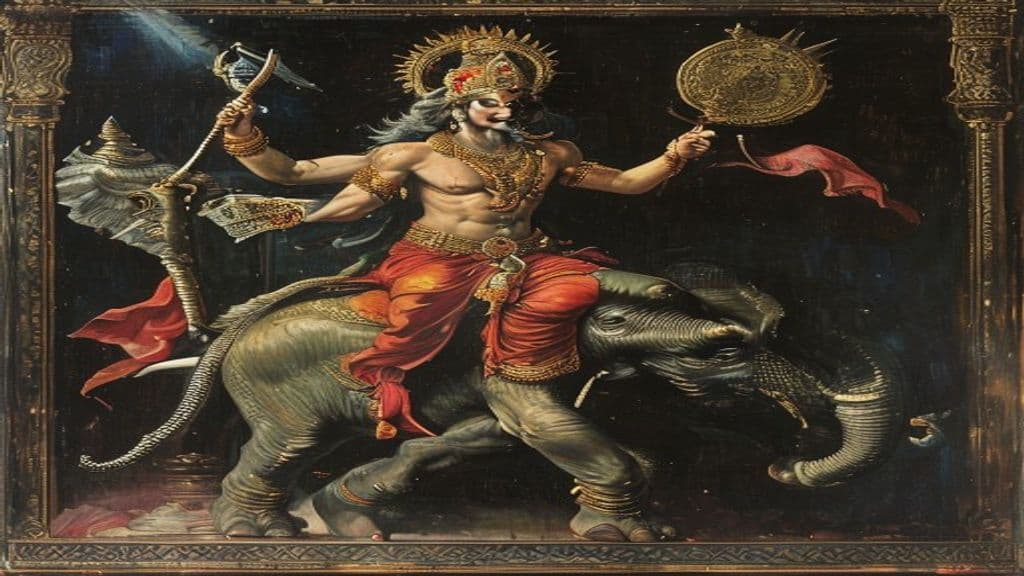
*Péh₂usōn (reconstructed)
Péh₂usōn is a hypothetical Proto‑Indo‑European pastoral guardian reconstructed by comparative scholars from parallels in Greek and Vedic traditions. Proposed as a Graeco‑Aryan ancestor‑figure, the reconstruction describes a protector of flocks, roads, and travellers rather than an attested historical cultic personality.
57 Mnemosyne
57 Mnemosyne is a large main-belt asteroid (S-type) discovered in 1859 and named after the Greek Titaness Mnemosyne. It is a non-sentient astronomical body studied for its orbital and rotational properties and has been used in dynamical measurements related to Jupiter.
Aamon
Aamon (also Amon) is a named spirit in early modern Western grimoire tradition (Pseudomonarchia Daemonum; the Ars Goetia / Lesser Key of Solomon). He is presented as a high-ranking infernal officer (Marquis/Prince) who governs forty legions and is credited with knowledge of past and future and with affecting human relationships (reconciling or procuring feuds and favor).
Abhimanyu
Abhimanyu is a youthful Kuru/Pandava warrior-hero in the Sanskrit epic Mahābhārata. Son of Arjuna and Subhadra, he is famed for entering the Chakravyuha battle formation on the thirteenth day of the Kurukshetra War and dying at age sixteen; his posthumous son Parikshit continues the Kuru line.
Abrahel
Abrahel is a demonological entity attested in early modern sources (notably Nicholas Rémy's Demonolatria as summarized in modern reference) portrayed as a female sexual spirit who seduced a man in 1581, induced him to kill his son, then restored the child to life in exchange for worship; the revival produced a diminished, foul-smelling corpse that later died again.
Abraxas
Abraxas (Abrasax) is a late‑antique Gnostic and magical name attested as a high-ranking cosmic power in heresiological summaries and as a potent name engraved on amulets (so-called Abraxas stones) in the Greco‑Roman magical milieu. Heresiologists associate Abraxas with rulership of 365 heavens and note the name's numerological value, while archaeological and papyrological contexts show its use as an amuletic formula.
Achamōth
Achamōth is a feminine emanational figure in certain Gnostic systems, attested as a daughter or subordinate aspect of the divine Wisdom, Sophia. She appears in ophitic/Naassene mythic genealogies where she is named as motherly/filial to lower, problematic figures such as Ilda‑Baoth; beyond this genealogical role the supplied sources record little concrete description or ritual material specific to her.
Achyuta
Achyuta (Sanskrit: अच्युत, acyuta) is primarily an epithet/theonym in Vaishnava Hindu tradition applied to Vishnu and Krishna, signifying the divine quality of being 'not fallen' — immutable, infallible, and imperishable. It functions as a devotional name in scripture, liturgy, and Pancharatra lists of divine emanations rather than as an autonomous folkloric spirit.
Acintya
Acintya is an Indonesian Hindu theological-symbolic representation of the ineffable supreme divine principle. In Balinese and Javanese practice it functions as a way to make ultimate reality present in ritual and art—often aniconically as an empty throne (padmasana) or anthropomorphically as a naked, flame-surrounded figure—rather than as a narrative, intervening deity.
Adam Kadmon
Adam Kadmon (Hebrew: אָדָם קַדְמוֹן) is the Kabbalistic Primordial Man: a supra‑human, archetypal pattern or persona projected at the first stage of creation after God's contraction (tzimtzum). It is a metaphysical template corresponding to the highest aspect of divine intention and the sefirotic structure rather than a historical, corporeal individual.
Adi (asura)
Adi is attested in modern reference works as the name of an Asura who 'appears in the Matsya Purāṇa.' Beyond this single-line citation in secondary sources, no descriptive material about the figure is provided in the supplied research notes.
Adi Shakti
Adi Shakti (also Adi Parashakti, Mahadevi, Adya Shakti) is the primordial feminine power in Hindu/Shakta theology, regarded as the ultimate reality (Para Brahman) and the source from which all goddesses and gods manifest. She is both an impersonal cosmic principle (Mulaprakriti) and a focus of devotional invocation in temples, mantras, and pilgrimage sites such as Shakti Peethas.
Community Record
- [1]Rig-Veda, Book 8: HYMN LXVI. Indra.. Rig Veda, Book 8: Hymn LXVI (translation excerpt containing 'Aurṇavābha')literary
- [2]At-Az: Index to 'The Secret Doctrine'. Index entry listing 'Aurnavabha Acharya, Vedic commentator, on Vishnu’s three strides I 112' (Theosophical index)other
- [3]SD References - Volume 1. Reference stating: 'The second writer, Aurnavabha, interprets Vishnu's three strides as the rising, culmination, and the setting of the sun.' (SD References - Volume 1)other
- [4]Vamana (Wikipedia) — contains links to avatara material. Wikipedia entry (used in the cited research notes as a contextual link for avatara and related Vedic/mythic material)wiki
- [5]Avatara — Mythology and folklore encyclopedia entry. Reference work on avatara motifs cited in the research notes; contextual background for interpretive traditions.other
- [6]SED - note on Nirukta and index entries. Bibliographic note referenced in the research material indicating absence of Aurnavabha in certain traditional lists (SED)other
- [7]Vedic Reader - Few Excerpts. Excerpt collection cited in the research notes as part of the corpus referencing Vedic names and passages.other
- [8]Knowing Indra | mAnasa-taraMgiNI (blog post). Scholarly-blog commentary on Indra and related hymnic catalogues; cited in research notes for contextual background.other