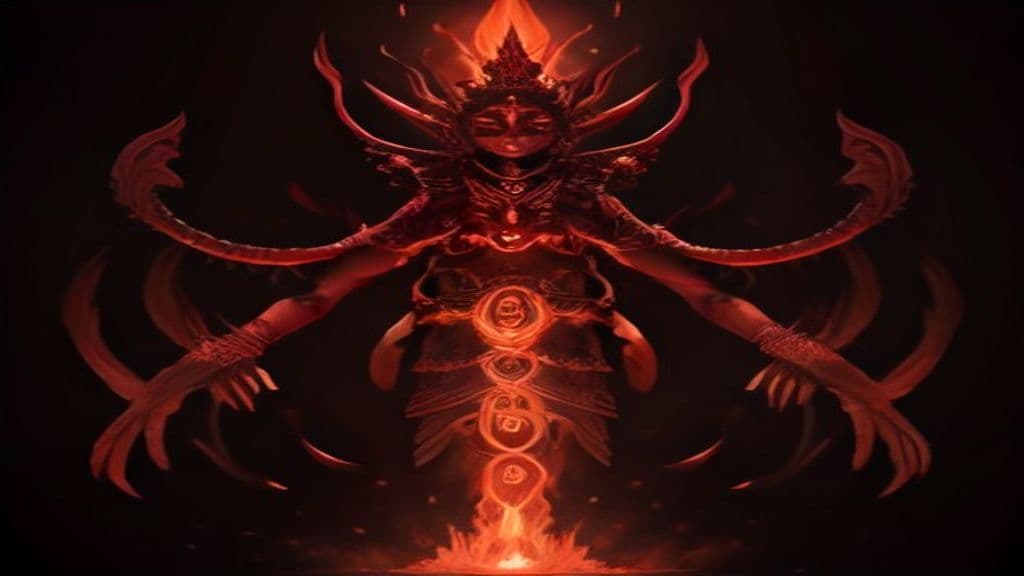
Bāṇasura is presented in the Purāṇic genealogical framework as the eldest son of King Bali, descended in the asura line from Prahlāda. Through severe penance and devotion to Lord Śiva he obtains boons and favor that make him a dominant sovereign of Śoṇitapura; the Bhagavata Purāṇa (SB 10.62–63) and related retellings place him in the mythic time of Kṛṣṇa and the Yadu dynasty, where his pride and martial actions bring him into direct conflict with Kṛṣṇa and the Yadu princes after his daughter Uṣā forms a relationship with Aniruddha.
Narrative sources depict Bāṇasura as a supernatural, many-armed sovereign: some accounts explicitly describe him as possessing one thousand arms (a motif recorded in summaries of his service to Śiva, e.g., playing mridangam during Śiva's tandava). In the battlefield episode with Kṛṣṇa his extra arms are severed, leaving him with four arms according to the narrative summaries. He is furthermore portrayed as a mighty chariot-riding king commanding large armies and celestial weapons.
Bāṇasura's principal capacities derive from ascetic merit and boons granted by Śiva: severe penance makes him fearsome and grants protective favors rather than absolute immortality. He exercises wide political and martial power as king of Śoṇitapura, marshaling vast forces (narratives describe large akshauhinī-style host actions) and employing weapons and mystical restraints (the narrative records use of Varuṇa's ropes to bind Aniruddha). In the war-account he wields many arms in combat, is defended directly by Śiva (who sallies forth to protect him), and engages with celestial weapons on the field; Kṛṣṇa neutralizes much of this power by employing counter-astras and by severing Bāṇasura's extra arms. His behavior in texts is ambivalent: an ardent Śiva-devotee and performer of penance, yet increasingly proud and oppressive, later repenting after defeat and receiving mercy.
Weaknesses
- conditionpride and arrogance (narrative moral liability)
- otherdependence on Śiva's protection (can be countered by Viṣṇu/Kṛṣṇa intervention as in the Purāṇic battle)
- othernarrative possibility of repentance and reconciliation (story resolves through Bāṇa's submission and Kṛṣṇa's mercy rather than destruction)
Wards
- otherdivine military intervention by Kṛṣṇa/Viṣṇu (narrative means of neutralising Bāṇasura's aggression)
- otherprotection by Śiva (narratively invoked on Bāṇasura's behalf during the battle)
*Perkʷūnos
*Perkʷūnos is the reconstructed Proto-Indo-European thunder‑god hypothesized by comparative linguistics and mythology. Scholarly reconstructions portray him as a storm or thunder figure associated with fructifying rain and as the combatant who fights a multi‑headed water‑serpent to release life‑giving waters; no direct attestations from the Proto‑Indo‑European period survive and the figure is inferred from later Indo‑European traditions.
*Péh₂usōn (reconstructed)
Péh₂usōn is a hypothetical Proto‑Indo‑European pastoral guardian reconstructed by comparative scholars from parallels in Greek and Vedic traditions. Proposed as a Graeco‑Aryan ancestor‑figure, the reconstruction describes a protector of flocks, roads, and travellers rather than an attested historical cultic personality.
57 Mnemosyne
57 Mnemosyne is a large main-belt asteroid (S-type) discovered in 1859 and named after the Greek Titaness Mnemosyne. It is a non-sentient astronomical body studied for its orbital and rotational properties and has been used in dynamical measurements related to Jupiter.
Abaddon
In Hebrew scripture Abaddon is primarily a noun meaning 'destruction' or a section/condition of the underworld paired with Sheol; in the New Testament Book of Revelation Abaddon is personified as an angelic figure (Greek Apollyon) described as the king of an army of locusts released from the abyss during the apocalypse.
Aban Yasht
The Aban Yasht is a hymn from the Persian tradition that praises Anahita, a goddess associated with water, fertility, and wisdom. It consists of 132 stanzas and is part of the 21 Yashts collection. (Note: - Power tier should be "Primordial" or possibly "Cosmic", given that it's a hymn of great spiritual significance and associated with a goddess. - The article incorrectly states that Anahita is associa)
Abath
No corroborated folkloric entity named "Abath" is documented in the provided sources. The string appears in the supplied material only as a surname/personal name in Aruban/Dutch-Caribbean archival records and as an unrelated taxonomic or encyclopedic hit; no mythic attributes, origin stories, rituals, or apotropaic practices for an entity called Abath are present in the documents reviewed.
Abatur
Abatur is an uthra (celestial emanation) in Mandaeism described as the 'father of the Uthras' and called the Ancient (ʿattīqā). He resides on the boundary between the World of Light and lower regions, functions as a judge who weighs souls (Abatur Muzania), and supplies instructions and materials to the demiurgic uthra Ptahil in accounts from the Diwan (Scroll) of Abatur.
Abatwa (Twa / Batwa)
Abatwa (also recorded as Twa, Batwa, Mutwa; singular forms Barhwa or Murhwa in some transcriptions) are indigenous hunter‑gatherer peoples of the Great Lakes region of Central Africa, historically identified as some of the earliest inhabitants of the area. The available sources treat them as human ethnic groups whose livelihoods, lands, and populations have been severely affected by conservation policies and modern violence.
Abellio
Abellio is a theonym attested in Roman‑period inscriptions from the Comminges area of the Pyrenees and reported as worshipped in the Garonne Valley of ancient Gallia Aquitania. Surviving evidence is limited to a small number of inscriptions; scholars have variously hypothesized solar or arboreal associations and compared the name to forms of Apollo or to Celtic Belenus, but the deity's precise role in local cosmology remains uncertain.
Abhimanyu
Abhimanyu is a youthful Kuru/Pandava warrior-hero in the Sanskrit epic Mahābhārata. Son of Arjuna and Subhadra, he is famed for entering the Chakravyuha battle formation on the thirteenth day of the Kurukshetra War and dying at age sixteen; his posthumous son Parikshit continues the Kuru line.
Abraham
Abraham (originally Abram) is the foundational patriarchal ancestor in the Hebrew Bible whose life establishes a covenantal relationship between his family/people and God. He functions as an exemplar of faith, the progenitor of promised descendants, and a narrative anchor for claims of land, blessing, and communal identity in later religious traditions.
Abraun
Abraun is an attested name in German-language plant-legend scholarship (Der abraun, ein beitrag zur pflanzensagenkunde, 1916) and a short database entry (Wikidata) labels it as a spirit from German mythology. Surviving accessible documentation is extremely limited: the principal academic treatment is a 1916 contribution to pflanzensagenkunde (plant-saga studies), but the excerpts available here contain only bibliographic metadata and do not record tales, descriptions, or rituals.
Community Record
- [1]Banasura - Wikipedia. Wikipedia: 'Bana, also referred to as Banasura (Sanskrit: बाणासुर, romanized: Bāṇāsura), is an asura king...'; summary of the thousand-arms motif and battle with Krishna and Shiva.wiki
- [2]Wikidata: Banasura. Wikidata entry identifying Bāṇasura as ancient king of Sonitpur in Hindu mythology.other
- [3]Śrīmad Bhāgavatam (SB 10.62). Vedabase SB 10.62: 'Of the one hundred sons of King Bali, the oldest was Bāṇāsura. He was a great devotee of Lord Śiva...'.literary
- [4]Śrīmad Bhāgavatam (SB 10.63). Vedabase SB 10.63: narrative account of the Aniruddha–Uṣā episode and the Yadu distress leading to the battle at Śoṇitapura.literary
- [5]Hare Kṛṣṇa site: Kṛṣṇa's Later Pastimes with Demons - King Banasura. Retelling and exposition of Bāṇasura episode emphasizing martial conflict and divine intervention.folk
- [6]Kalakshetra archive — Usha Parinayam (dance drama). Dance-drama metadata/description: describes Bāṇasura as the demon/king who undertakes severe penance to solicit blessings of Lord Shiva; frames the Uṣā–Aniruddha episode.other
- [7]The Sampradaya Sun - Feature on Banasura (Sep 2018). Summary material on Bāṇasura's confrontation with Kṛṣṇa and relation to Purāṇic narrative themes.folk