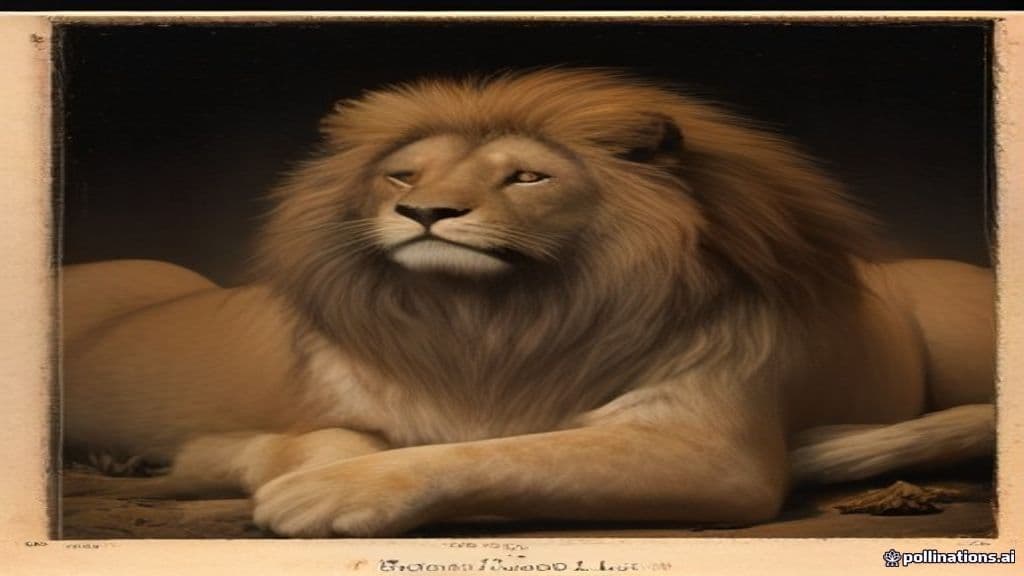
Not a mythic origin but a palaeontological and historical lineage: fossil remains assignable to the North African lineage date from the Late Pleistocene (samples from sites such as Bizmoune cave near Essaouira dated to roughly 100,000–110,000 years), and the population persisted historically across the Maghreb until extirpation in the 20th century due to hunting, firearms and bounty-driven eradication campaigns. Taxonomic treatments have varied across centuries, with 19th-century subspecies names later reassessed by modern genetic and morphological analyses.
Described in zoological and historical accounts as similar to other lions but with notable variation: coat coloration ranging from light to dark tawny; male manes variable in colour and length, sometimes reported to extend over shoulders and under the belly with hair lengths recorded from roughly 8 to 22 cm in museum specimens; head-to-tail lengths of preserved males in collections reported between about 2.35 and 2.8 m, skull lengths between c. 30.85 and 37.23 cm. Historical hunter accounts claimed very large wild males (270–300 kg), but such field weight estimates are regarded as questionable in the sources.
As a biological population of Panthera leo, behaviours and abilities described in the sources align with large-predator ecology rather than supernatural powers: predatory behaviour, territoriality, and interactions with humans that led to conflict. Sources emphasize that human technology and organized eradication (firearms and bounties) drove population declines. No folkloric supernatural abilities are attested in the supplied material.
Weaknesses
- othervulnerability to human hunting and firearms
- otherpopulation decline due to organized bounties and habitat pressures
Wards
None recorded.
*Perkʷūnos
*Perkʷūnos is the reconstructed Proto-Indo-European thunder‑god hypothesized by comparative linguistics and mythology. Scholarly reconstructions portray him as a storm or thunder figure associated with fructifying rain and as the combatant who fights a multi‑headed water‑serpent to release life‑giving waters; no direct attestations from the Proto‑Indo‑European period survive and the figure is inferred from later Indo‑European traditions.
*Péh₂usōn (reconstructed)
Péh₂usōn is a hypothetical Proto‑Indo‑European pastoral guardian reconstructed by comparative scholars from parallels in Greek and Vedic traditions. Proposed as a Graeco‑Aryan ancestor‑figure, the reconstruction describes a protector of flocks, roads, and travellers rather than an attested historical cultic personality.
57 Mnemosyne
57 Mnemosyne is a large main-belt asteroid (S-type) discovered in 1859 and named after the Greek Titaness Mnemosyne. It is a non-sentient astronomical body studied for its orbital and rotational properties and has been used in dynamical measurements related to Jupiter.
Abaddon
In Hebrew scripture Abaddon is primarily a noun meaning 'destruction' or a section/condition of the underworld paired with Sheol; in the New Testament Book of Revelation Abaddon is personified as an angelic figure (Greek Apollyon) described as the king of an army of locusts released from the abyss during the apocalypse.
Aban Yasht
The Aban Yasht is a hymn from the Persian tradition that praises Anahita, a goddess associated with water, fertility, and wisdom. It consists of 132 stanzas and is part of the 21 Yashts collection. (Note: - Power tier should be "Primordial" or possibly "Cosmic", given that it's a hymn of great spiritual significance and associated with a goddess. - The article incorrectly states that Anahita is associa)
Abath
No corroborated folkloric entity named "Abath" is documented in the provided sources. The string appears in the supplied material only as a surname/personal name in Aruban/Dutch-Caribbean archival records and as an unrelated taxonomic or encyclopedic hit; no mythic attributes, origin stories, rituals, or apotropaic practices for an entity called Abath are present in the documents reviewed.
Abatur
Abatur is an uthra (celestial emanation) in Mandaeism described as the 'father of the Uthras' and called the Ancient (ʿattīqā). He resides on the boundary between the World of Light and lower regions, functions as a judge who weighs souls (Abatur Muzania), and supplies instructions and materials to the demiurgic uthra Ptahil in accounts from the Diwan (Scroll) of Abatur.
Abatwa (Twa / Batwa)
Abatwa (also recorded as Twa, Batwa, Mutwa; singular forms Barhwa or Murhwa in some transcriptions) are indigenous hunter‑gatherer peoples of the Great Lakes region of Central Africa, historically identified as some of the earliest inhabitants of the area. The available sources treat them as human ethnic groups whose livelihoods, lands, and populations have been severely affected by conservation policies and modern violence.
Abellio
Abellio is a theonym attested in Roman‑period inscriptions from the Comminges area of the Pyrenees and reported as worshipped in the Garonne Valley of ancient Gallia Aquitania. Surviving evidence is limited to a small number of inscriptions; scholars have variously hypothesized solar or arboreal associations and compared the name to forms of Apollo or to Celtic Belenus, but the deity's precise role in local cosmology remains uncertain.
Abraham
Abraham (originally Abram) is the foundational patriarchal ancestor in the Hebrew Bible whose life establishes a covenantal relationship between his family/people and God. He functions as an exemplar of faith, the progenitor of promised descendants, and a narrative anchor for claims of land, blessing, and communal identity in later religious traditions.
Abraun
Abraun is an attested name in German-language plant-legend scholarship (Der abraun, ein beitrag zur pflanzensagenkunde, 1916) and a short database entry (Wikidata) labels it as a spirit from German mythology. Surviving accessible documentation is extremely limited: the principal academic treatment is a 1916 contribution to pflanzensagenkunde (plant-saga studies), but the excerpts available here contain only bibliographic metadata and do not record tales, descriptions, or rituals.
Abtin
Abtin (Persian: آبتین), attested also as Athwya, is a mythic ancestral figure in Iranian tradition described in Avestan and later epic literature as one of a small set of formative human-like figures involved in preparing the corporeal world and as the father of the epic hero-king Fereydun in the Shahnama.
Community Record
- [1]Barbary lion - Wikipedia. Wikipedia: 'Barbary lion' entrywiki
- [2]Barbary lion | Science and History of the North African Lion (blog). Kent University blog: Science and History of the North African Lionother
- [3]Barbary lion at Belfast Zoo. Belfast Zoo species pageother
- [4]Primate Conservation (archive). Archive: relevant conservation literature (contains historical and conservation context)academic
- [5]Rare Barbary Lion Born In Czech Zoo - Prague Monitor (2017). Prague Monitor news report on captive-born Barbary-lion-line cubsother
- [6]Czech zoo welcomes four rare Barbary lion cubs | Africanews (2025). Africanews: report on captive cubs and relocation plansother
- [7]Barbary Lions In The News (cryptozoonews). Cryptozoonews compilation of media reports concerning Barbary lionsother
- [8]PICRYL - Barbary lion images collection. Public-domain image collection related to Barbary lionsother