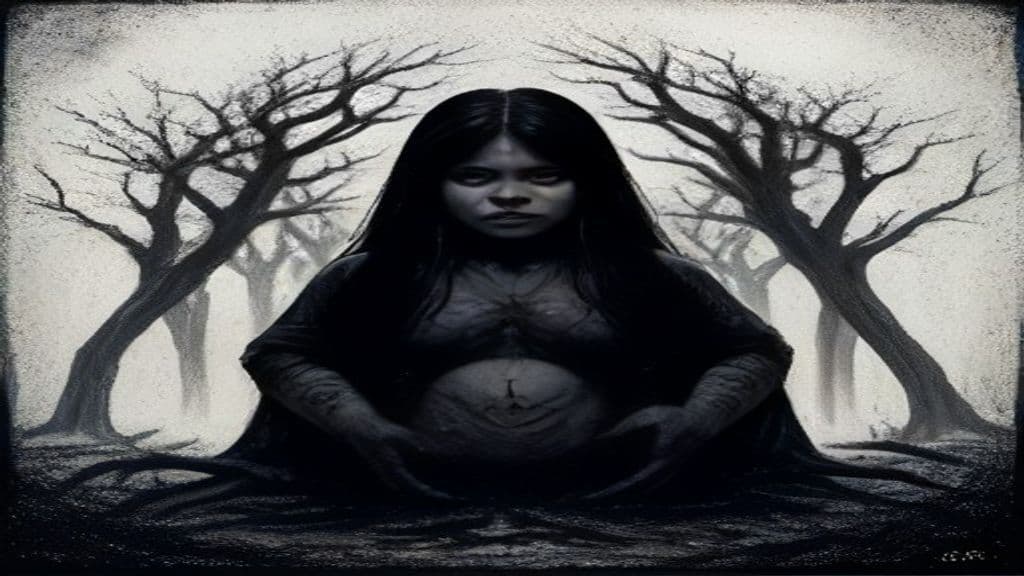
In Ilocano accounts the Batibat is a spirit that dwells in trees. When such a tree is cut down and the wood is repurposed—especially as a support post for a house—the spirit is displaced and ‘‘made homeless.’’ The folktale logic emphasizes that the Batibat then inhabits what remains of its tree or the post and forbids humans from sleeping near that post; violation of that prohibition provokes the Batibat's vengeful response.
Sources describe the Batibat as taking the form of an ancient, grotesquely obese, tree-dwelling female spirit. The description emphasizes an aged, corpulent female figure closely associated with the tree in which it resides.
When a person sleeps near a post or remnant of a felled tree that housed the Batibat, the spirit is said to transform into its true form and attack. The attack is described as suffocating the victim and inducing sleep paralysis and waking nightmares; culturally the Batibat is linked to the local experience and term for nightmare and to nocturnal, potentially fatal sleep afflictions.
Weaknesses
- conditionawaken by biting one's thumb
- conditionawaken by wiggling one's toes
Wards
- conditionbite one's thumb to awaken from attack
- conditionwiggle one's toes to awaken from attack
- ritualavoid using wood from spirit-housing trees as house posts (preventive practice)

Aguingay
Aguingay (also Agingay) is a legendary woman from the Bulusan epic of Sorsogon, Philippines. Presented as a mortal of exceptional beauty and tragic fate, her life and death are etiologically linked to local landscape features (Mt. Bulusan and two lakes) and commemorated in an annual festival.
Alan
A class of non‑human spirit-beings in Tinguian (Philipine) folklore associated with reproductive wastes and springs; said to transform discarded menstrual blood, afterbirth, or miscarried tissue into human children whom they rear, and to dwell in fine houses near springs. Key described features include wings and backward-pointing fingers and toes.
Amalanhig
Amalanhig are Visayan undead beings in Philippine folk belief, described as aswang who failed to transfer their monstrosity or power before death and who rise from graves to attack living humans. Accounts portray them as externally human in appearance with enlarged upper canines and as predators that bite, feed with a pointed tongue in some tellings, or — in an alternative variant — tickle victims to death.
Angalo
Angalo is a primordial culture-hero and giant in Ilocano mythology credited with shaping the landscape of Luzon and explaining natural phenomena; narratives present him as the first man and an ancestral figure whose bodily acts produced mountains, valleys, seas, and celestial features.
Anggitay
A Philippine folkloric female equid–human hybrid often described with the upper body of a woman and the lower body of a horse. Frequently compared to the Greek centauride and sometimes presented as a female counterpart to the tikbalang; traditionally associated with an attraction to gemstones and jewelry and with a local homeland in Santo Tomas, Batangas in some accounts.
Anito
Anito is a category of non‑human and post‑human spiritual beings in indigenous Philippine animistic worldviews, encompassing ancestor spirits, nature spirits/local deities, and sometimes carved effigies (taotao) that house or represent those spirits. They mediate relations between the living and the unseen world, functioning as household guardians, owners of places, intercessors, or occasional agents of harm when offended.
Aswang
The most feared supernatural being in Philippine folklore — a shape-shifting monster that appears human by day but transforms at night to prey on pregnant women and children.
Bakla
Bakla is a Philippine social and gender category—commonly an assigned‑male‑at‑birth person who adopts a feminine gender expression and is often treated as a third gender. Historically some bakla served as indigenous ritual specialists (babaylan, katalonan), but the term itself denotes a social identity, not a supernatural being.
Bakunawa
A dragon- or serpent-like mythic being from Philippine tradition associated with the moon and eclipses; its actions explain lunar eclipses and some natural phenomena and were integrated into ritual practice and calendrical knowledge.
Bal-Bal
A Philippine folkloric undead/monster that steals corpses from funerals and graves and feeds on them, noted for keen scent for dead bodies, sharp claws and teeth, foul breath, and reportedly leaving a banana‑tree trunk in the coffin as a substitute for the stolen corpse.
Bathalà
In pre‑colonial Tagalog religion Bathalà (also Maykapál) functions as the transcendent supreme creator-preserver — the originator and ruler of the universe. The lexeme also served as an honorific applied to lesser tutelary spirits and portentous phenomena, and was later syncretized with the Christian Dios after Spanish contact.
Berbalang
Berbalangs are a class of corpse‑eating, astral‑projecting beings described in a late‑19th‑century ethnographic account from the island of Cagayan Sulu (Mapun). The report portrays them as a village community whose members are said to dig up graves to eat corpses and, by entering trance, liberate an astral body to possess and feed on the living; protective measures recorded include lime and a coconut pearl talisman.
Community Record
- [1]Batibat. Wikipedia: Batibatwiki
- [2]Batibat (Wikidata). Wikidata: Batibatother
- [3]Episode 18 - Eenie, Meenie, Miney... ALP. Archive.org listing for podcast episode discussing 'alp and the batibat'other