
Recorded tradition locates Belsnickel in the Palatinate and neighboring German regions as a seasonal visitor associated with the feast period of Saint Nicholas and the lead-up to Christmas. Unlike many continental companions of Saint Nicholas, Belsnickel traditionally visits alone rather than serving a saintly benefactor, fusing both punitive and rewarding functions that elsewhere are divided. Historical sources note immigrant transmission to Pennsylvania and other communities in the 19th century; nineteenth-century English-language accounts (e.g., glosses calling him 'Pelsnichol, or Nicholas with the fur') link his name to fur-clad dress and to a familiar form of Nicholas, but do not supply a definitive etymology.
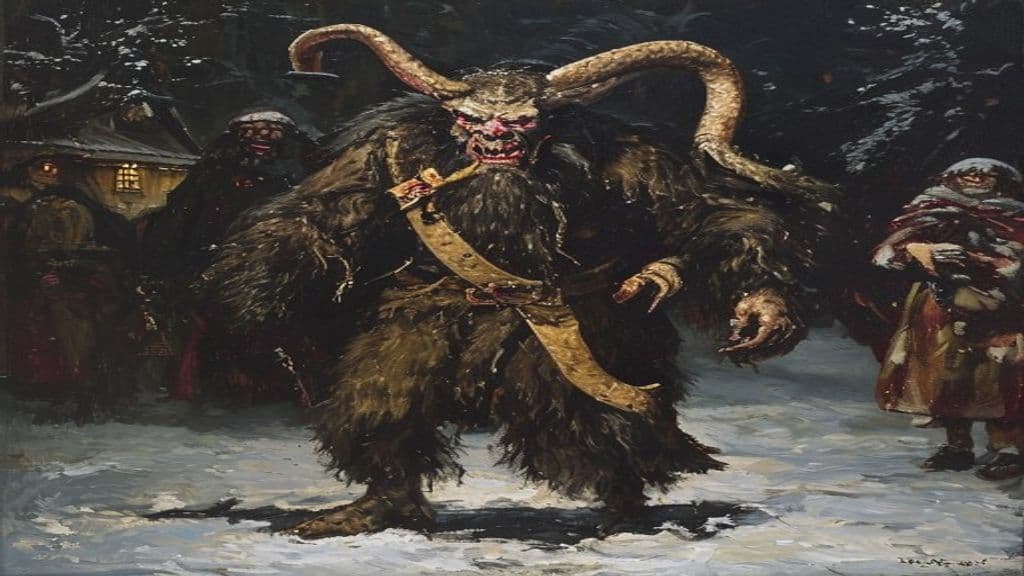
Accounts consistently describe a man dressed in furs and ragged clothing: a long black or brown coat or robe (sometimes torn and dirty), worn with a rope at the waist, and a fur cap or bearskin hat often decorated with bells. The face is commonly disguised—reports mention hideous masks or disguised faces—and some descriptions add a long white beard and a large sack. He carries a switch (birch or hazel rod) and pockets or a sack containing cakes, candies, and nuts. In communal 'Belsnickling' enactments participants add bells, chains, and false faces for a noisy procession.
Sources describe Belsnickel's role and behaviours rather than supernatural powers: he inspects children's conduct, quizzes or requires songs, and dispenses sweets to compliant children while threatening or administering punishment to those deemed naughty. Practitioners rap on doors or windows with a stick, scatter candies on the floor for good children, leave birch rods in stockings, or in some accounts strike youngsters with a switch as part of the performance. The figure also appears in public mumming processions—groups of young men dressed in furs who make loud, boisterous rounds at night—performing a socially sanctioned mixture of intimidation, satire, and gift-giving.
Weaknesses
- conditioncompliance by children (answering questions or singing)
- conditionacceptance of the performance as symbolic (negotiated discipline such as leaving only a birch rod in stockings)
Wards
- conditionchildren answer questions or sing when challenged
- conditionhousehold staging (father or head away so a designated performer may enact the role)
Abraun
Abraun is an attested name in German-language plant-legend scholarship (Der abraun, ein beitrag zur pflanzensagenkunde, 1916) and a short database entry (Wikidata) labels it as a spirit from German mythology. Surviving accessible documentation is extremely limited: the principal academic treatment is a 1916 contribution to pflanzensagenkunde (plant-saga studies), but the excerpts available here contain only bibliographic metadata and do not record tales, descriptions, or rituals.
Adils
Adils (Old Norse Aðils; also Eadgils, Adillus, Athisl, Adhel) is a semi‑legendary sixth‑century Swedish king attested in Old Norse saga material and later medieval traditions. He appears in saga episodes as a storied royal figure involved in warfare, court acts, and marriage suits rather than as a supernatural being.
Agent Liberty
Agent Liberty is a fictional human operative persona in DC Comics and its television adaptation (Arrowverse). The identity—most prominently used by Benjamin 'Benjy/Ben' Lockwood—functions as a costumed, paramilitary/enforcer role tied to political movements (Sons/Children of Liberty) or official security details, driven by ideological 'liberty' rhetoric rather than supernatural agency.
Agilaz (Egil)
Agilaz (reconstructed Proto-Germanic) — commonly recorded in medieval sources as Egil or Ægil — is a legendary archer attested in Germanic heroic tradition. He appears as the brother of Völund (Wayland/Weland) in the Old Norse poem Völundarkviða and in the Thidreks saga, and his name is also inscribed on early medieval objects (Franks Casket, Pforzen buckle). The attested material presents him as a named heroic human archer within saga and inscriptional contexts rather than as a recurrent supernatural species.
Agropelter
A North American "fearsome critter" of lumbercamp tall-tale tradition said to dwell in hollow conifer trees and hurl broken branches and splinters at unwary people; presented in folklore as an animal-like, mischievous or predatory woodland creature rather than a deity or spirit of formal cosmology.
Alaisiagae
A group of Germanic female deities attested in Roman Britain, worshipped by continental auxiliary troops at a shrine near Vercovicium (Housesteads) on Hadrian's Wall. Epigraphic evidence records dedications to named members (Beda, Fimmilena, and in other lists Baudihillia and Friagabis) alongside Mars Thincsus and the numen of the emperor; modern scholarship interprets them variously as war/victory goddesses, as goddesses associated with assembly/justice, or as part of Matronae‑type fertility/ancestor cults.
Alberich
In Germanic heroic legend, Alberich is a dwarf associated with elven qualities and power. (Note: 1. Power tier: Reduce to Ancient as Alberich's abilities are not described beyond being a dwarf with elven qualities. 2. Origin story: Clarify that Alberich is mentioned in multiple Germanic texts, bu)
Alcis
A pair of youthful brother-deities worshipped by the Naharvali, attested only in Tacitus' Germania (c. 98 CE). They were venerated in a sacred grove under the care of a priest in female attire and are compared by Roman ethnography to the Graeco‑Roman Dioscuri (Castor and Pollux).
Alf and Alfhild
Alf and Alfhild are legendary human figures from Old Norse/early Scandinavian narrative tradition preserved principally in Saxo Grammaticus' Gesta Danorum. The tale presents Alf as a Danish prince and Alfhild as a Geatish princess who becomes a shieldmaiden and leader of a fleet of female raiders; their story includes combat, recognition, marriage, and later dynastic conflict.
Alfred Bulltop Stormalong
A New England maritime tall-tale hero and giant seafarer, Stormalong functions in sailors' oral tradition and early-20th-century tall-tale collections as a repository for exaggerated seamanship, prodigious physical size, and impossible nautical exploits rather than as a literal supernatural being.
All-Flash
All-Flash (originally All-Flash Quarterly) is a Golden Age American comic-book magazine series published 1941–1947 that served as the first solo magazine vehicle for Jay Garrick, the original Flash. The title is a commercial/branding name later used as an English lexical phrase in unrelated technical and web contexts.
Allerleirauh
Allerleirauh is the eponymous heroine of a Brothers Grimm fairy tale (Grimm no. 65; ATU 510B) who flees an enforced-marriage crisis by disguising herself in a mantle of many furs, takes menial service in another court, and later reveals her identity through three magnificent dresses and token objects to secure recognition and marriage.
Community Record
- [1]Belsnickel. Wikipedia: Belsnickel (overview of nature, appearance, behaviour, geography, and diaspora)wiki
- [2]Wikidata: Belsnickel. Wikidata entry for Belsnickelwiki
- [3]19th-century English gloss: 'Pelsnichol, or Nicholas with the fur'. 1853 British magazine article as cited on Wikipedia (gloss linking Pelz-/Pels- to fur and -nichol to Nicholas)folk
- [4]Jacob Brown (19th-century Maryland account). Historic Maryland recollection describing Kriskinkle/Beltznickle visiting, disguising the face, and using a switch while dispensing treatsfolk
- [5]Der Belsnickel of the Pennsylvania Dutch: 'He looked scary and carried a sack of presents'. Local account summarising Pennsylvania Dutch practice and appearanceother
- [6]Rambles.NET: Pennsylvania Dutch Night Before Christmas (Chet Williamson). Description of Pennsylvania Dutch Belsnickel timing and customsother
- [7]Companions of Saint Nicholas. Comparative context noting that Belsnickel fuses the rewarding and punitive roles common among companions of Saint Nicholaswiki