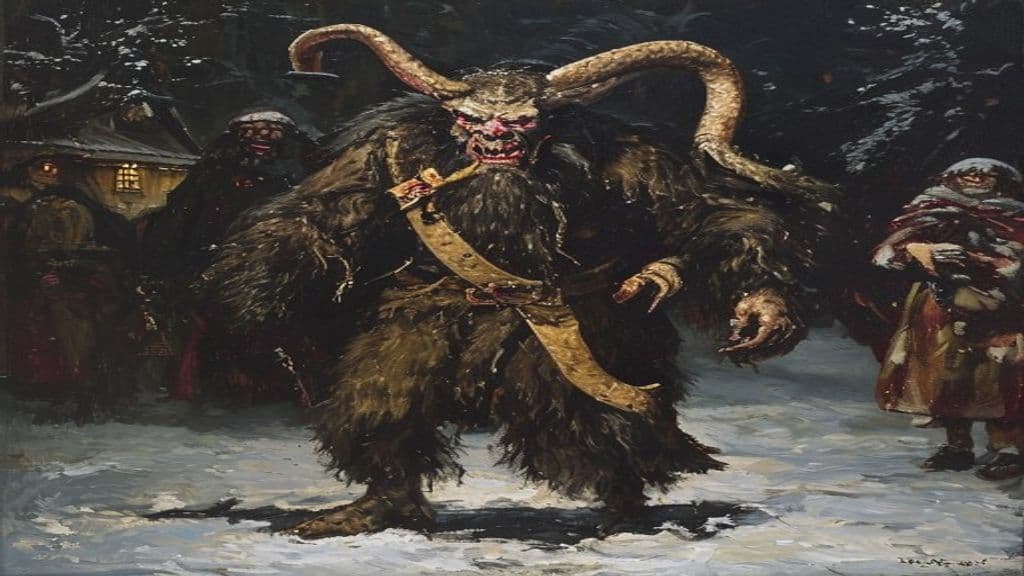
Sources situate Krampus within Alpine seasonal masquerade traditions associated with Percht/Perchten figures and note earliest documentary attestations in early modern Europe; by the 17th century a punitive companion role was established in which Krampus was paired with Saint Nicholas to carry out punishments a saint would not be expected to perform. Some informants and scholars describe Krampus as deriving from pre-Christian or 'pagan' masked‑devil traditions later assimilated into Christian festival time, but the supplied sources present this as an interpretive position rather than a single uncontested origin narrative. Political and social interventions in the 20th century (for example, prohibitions in the 1930s and anti‑Krampus propaganda in the 1950s) document contested modern histories of suppression and revival.
Krampus is typically depicted as a horned, anthropomorphic man covered in brown or black hair, often shown with one grotesque human foot and one cloven goat's hoof. Features commonly include long pointed fangs and a very long, snake- or dragon-like tongue. Costuming in processions frequently uses carved wooden masks, animal furs, chains and bells, and carries props such as a bundle of birch branches (Rute), a whip, and occasionally a sack or basket strapped to the back (motifs in older accounts describe naughty children placed in a sack).
In folklore Krampus acts as the punitive counterpart to Saint Nicholas: he visits on the evening of 5 December (Krampusnacht), threatens or punishes badly behaved children with birch rods (Rute), and in older traditional motifs is said to carry off or threaten to carry off naughty children in a sack or basket (older accounts include motifs of drowning, eating, or transport to Hell as part of the repertoire). In public Krampuslauf/Perchtenlauf processions, masqueraders wearing Krampus costume use theatrical antics—thrashing chains, ringing bells, brandishing birch bundles—to frighten audiences and enact social correction. The chains are commonly interpreted in the sources as symbolic (thought to represent the binding of the Devil by the Christian Church).
Weaknesses
- conditionsocial controls (good behavior as prevention)
- otherinstitutional suppression (historical prohibitions and public campaigns)
Wards
- conditionbeing a well-behaved child (cultural preventive measure)

*Perkʷūnos
*Perkʷūnos is the reconstructed Proto-Indo-European thunder‑god hypothesized by comparative linguistics and mythology. Scholarly reconstructions portray him as a storm or thunder figure associated with fructifying rain and as the combatant who fights a multi‑headed water‑serpent to release life‑giving waters; no direct attestations from the Proto‑Indo‑European period survive and the figure is inferred from later Indo‑European traditions.
*Péh₂usōn (reconstructed)
Péh₂usōn is a hypothetical Proto‑Indo‑European pastoral guardian reconstructed by comparative scholars from parallels in Greek and Vedic traditions. Proposed as a Graeco‑Aryan ancestor‑figure, the reconstruction describes a protector of flocks, roads, and travellers rather than an attested historical cultic personality.
57 Mnemosyne
57 Mnemosyne is a large main-belt asteroid (S-type) discovered in 1859 and named after the Greek Titaness Mnemosyne. It is a non-sentient astronomical body studied for its orbital and rotational properties and has been used in dynamical measurements related to Jupiter.
Abaddon
In Hebrew scripture Abaddon is primarily a noun meaning 'destruction' or a section/condition of the underworld paired with Sheol; in the New Testament Book of Revelation Abaddon is personified as an angelic figure (Greek Apollyon) described as the king of an army of locusts released from the abyss during the apocalypse.
Abadir
Abadir is a polysemous name attested in distinct cultural contexts: a legendary founding saint and clan ancestor in eastern Ethiopia (Sheikh Abadir Umar Al‑Rida / Aw Abadir), a term applied to cone‑shaped cult stones in Phoenician religious description, and a personal name of a martyr (Abadir/Apater) in the Coptic Synaxarium. The attestations are independent usages of the same name rather than a single supernatural being.
Abadiu of Antinoe
Abadiu of Antinoe was a fourth‑century bishop of Antinoe (Antinoopolis, in Roman Egypt) commemorated as a martyr and saint in the Coptic Orthodox Church, with a feast day on 26 December. Sources record that he was killed during a theological dispute with Arian opponents and reference him in collections of Egyptian martyrs.
Abagtha
Abagtha (Hebrew: אבגתא, ’Ǎḇaḡṯā) is a named human court official in the Hebrew Bible’s Book of Esther, listed among seven chamberlains who ministered before King Ahasuerus and were commanded to bring Queen Vashti before the king. He is attested only in Esther 1:10 and is presented as an institutional palace attendant rather than a supernatural being.
Aban Yasht
The Aban Yasht is a hymn from the Persian tradition that praises Anahita, a goddess associated with water, fertility, and wisdom. It consists of 132 stanzas and is part of the 21 Yashts collection. (Note: - Power tier should be "Primordial" or possibly "Cosmic", given that it's a hymn of great spiritual significance and associated with a goddess. - The article incorrectly states that Anahita is associa)
Abanoub
Abanoub is a 4th‑century Egyptian Christian child martyr venerated in the Coptic tradition. Remembered for his public confession of Christ, miraculous healings associated with his passion, and the translation and veneration of his relics, his feast is observed on July 31 (Epip 24) and his cult centers include Nehisa and Samanoud.
Abaskhiron the Soldier
A Coptic Orthodox martyr venerated for refusing imperial idolatry during the Diocletian persecution; reputedly healed by the Archangel Michael, preserved in monastery relics, and commemorated on 14 June (7 Paoni).
Abath
No corroborated folkloric entity named "Abath" is documented in the provided sources. The string appears in the supplied material only as a surname/personal name in Aruban/Dutch-Caribbean archival records and as an unrelated taxonomic or encyclopedic hit; no mythic attributes, origin stories, rituals, or apotropaic practices for an entity called Abath are present in the documents reviewed.
Abatur
Abatur is an uthra (celestial emanation) in Mandaeism described as the 'father of the Uthras' and called the Ancient (ʿattīqā). He resides on the boundary between the World of Light and lower regions, functions as a judge who weighs souls (Abatur Muzania), and supplies instructions and materials to the demiurgic uthra Ptahil in accounts from the Diwan (Scroll) of Abatur.
Community Record
- [1]Krampus. Wikipedia article 'Krampus' (sections on origin, appearance, Krampusnacht, Perchtenlauf, modern history).wiki
- [2]Wikidata: Krampus. Wikidata entry for Krampus (label and basic classification).other
- [3]Archive: A Style Experiment. Archive listing referencing Krampus in modern media and discussions.other
- [4]Archive: #469 avec Evelyne Ferron!. Archive media item referencing Krampus and related winter monsters in contemporary discussion.other
- [5]Archive: Christmas Spirit (and Monsters and Other Fun). Archive item discussing Christmas monsters including Krampus in popular contexts.other
- [6]From Bavaria to Milwaukee: A Christmas devil’s long march into local German-American traditions. Article tracing migration and local traditions of Bavarian/Germanic Krampus figures into diaspora contexts.other
- [7]Krampus Stirs Controversy in Holiday Parades. Blog post noting modern controversies in holiday parades involving Krampus.other
- [8]INTRODUCTION (scholarly bitstream). Scholarly introduction discussing Perchten and related Alpine masquerade traditions and their integration with Christian festivals.academic