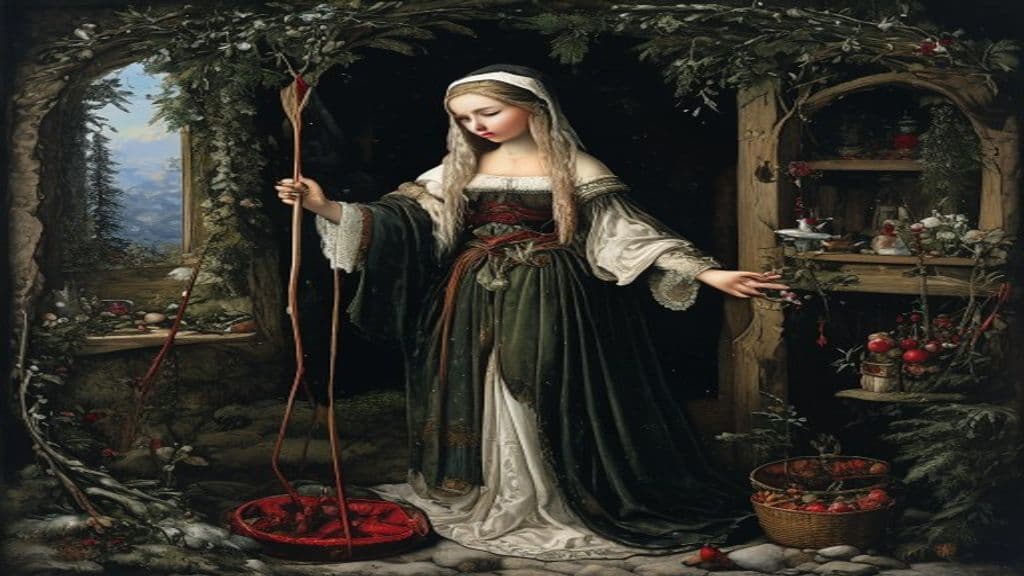
Surviving references present Berchta as a figure rooted in Alpine popular belief and memory of pre-Christian seasonal cults rather than as a single unified mythic biography. Encyclopedic summaries and regional myth notes describe Perchta/Berchta as thought to be a goddess in Alpine paganism with continuing presence in local place-names (for example the Berchtesgaden place-name has been linked in folk etymology to 'Berchta' + 'gaden') and in listings of Christmas and winter traditions (Sources: Wikipedia summary; Berchtesgaden myths pages; The Christmas Almanack listing; Wikidata). Scholarly and folkloric treatments therefore present her as a surviving or reinterpreted maternal/seasonal female figure remembered in winter rite contexts (Sources: Wikipedia; song catalogue listing that places her among mother-earth goddesses).
The sources do not fix a single, detailed corporeal description; instead they emphasize roles and emblematic accoutrements. A recurring image in the song material names Berchta 'with the rocken' (distaff/spinning) moving about in wintertime, linking her visually to spinning and textile-work paraphernalia rather than to a fixed human appearance (Source: Die große Göttin / song lyrics). Other compilations and encyclopedic summaries treat her as a goddess/spiritiess feminine figure of the Alpine tradition without preserving consistent physical attributes (Sources: Wikipedia; The Christmas Almanack).
Folkloric sources and compiled songs ascribe to Berchta a set of seasonal behaviors and moral functions: she is said to travel or be present during winter and around Christmastide, oversee domestic textile work (spinning/distaff), reward industrious women, and punish laziness or disorder in household duties. The song explicitly recounts her 'going about in wintertime' with the distaff, 'entangling the full skeins' and 'rewarding the industrious maid' (Source: Die große Göttin / song lyrics). Encyclopedic and regional myth notes likewise describe her as a goddess-like Alpine figure associated with the seasonal cycle and with winter/Christmas customs (Sources: Wikipedia; Berchtesgaden myths; The Christmas Almanack). Some poetic lines group her among a set of mother/earth/seasonal goddesses and briefly gesture to more ambiguous powers connected to the borderlands of life and death in verse, but the extant excerpts do not provide a developed cosmological portfolio or ritual technicalities (Source: song lines; Strange Horizons context on Christmas Eve spirits).
Weaknesses
- otherNo specific weaknesses recorded in provided sources
Wards
- conditionHousehold diligence (maintaining proper domestic spinning and industrious behavior) — sources record social expectation that industriousness earns Berchta's favor
- otherNo specific apotropaic rituals, formulas, or protective prescriptions against Berchta are recorded in the supplied excerpts

Stree
A vengeful female spirit from Chanderi who abducts men during festival nights. Warded off by the inscription 'O Stree, kal aana' — her legend, still practised on walls across Madhya Pradesh, inspired the 2018 Bollywood horror-comedy.

Freyja
Freyja is a major Vanir goddess in Norse mythology associated with love, beauty, fertility, gold, war, and the seiðr form of magic. She rules the field Fólkvangr and the hall Sessrúmnir, where she receives half of those slain in battle, and is attested across the Poetic Edda, the Prose Edda, skaldic poetry, and later Scandinavian folklore.
*Perkʷūnos
*Perkʷūnos is the reconstructed Proto-Indo-European thunder‑god hypothesized by comparative linguistics and mythology. Scholarly reconstructions portray him as a storm or thunder figure associated with fructifying rain and as the combatant who fights a multi‑headed water‑serpent to release life‑giving waters; no direct attestations from the Proto‑Indo‑European period survive and the figure is inferred from later Indo‑European traditions.
*Péh₂usōn (reconstructed)
Péh₂usōn is a hypothetical Proto‑Indo‑European pastoral guardian reconstructed by comparative scholars from parallels in Greek and Vedic traditions. Proposed as a Graeco‑Aryan ancestor‑figure, the reconstruction describes a protector of flocks, roads, and travellers rather than an attested historical cultic personality.
57 Mnemosyne
57 Mnemosyne is a large main-belt asteroid (S-type) discovered in 1859 and named after the Greek Titaness Mnemosyne. It is a non-sentient astronomical body studied for its orbital and rotational properties and has been used in dynamical measurements related to Jupiter.
Abaddon
In Hebrew scripture Abaddon is primarily a noun meaning 'destruction' or a section/condition of the underworld paired with Sheol; in the New Testament Book of Revelation Abaddon is personified as an angelic figure (Greek Apollyon) described as the king of an army of locusts released from the abyss during the apocalypse.
Abadir
Abadir is a polysemous name attested in distinct cultural contexts: a legendary founding saint and clan ancestor in eastern Ethiopia (Sheikh Abadir Umar Al‑Rida / Aw Abadir), a term applied to cone‑shaped cult stones in Phoenician religious description, and a personal name of a martyr (Abadir/Apater) in the Coptic Synaxarium. The attestations are independent usages of the same name rather than a single supernatural being.
Abadiu of Antinoe
Abadiu of Antinoe was a fourth‑century bishop of Antinoe (Antinoopolis, in Roman Egypt) commemorated as a martyr and saint in the Coptic Orthodox Church, with a feast day on 26 December. Sources record that he was killed during a theological dispute with Arian opponents and reference him in collections of Egyptian martyrs.
Abagtha
Abagtha (Hebrew: אבגתא, ’Ǎḇaḡṯā) is a named human court official in the Hebrew Bible’s Book of Esther, listed among seven chamberlains who ministered before King Ahasuerus and were commanded to bring Queen Vashti before the king. He is attested only in Esther 1:10 and is presented as an institutional palace attendant rather than a supernatural being.
Aban Yasht
The Aban Yasht is a hymn from the Persian tradition that praises Anahita, a goddess associated with water, fertility, and wisdom. It consists of 132 stanzas and is part of the 21 Yashts collection. (Note: - Power tier should be "Primordial" or possibly "Cosmic", given that it's a hymn of great spiritual significance and associated with a goddess. - The article incorrectly states that Anahita is associa)
Abanoub
Abanoub is a 4th‑century Egyptian Christian child martyr venerated in the Coptic tradition. Remembered for his public confession of Christ, miraculous healings associated with his passion, and the translation and veneration of his relics, his feast is observed on July 31 (Epip 24) and his cult centers include Nehisa and Samanoud.
Abaskhiron the Soldier
A Coptic Orthodox martyr venerated for refusing imperial idolatry during the Diocletian persecution; reputedly healed by the Archangel Michael, preserved in monastery relics, and commemorated on 14 June (7 Paoni).
Abath
No corroborated folkloric entity named "Abath" is documented in the provided sources. The string appears in the supplied material only as a surname/personal name in Aruban/Dutch-Caribbean archival records and as an unrelated taxonomic or encyclopedic hit; no mythic attributes, origin stories, rituals, or apotropaic practices for an entity called Abath are present in the documents reviewed.
Abatur
Abatur is an uthra (celestial emanation) in Mandaeism described as the 'father of the Uthras' and called the Ancient (ʿattīqā). He resides on the boundary between the World of Light and lower regions, functions as a judge who weighs souls (Abatur Muzania), and supplies instructions and materials to the demiurgic uthra Ptahil in accounts from the Diwan (Scroll) of Abatur.
Community Record
- [1]Perchta (Wikipedia). Wikipedia, 'Perchta' entry — summary of Perchta/Berchta as a goddess in Alpine paganism and Upper German/Austrian/Slovenian regions.wiki
- [2]Perchta (Wikidata). Wikidata entry Q258927 — character metadata classifying Perchta as a figure of Continental Germanic and Slavic mythology.other
- [3]Berchtesgaden Myths (WorldFutureFund). Berchtesgaden myths note linking 'Berchta' as an Alpine goddess name and discussing Berchtesgaden place-name association.folk
- [4]The Christmas Almanack (archive.org). The Christmas Almanack — listing Berchta among Christmas/winter tradition entries in a compendium of Christmas customs.folk
- [5]Die große Göttin (song; lyric excerpt). Modern performance and lyric translation that lists Berchta among goddess-epithets and contains lines: 'Bald als Berchta mit dem Rocken gehst du um zur Winterzeit / Und verwirrst die vollen Wocken und belohnst die fleiß'ge Maid.'literary
- [6]Drive the Cold Winter Away / folk song listing (Roud V9375). Folk-song catalogue context referencing wintertime and Christmas folk material in which figures like Berchta appear in the seasonal repertoire.folk
- [7]Strange Horizons — 'Do No Harm to Me or Mine: The Haunted History of Christmas Eve'. Article discussing older accounts of wandering air-spirits around Christmas Eve and contextualizing seasonal figures like Berchta in Christmastide beliefs.other