
No cosmogonic origin story is recorded in the provided sources. The name is a German compound of Bier ("beer") + Esel ("donkey") attested in print as an insult in 1597 (Bürgel) and discussed in a 1705 work (Johann Georg Schmidt's Die gestriegelte Rockenphilosophie), and has been used in folklore scholarship to denote a beer‑house kobold or house spirit associated with beerplaces.
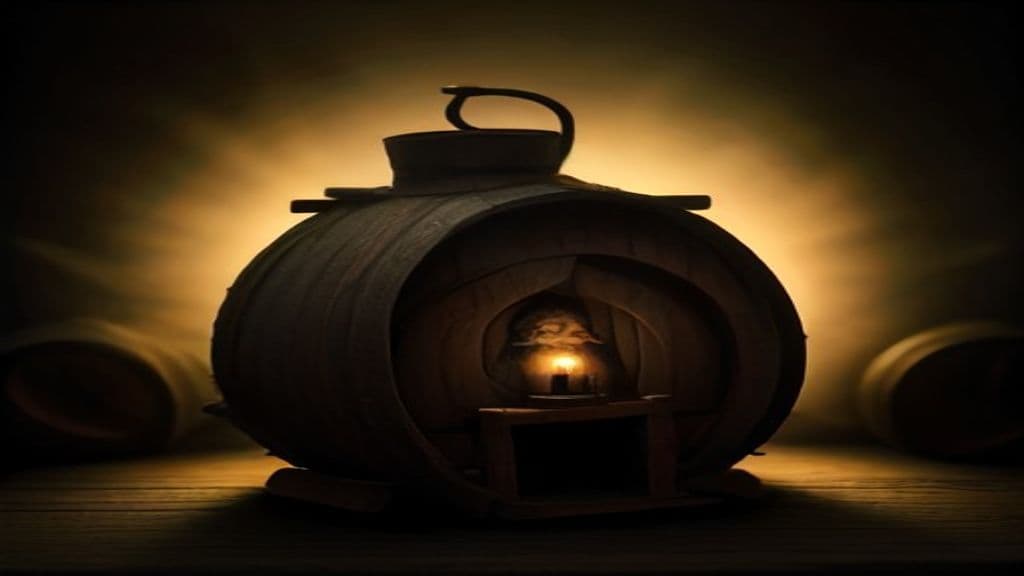
Descriptions vary regionally. Common motifs describe a spirit with donkey legs, sometimes only three (a three‑legged donkey form) or donkey‑headed and hooved; several Thuringian accounts emphasize the three‑ or four‑legged donkey imagery. Other localized accounts include a Bohemian witness who described a horned gray ox with a thick red human head; some traditions focus more on behavior and occupations than on fixed monstrous detail.
In occupational and household contexts the Bieresel is recorded doing chores in breweries, inns and cellars—cleaning bottles, steins, casks and kegs, bringing beer into houses and performing other household tasks—in return for payment in the form of a nightly portion of beer. If not given its beer or otherwise offended, it is said to retaliate by breaking or hiding vessels and equipment, throwing people out of bed, creating disturbances, and in some Bohemian tales behaving as a noisy poltergeist with allegedly harmful or deadly encounters. In some Thuringian accounts the Bieresel practices aufhocken—leaping upon the backs of drunkards or late tavern visitors and forcing them to carry the spirit home; in Vogtland it is reported to mingle harmlessly among pub crowds.
Weaknesses
- substancenightly portion of beer (appeasement)
- conditionconfrontation/driving out by force (anecdotal instance: bear and handler drove it away at Katzenmühle)
Wards
- ritualnightly beer offering
- conditionavoid late drunken wandering
Kobold
The German household and mine spirit — a mischievous but potentially helpful small being who attaches to a household, bringing luck or disaster depending on how it is treated.

Clurichaun
A solitary Irish fairy-like household and cellar spirit associated with drinking places (breweries, pubs, wine cellars). He is a heavy drinker and smoker, a mischievous trickster who can also act as a protective domestic spirit for a household that tolerates him; accounts are primarily from 19th-century collectors and later summaries.
*Perkʷūnos
*Perkʷūnos is the reconstructed Proto-Indo-European thunder‑god hypothesized by comparative linguistics and mythology. Scholarly reconstructions portray him as a storm or thunder figure associated with fructifying rain and as the combatant who fights a multi‑headed water‑serpent to release life‑giving waters; no direct attestations from the Proto‑Indo‑European period survive and the figure is inferred from later Indo‑European traditions.
*Péh₂usōn (reconstructed)
Péh₂usōn is a hypothetical Proto‑Indo‑European pastoral guardian reconstructed by comparative scholars from parallels in Greek and Vedic traditions. Proposed as a Graeco‑Aryan ancestor‑figure, the reconstruction describes a protector of flocks, roads, and travellers rather than an attested historical cultic personality.
57 Mnemosyne
57 Mnemosyne is a large main-belt asteroid (S-type) discovered in 1859 and named after the Greek Titaness Mnemosyne. It is a non-sentient astronomical body studied for its orbital and rotational properties and has been used in dynamical measurements related to Jupiter.
Abaddon
In Hebrew scripture Abaddon is primarily a noun meaning 'destruction' or a section/condition of the underworld paired with Sheol; in the New Testament Book of Revelation Abaddon is personified as an angelic figure (Greek Apollyon) described as the king of an army of locusts released from the abyss during the apocalypse.
Aban Yasht
The Aban Yasht is a hymn from the Persian tradition that praises Anahita, a goddess associated with water, fertility, and wisdom. It consists of 132 stanzas and is part of the 21 Yashts collection. (Note: - Power tier should be "Primordial" or possibly "Cosmic", given that it's a hymn of great spiritual significance and associated with a goddess. - The article incorrectly states that Anahita is associa)
Abath
No corroborated folkloric entity named "Abath" is documented in the provided sources. The string appears in the supplied material only as a surname/personal name in Aruban/Dutch-Caribbean archival records and as an unrelated taxonomic or encyclopedic hit; no mythic attributes, origin stories, rituals, or apotropaic practices for an entity called Abath are present in the documents reviewed.
Abatur
Abatur is an uthra (celestial emanation) in Mandaeism described as the 'father of the Uthras' and called the Ancient (ʿattīqā). He resides on the boundary between the World of Light and lower regions, functions as a judge who weighs souls (Abatur Muzania), and supplies instructions and materials to the demiurgic uthra Ptahil in accounts from the Diwan (Scroll) of Abatur.
Abatwa (Twa / Batwa)
Abatwa (also recorded as Twa, Batwa, Mutwa; singular forms Barhwa or Murhwa in some transcriptions) are indigenous hunter‑gatherer peoples of the Great Lakes region of Central Africa, historically identified as some of the earliest inhabitants of the area. The available sources treat them as human ethnic groups whose livelihoods, lands, and populations have been severely affected by conservation policies and modern violence.
Abellio
Abellio is a theonym attested in Roman‑period inscriptions from the Comminges area of the Pyrenees and reported as worshipped in the Garonne Valley of ancient Gallia Aquitania. Surviving evidence is limited to a small number of inscriptions; scholars have variously hypothesized solar or arboreal associations and compared the name to forms of Apollo or to Celtic Belenus, but the deity's precise role in local cosmology remains uncertain.
Abraham
Abraham (originally Abram) is the foundational patriarchal ancestor in the Hebrew Bible whose life establishes a covenantal relationship between his family/people and God. He functions as an exemplar of faith, the progenitor of promised descendants, and a narrative anchor for claims of land, blessing, and communal identity in later religious traditions.
Abraun
Abraun is an attested name in German-language plant-legend scholarship (Der abraun, ein beitrag zur pflanzensagenkunde, 1916) and a short database entry (Wikidata) labels it as a spirit from German mythology. Surviving accessible documentation is extremely limited: the principal academic treatment is a 1916 contribution to pflanzensagenkunde (plant-saga studies), but the excerpts available here contain only bibliographic metadata and do not record tales, descriptions, or rituals.
Abtin
Abtin (Persian: آبتین), attested also as Athwya, is a mythic ancestral figure in Iranian tradition described in Avestan and later epic literature as one of a small set of formative human-like figures involved in preparing the corporeal world and as the father of the epic hero-king Fereydun in the Shahnama.
Community Record
- [1]Bieresel (Wikipedia). Wikipedia contributors. 'Bieresel.' Wikipedia, The Free Encyclopedia.wiki
- [2]German folklore (Wikipedia). Wikipedia contributors. 'German folklore.' Wikipedia, The Free Encyclopedia.wiki
- [3]Der Pummpälzweg — English page. Der Pummpälzweg (English). pummpaelz.de.other