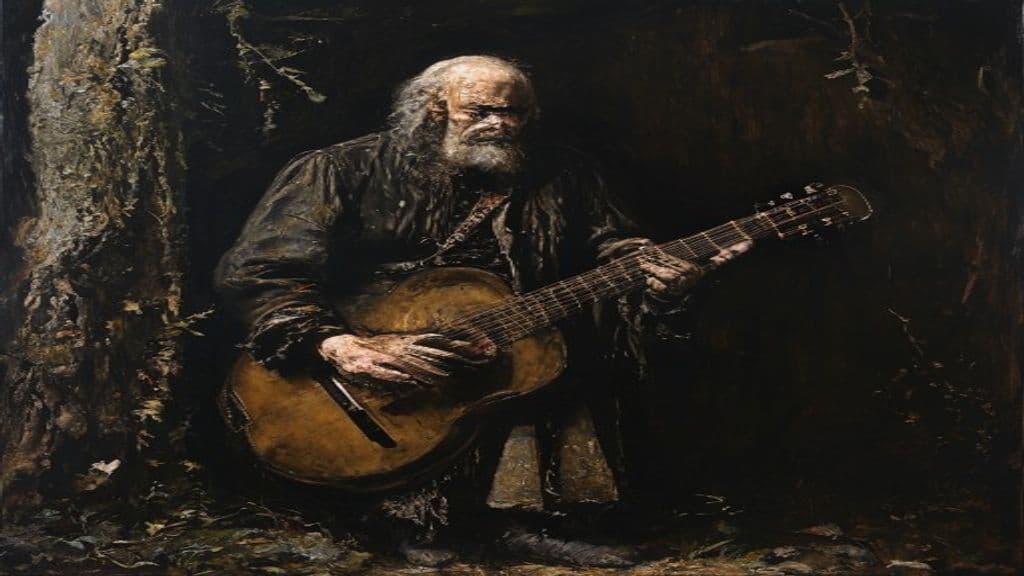
Attestations for Billy Blind come from narrative ballads (the Child Ballads) rather than prose origin myths; the provided sources do not record an independent cosmogonic origin story. Secondary commentary included in the source material offers speculation that the character may be a folk-memory or vestigial echo of older Germanic deity imagery (for example, a playful aspect of Woden/Odin) or that he may relate to Scottish figures such as 'Blind Harie.' Those suggestions are explicitly presented as scholarly or speculative hypotheses in the secondary source material and are not established within the ballads themselves.
The supplied materials do not provide a detailed or consistent physical description of Billy Blind in the ballads. The primary characterization in the sources is functional—he is a household spirit 'much like a brownie' who appears within ballad narratives to give advice—rather than a described visual type. Modern fictional adaptations (not primary traditional sources) sometimes portray him visually, but no traditional-size, clothing, or facial-feature descriptions are provided in the cited summaries.
In the documented ballad examples Billy Blind's abilities are advising, revealing hidden facts, and directing or prescribing stratagemic or ritualized actions that neutralize hostile magic or resolve social crises. Specific examples in the source summaries: in 'Gil Brenton' (Child no. 5c) he advises that the bride beside the hero is not the true bride and reveals the true situation; in 'Willie's Lady' (Child no. 6) he prescribes making a wax baby and staging a christening to force the witch-mother to reveal and thereby undo her enchantments; in 'Young Bekie' (Child no. 53C) he advises Burd Isobel and aids a magical journey to reach the bridegroom; in 'The Knight and the Shepherd's Daughter' (Child no. 110) he appears in variants to reveal hidden facts about births. The sources present these functions within narrative contexts; they do not ascribe cosmic, elemental, or broadly destructive powers to him.
Weaknesses
- otherNo traditional weaknesses recorded in provided sources
- otherIf any limitations are inferred from brownie-like category, such inferences are speculative and not documented in the cited materials
Wards
- otherNo traditional wards or protective measures against Billy Blind are recorded in the provided sources

Domovoi
The house spirit of Slavic tradition — a small, invisible guardian of the home bound to a specific dwelling and its family. Protective when respected; dangerous when insulted or forgotten.
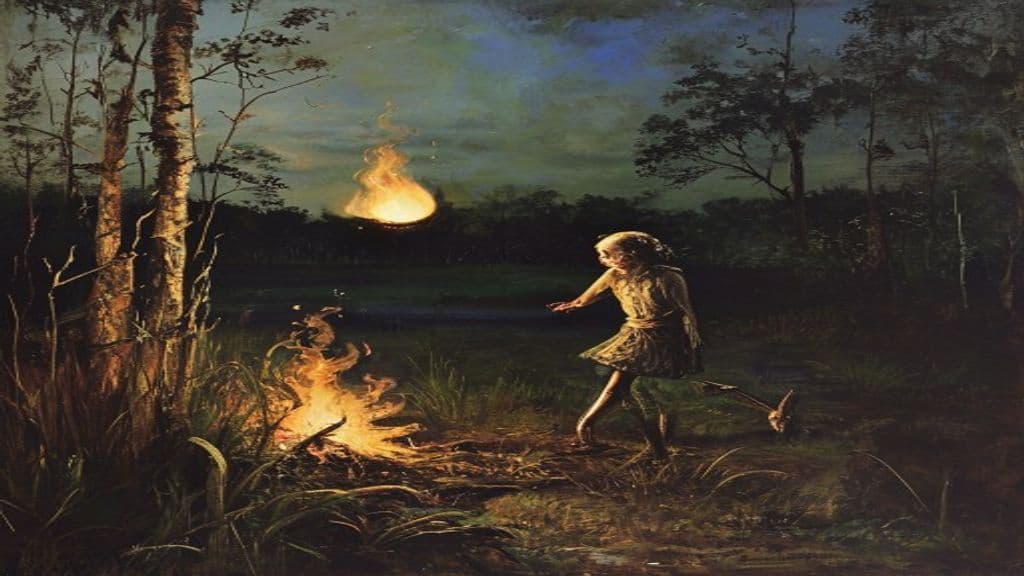
Will-o'-the-wisp
An atmospheric 'ghost light' — a small, mobile, lamp-like light seen at night over marshes, bogs, wet ground, or graveyards. In many cultures the phenomenon is interpreted as a supernatural being or manifestation (wandering nature-spirit, soul of the dead, transformed witch, or treasure-indicator); modern science offers chemiluminescent explanations for some occurrences.
*Perkʷūnos
*Perkʷūnos is the reconstructed Proto-Indo-European thunder‑god hypothesized by comparative linguistics and mythology. Scholarly reconstructions portray him as a storm or thunder figure associated with fructifying rain and as the combatant who fights a multi‑headed water‑serpent to release life‑giving waters; no direct attestations from the Proto‑Indo‑European period survive and the figure is inferred from later Indo‑European traditions.
*Péh₂usōn (reconstructed)
Péh₂usōn is a hypothetical Proto‑Indo‑European pastoral guardian reconstructed by comparative scholars from parallels in Greek and Vedic traditions. Proposed as a Graeco‑Aryan ancestor‑figure, the reconstruction describes a protector of flocks, roads, and travellers rather than an attested historical cultic personality.
57 Mnemosyne
57 Mnemosyne is a large main-belt asteroid (S-type) discovered in 1859 and named after the Greek Titaness Mnemosyne. It is a non-sentient astronomical body studied for its orbital and rotational properties and has been used in dynamical measurements related to Jupiter.
Abaddon
In Hebrew scripture Abaddon is primarily a noun meaning 'destruction' or a section/condition of the underworld paired with Sheol; in the New Testament Book of Revelation Abaddon is personified as an angelic figure (Greek Apollyon) described as the king of an army of locusts released from the abyss during the apocalypse.
Aban Yasht
The Aban Yasht is a hymn from the Persian tradition that praises Anahita, a goddess associated with water, fertility, and wisdom. It consists of 132 stanzas and is part of the 21 Yashts collection. (Note: - Power tier should be "Primordial" or possibly "Cosmic", given that it's a hymn of great spiritual significance and associated with a goddess. - The article incorrectly states that Anahita is associa)
Abath
No corroborated folkloric entity named "Abath" is documented in the provided sources. The string appears in the supplied material only as a surname/personal name in Aruban/Dutch-Caribbean archival records and as an unrelated taxonomic or encyclopedic hit; no mythic attributes, origin stories, rituals, or apotropaic practices for an entity called Abath are present in the documents reviewed.
Abatur
Abatur is an uthra (celestial emanation) in Mandaeism described as the 'father of the Uthras' and called the Ancient (ʿattīqā). He resides on the boundary between the World of Light and lower regions, functions as a judge who weighs souls (Abatur Muzania), and supplies instructions and materials to the demiurgic uthra Ptahil in accounts from the Diwan (Scroll) of Abatur.
Abatwa (Twa / Batwa)
Abatwa (also recorded as Twa, Batwa, Mutwa; singular forms Barhwa or Murhwa in some transcriptions) are indigenous hunter‑gatherer peoples of the Great Lakes region of Central Africa, historically identified as some of the earliest inhabitants of the area. The available sources treat them as human ethnic groups whose livelihoods, lands, and populations have been severely affected by conservation policies and modern violence.
Abdiel
Abdiel (Hebrew עֲבְדִּיאֵל) is primarily a theophoric Hebrew personal name meaning "servant of El/servant of God," attested once in the Hebrew Bible (1 Chronicles 5:15). In later literature—most notably John Milton's Paradise Lost—Abdiel is reimagined as a faithful seraph who opposes Satan's revolt. The provided sources do not treat Abdiel as an autonomous folkloric spirit type or record rituals or wards associated with the name.
Abellio
Abellio is a theonym attested in Roman‑period inscriptions from the Comminges area of the Pyrenees and reported as worshipped in the Garonne Valley of ancient Gallia Aquitania. Surviving evidence is limited to a small number of inscriptions; scholars have variously hypothesized solar or arboreal associations and compared the name to forms of Apollo or to Celtic Belenus, but the deity's precise role in local cosmology remains uncertain.
Abiel
Abiel is attested in the supplied sources only as a male given name — borne by several historical American individuals and listed as two minor biblical figures. The provided materials contain no evidence presenting Abiel as a supernatural, mythological, or folkloric entity.
Abigail
Abigail is a female figure in the Hebrew Bible portrayed in 1 Samuel 25 as the intelligent and beautiful wife of Nabal who intervenes to prevent David from committing violence; later tradition regards her as one of the Tanakh's seven female prophets and as a model of beauty and wisdom.
Community Record
- [1]Billy Blind — Wikipedia. Wikipedia, 'Billy Blind' entry — summary of attestations in Child Ballads and secondary commentarywiki
- [2]Wikidata: Billy Blind (Q4912222). Wikidata item classifying Billy Blind as a household sprite in British folkloreother
- [3]Archive references (modern adaptations and mentions). Archive.org item listed among source materials provided; mentioned in the research notes as part of compiled materials (not a primary ballad text)other
- [4]Archive references (modern adaptations and mentions). Archive.org item listed among source materials provided; mentioned in the research notes as part of compiled materials (not a primary ballad text)other
- [5]Archive references (modern adaptations and mentions). Archive.org item listed among source materials provided; mentioned in the research notes as part of compiled materials (not a primary ballad text)other