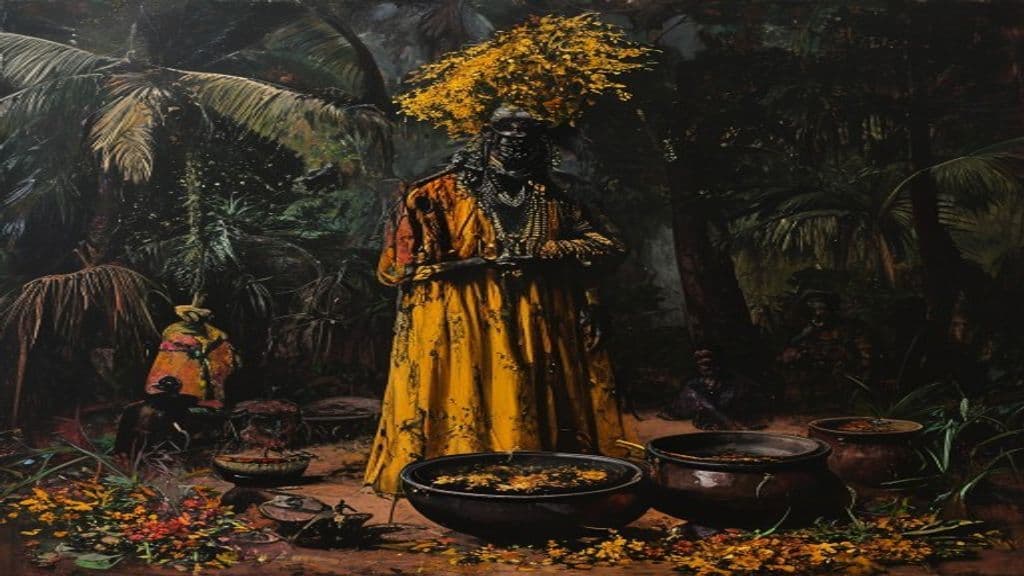
The term birongo (bilongo) derives from Kikongo bilongo, a word for ingredients of magical use; in Venezuela the word expanded to designate a body of folk medicine, ritual knowledge, and magico‑religious practice brought by Central African (notably Kongo) cultural forms and maintained in Afro‑Venezuelan coastal communities. Over time these practices syncretized with Catholic saint veneration (e.g., Malembe/San Juan Congo mapped onto Saint John and other saints) and local ritual institutions (cofradías, mayordomos), producing a lived therapeutic and communal religious system in regions such as Barlovento and the southern coast of Lake Maracaibo.
Birongo is not an anthropomorphic entity; the term refers to ritual practices, materia (herbal mixtures, nganga‑like cauldrons), roles (curanderos, ensalmaderos, mediums), and communal ritual forms (drumming, singing, velaciones). Sources provide no single bodily description because Birongo denotes a tradition and its paraphernalia rather than a personified spirit.
As a ritual system Birongo's operative techniques include diagnosing and treating spiritual and physical afflictions (e.g., mal de ojo) through herbal preparations (baths, teas), tobacco divination, prayer, and soothsaying; invoking ancestors and Catholic saints in syncretic configurations; producing trance and spirit‑possession during drumming rituals (ranging from light trance to full possession, often with screaming, dancing, and tingling sensations); and organizing communal rites (velaciones, week‑long festivals) under cofradía and mayordomo leadership. Material paraphernalia such as nganga‑like vessels, libations (liquor), tobacco smoke, perfumes, offerings, and occasional animal sacrifice are used to encourage spirit engagement and effect therapeutic change.
Weaknesses
- ritualRequirement for ritual preparation (herbal head‑washing and structured ritual leadership)
- ritualNeed for communal controls (drumming, singing, mayordomo organization) to regulate trance and possession
- ritualDiagnostic prerequisites (tobacco divination and mediumship) to correctly identify afflictions before treatment
Wards
- ritualHerbal head‑washing (initiation purification)
- ritualHerbal baths and washes (preventative and healing use)
- ritualTobacco divination (diagnostic/preventative)
- ritualDrumming and singing (used to engage and regulate spirit interaction)
- ritualLibations and tobacco smoke (employed during protection and ritual management)
- ritualOfferings and occasional animal sacrifice (to connect patient with spirits and stabilize interactions)
A ƭat Roog
A term attested in the vocabulary surrounding Roog within the Serer religious system; the provided sources do not supply a clear definitional account of an entity by this exact name. Material available situates the term in the wider context of Serer cosmology in which Roog is the universal supreme deity and ancestor cult (pangool) and priestly mediation (o yaal pangool) structure ritual life.
Abada (unicorn)
Mythical creature in Central African tradition with two crooked horns, possessing healing properties. (Note: 1. Power tier: Primordial (Abada has cosmic, deity-level healing properties) 2. Sensory cues: physical presence and possibly an aura or energy emanating from the horns 3. Weaknesses: should be mention)
Abena Mansa
A name attested in a single contemporary Ghanaian blog anecdote as a 'mysterious being'; available sources do not establish Abena Mansa as a coherent, traditional supernatural figure or provide corroborating ethnographic detail.
Abonsam
Abonsam is a malevolent spirit name used in accounts from the Gold Coast (modern Ghana) to explain community-level misfortune such as accidents and disease. When local ritual specialists diagnose Abonsam as the cause, communities perform a prolonged communal expulsion ritual intended to drive the spirit into the sea.
Adze
A vampiric firefly of the Ewe people of West Africa — a spirit that takes the form of a firefly by night and a malicious possessing being by day, drinking the blood of sleeping children and spreading disease.
Adze (Folklore)
Vampiric being in Ewe folklore, transforming into human shape upon capture. (Note: 1. Power tier should be Greater, as "deity-level" powers are implied by the ability to possess humans. 2. Add sensory cues (e.g., glowing lights) based on its firefly form. 3. Add weaknesses and wards)
Agbọghọ Mmụọ Masquerade
An Igbo masquerade category—literally 'Maiden Spirits'—in which masked (traditionally male) dancers embody the spirits of deceased unmarried girls, performing idealized adolescent feminine comportment and beauty in annual dry‑season civic ceremonies and at funerals and initiation rites in the Nri–Awka region.
Alicanto
A nocturnal, flightless bird-like being from Chilean Atacama desert folklore whose glowing wings indicate the presence of underground ores; it can guide a stealthy prospector to a mother lode or, if offended or detected, extinguish its light and mislead or endanger the seeker.
Aloja
Aloja is listed in available sources as a named figure in Catalan legend; beyond a brief disambiguation listing, traditional folkloric details are absent in the consulted material. A contemporary commercial design note reinterprets Aloja as a Mediterranean/sea goddess with energetic yet tender character, but this is explicitly a modern creative description rather than documented folk belief.
Alusi
Alusi (also spelled arusi) are spirit-agents or divinities in the traditional religion of the Igbo people, each responsible for specific domains such as health, agriculture, rivers, justice, and the sky. They are worshipped and served through localized cults with priests and devotees and are distinct from clan ancestors (Ndichie).
Anansi
The spider trickster god of Akan folklore — cunning, mischievous, and wise. Keeper of stories and teacher of human beings, brought through the slave trade into Caribbean and African-American tradition.
Asanbosam
The Asanbosam (also Sasabonsam, Asasabonsam) is an Akan folkloric humanoid creature that dwells in trees and is described as vampire-like, feeding on people who enter its forest territory and enforcing localized rules of the woodland.
Community Record
- [1]Birongo (Wikipedia). Wikipedia: 'The term "birongo" comes from the Kikongo word "bilongo"...' and sections on practices, mediumship, and regional distribution.wiki
- [2]Wikidata entry: Birongo (Q18643884). Wikidata record referenced in source notes (place name homonym noted but not used as primary religious source).other