
No mythic origin is given in the lai; Marie de France presents Bisclavret as a baron who (she says) 'vanishes every week for three full days' into wolf‑form. Marie claims to have translated the story from Breton performance tradition, but the narrative itself does not supply a cause or ancestral origin for the condition. The plot centers on the baron’s secret practice, the discovery of his hidden clothing by his wife (who conspires with another knight), the theft of those garments which prevents his reversion, and the eventual royal inquiry that leads to the clothes’ recovery and the baron’s restoration while the wife and her new husband are exiled.
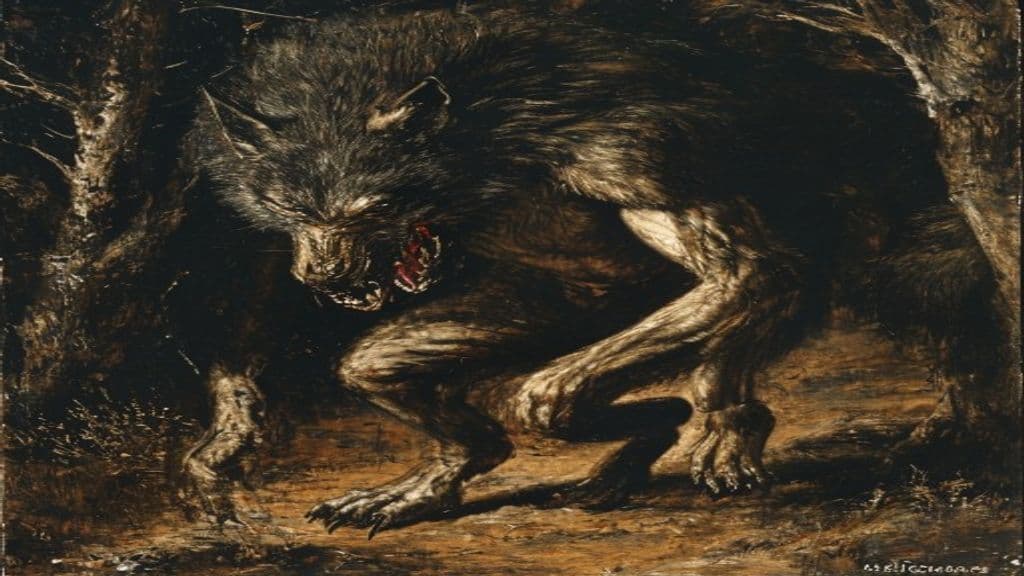
In human guise Bisclavret is introduced as a baron and a well‑loved knight of the king. In his wolf form he appears as a wolf whose behavior in the poem is marked by nobility and gentleness rather than blind savagery: when cornered during a royal hunt he seeks the king's mercy by taking the king's stirrup and kissing his foot and leg. The narrative also records a violent, targeted episode in which the wolf tears off his wife's nose; the lai later remarks that some of her female descendants were born without noses, linking that mutilation to genealogical consequence.
Textual evidence attributes cyclical physical shape‑change (a weekly disappearance for three days) and retained memory, social recognition, and reason in wolf form: Bisclavret recognizes and submits to his lord, behaves submissively toward the king, and directs aggressive acts at specific wrongdoers (the wife and her new husband). The tale emphasizes a material dependence for reversion: the transformed man must hide his clothing in a secure place to be able to return to human form, and if those garments are withheld he cannot change back. No wider supernatural powers (speech, command over elements, or cosmic effects) are described in the supplied sources.
Weaknesses
- conditionloss or withholding of the hidden clothing required for reversion
- othersocial/judicial intervention (investigation, retrieval of clothing, and private facilitation of change by royal agents)
Wards
- otherwithholding or seizure of transformative clothing (used in the narrative to prevent reversion)
3-D Man
3-D Man is a Marvel Comics superhero identity associated with a 1950s-era origin in which the body of Chuck Chandler can materialize in three-dimensional existence when activated by his brother Hal via a pair of glasses. The mantle was later assumed by Delroy Garrett (formerly Triathlon) in modern continuity.
5 Ronin
5 Ronin is a 2011 Marvel Comics five-issue limited series that reimagines five Marvel superhero archetypes as rōnin (masterless samurai) in a fictionalized post‑Sekigahara feudal Japan. The work places Wolverine, Hulk, Punisher, Psylocke, and Deadpool analogues into period roles to explore displacement, revenge, and identity in an era of political upheaval.
A Elbereth Gilthoniel
An Elvish hymn in Sindarin addressed to Elbereth (Varda) from J. R. R. Tolkien's legendarium. Presented in The Lord of the Rings and later musical and dramatic adaptations, the hymn functions as devotional poetic language that evokes Elvish reverence for the star-kindler rather than an independent supernatural agent.
A.R.G.U.S.
A.R.G.U.S. is a fictional clandestine United States government agency in the DC Comics universe that investigates, contains, and manages superhuman, meta-human, and supernatural incidents and assets. Introduced in The New 52 continuity, it functions as an institutional actor providing intelligence, logistical support, covert task forces (notably Task Force X / the Suicide Squad), and a dedicated magic division across comics and media adaptations.
Abdiel
Abdiel (Hebrew עֲבְדִּיאֵל) is primarily a theophoric Hebrew personal name meaning "servant of El/servant of God," attested once in the Hebrew Bible (1 Chronicles 5:15). In later literature—most notably John Milton's Paradise Lost—Abdiel is reimagined as a faithful seraph who opposes Satan's revolt. The provided sources do not treat Abdiel as an autonomous folkloric spirit type or record rituals or wards associated with the name.
Abiel
Abiel is attested in the supplied sources only as a male given name — borne by several historical American individuals and listed as two minor biblical figures. The provided materials contain no evidence presenting Abiel as a supernatural, mythological, or folkloric entity.
Abigail
Abigail is a female figure in the Hebrew Bible portrayed in 1 Samuel 25 as the intelligent and beautiful wife of Nabal who intervenes to prevent David from committing violence; later tradition regards her as one of the Tanakh's seven female prophets and as a model of beauty and wisdom.
Abin Sur
Abin Sur is a fictional extraterrestrial Green Lantern from the planet Ungara in DC Comics. A former history professor turned Green Lantern of Space Sector 2814, he discovered and investigated a prophecy tied to the "Blackest Night," died wounded on Earth and chose Hal Jordan as his ring-successor, and was later reanimated as a Black Lantern in the Blackest Night storyline.
Absolute Green Lantern (tradition)
A modern comic-book reinterpretation in DC's Absolute Universe in which a giant green lantern-shaped vessel appears above Evergreen, Nevada, generates an impenetrable green dome, judges townspeople and sends the judged into the Lantern to await further adjudication in OA (Omega‑Alpha). The story reframes Green Lantern mythos as cosmic/religious horror with an "Enlightenment Spectrum" of flames (Qard, Rao, Sur, Aur) stewarded by Oans such as Abin Sur.
Absorbing Man
A fictional Marvel Comics character (Carl "Crusher" Creel) whose body acquires the physical properties of materials or energies he touches. Debuting in Journey into Mystery #114 (March 1965), created by Stan Lee and Jack Kirby, he is presented as a mortal supervillain/occasional antihero who challenges heroes such as Thor, Hulk, Spider-Man, and the Avengers.
Accolon
Accolon is a mortal knight of the Arthurian court, presented in the Post-Vulgate Merlin tradition and Malory's Le Morte d'Arthur as Morgan le Fay's paramour and instrument in a plot to supplant King Arthur; his tale centers on enchanted weapons (Excalibur and its scabbard), love-manipulation, and a tragic duel with Arthur.
Ace West
Ace West (Wallace Daniel "Ace" West) is a contemporary American comic-book character in DC Comics continuity, a young speedster who channels the metaphysical Speed Force and occupies legacy-hero roles such as Kid Flash and Ace. Introduced in New 52-era stories as a biracial reinterpretation of Wally West and later retconned in DC Rebirth as a distinct Wallace West, son of Daniel West (Reverse-Flash), he appears across present-day and alternate/future timelines and participates in team and sacrifice narratives tied to the Speed Force.
Community Record
- [1]Bisclavret. Wikipedia: Bisclavret (summary and quotations drawn from synopsis and article sections)wiki
- [2]The lais of Marie de France. Marie de France, The Lais (translation and collected lais)literary
- [3]Marie de France : poetry, new translations, backgrounds and contexts, criticism. Collected translations, backgrounds and criticism on Marie de Franceother
- [4]On Teaching Bisclavret. Goucher faculty summary and teaching notes discussing interpretive pointsother
- [5]Bisclavret (poetryintranslation.com). Translation of Marie de France's lais including Bisclavretliterary